
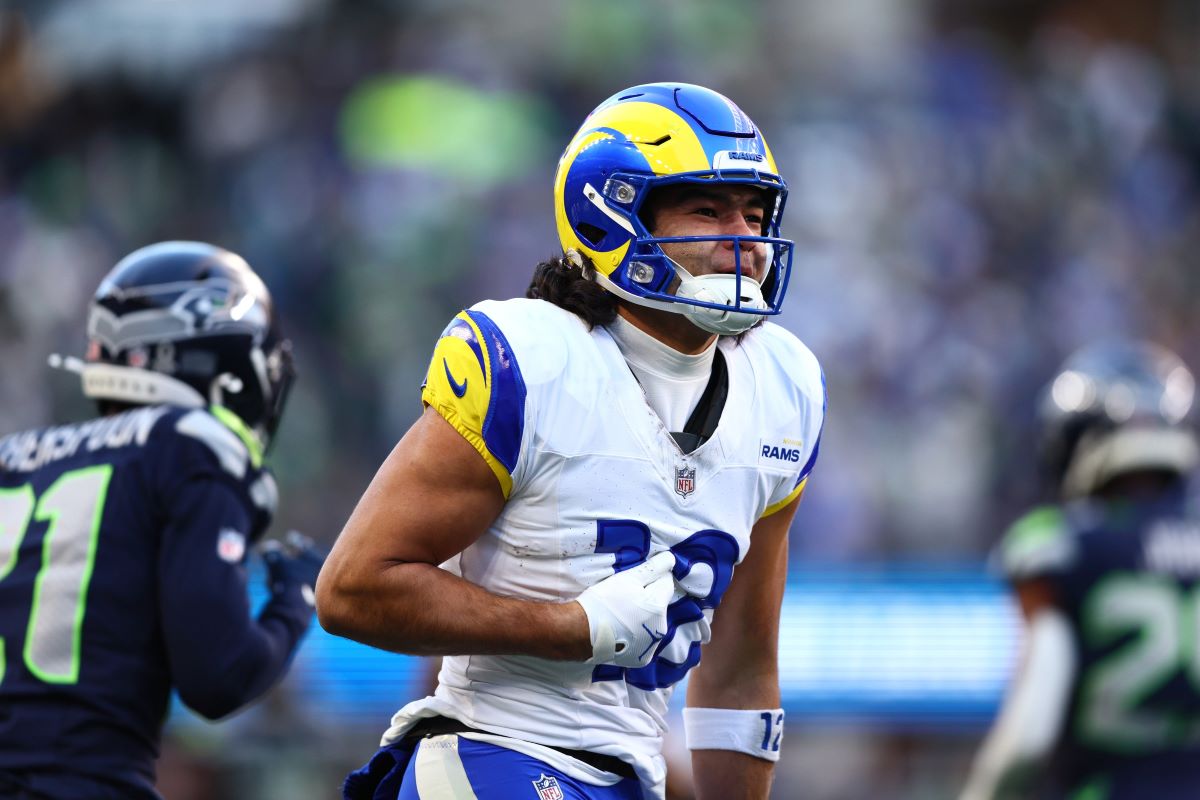
ESPN reported that Los Angeles Rams star wide receiver Puka Nacua has checked himself into rehab.
Whether this was forced by the Rams organization or Nacua’s own choice is yet to be determined. It’s important, though, to look back at how we got here in the first place…and what it means in terms of mental health in professional sports.
Nacua’s Rise & Fall

An unheralded fifth-round pick in 2023, Nacua quickly emerged as a downfield threat for Los Angeles. His first year saw him rack up over 1400 yards, six touchdowns, and finish second in Rookie Of The Year voting.
Nacua saw limited playing time in 2024 due to injury but was still productive on 79 receptions, 990 yards and three touchdowns. His hands softened too–Nacua boasted a 74% catch rate compared to 67% in 2023.
Nacua hit the ground running in 2025. His dominance paired with Matthew Stafford’s MVP campaign posed nightmares for secondary squads around the league. Nacua led the league in receptions, posted a stupidly good 1700 yards and a career-high 10 TDs.
That’s where the positives end, though. December was a rough month.
Nacua went live on a stream with Adin Ross and made an antisemitic gesture. Nacua later apologized and said he “had no idea” what the gesture meant–okay, sure. An athlete does something stupid on social media. What else is new? He issues a PR-laced apology, and the world moves on.
In this case, though, things get worse.
Nacua then said, “Concussions aren’t real.” If concussions aren’t real, what does that make Tua? Nacua then live-streamed inside the Rams’ locker room, which broke team rules.
New Year’s Eve came next. Nacua allegedly bit a woman not once, but twice, and issued another antisemitic gesture. This time, it was verbal.
Nacua checked himself into a Malibu-based rehab on Wednesday. This begs a question.
How Does The NFL Keep Getting Away With It?
Alright, look. The National Football League and mental health don’t belong in the same sentence–but they should. Time and time again, we’ve seen players leave the league worse off than before.
Is it the fame? The money? Do they miss the adrenaline on Sunday?
Yes, some of the above plays into it. The fact is, though, most of these guys have never learned how to manage mental health. They believe their sole purpose on this earth is to play football, and for what it’s worth? They’re damn good at it. There’s another component to it, though.
What about the player behind the face mask?
An athlete is composed of two selves: the public persona of what they do and where they do it, and the human being. Sometimes the lines get blurred, and you see Antonio Brown-levels of antics. Chronic Traumatic Encephalopathy also has a tremendous factor in all this; one of the leading side effects of CTE is personality changes. I understand the NFL has done all it can (or so it thinks) to mitigate that risk, but you can’t ignore it anymore.
Mental health should be treated as a concussion. Why? They both exist in the same space. Nakua isn’t the first, nor will he be the last, to struggle beyond the game. Numerous National Football League players have struggled. Brandon Marshall and Junior Seau to name a few. Kenny McKinley’s story isn’t talked about enough, and that was during his NFL career.
The National Football League needs to prioritize mental health, or at least take it more seriously. Sure, they have programs like the NFL Life Line, and in 2019, mandated that all teams have a mental health clinician. You have the solutions, but the problem remains.
The stigma. The half-measures the NFL takes to prevent situations like these aren’t enough. They spend more time covering up than preventing. Nacua doesn’t have to be a tragic “what-if” story. It can be used to inspire hope. That there is someone out there who gives a damn. Men’s mental health isn’t talked about enough, but that doesn’t mean it has to be twice as difficult for the NFL to give some kind of platform to athletes like Nacua.
End Of My Puka Nacua Rant
Nacua deserves a chance at redemption; I think most people deserve that. He’s worthy of the help he deserves, and many athletes, not just NFL players, need to follow that.
Nothing’s more important than your mental health. Nothing.
