
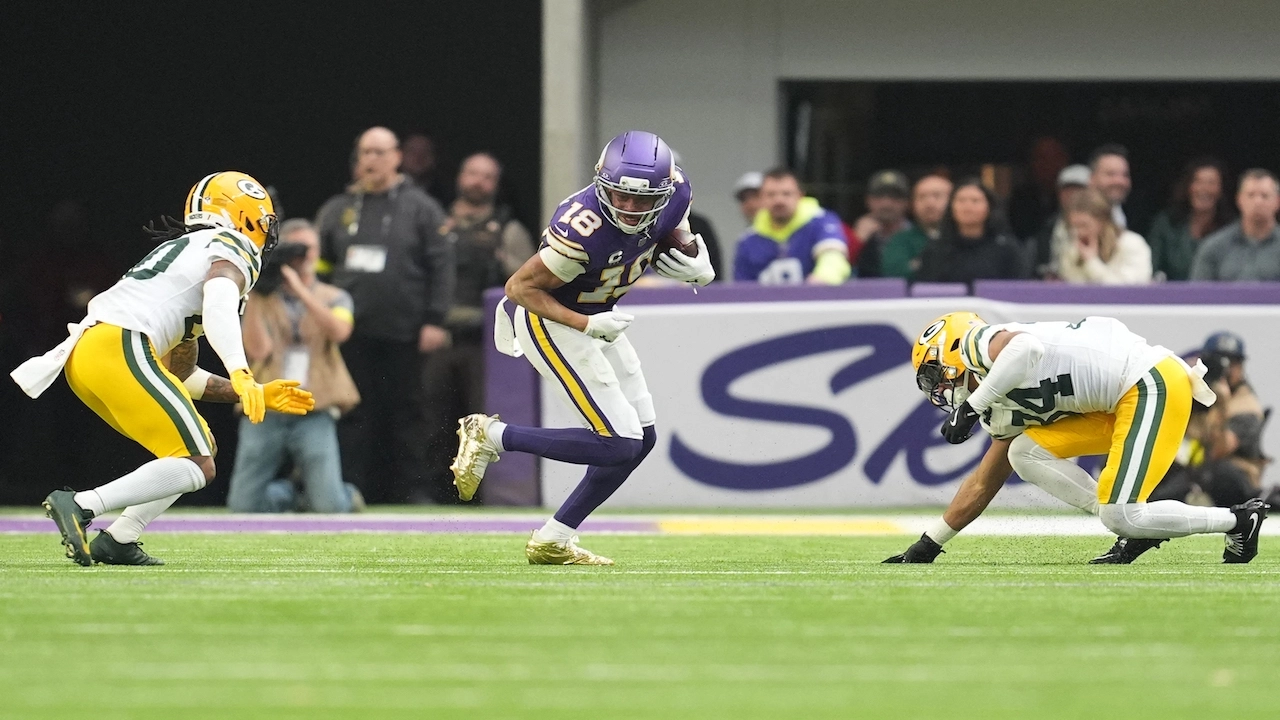
Looking for the best 2026 Dynasty Fantasy Football WR Rankings? We’ve ranked the Top 24 dynasty wide receivers based on age, talent, quarterback situation, long-term upside, and trade value. Whether you’re preparing for a startup draft or rebuilding your roster, these rankings are designed to help you dominate dynasty leagues.
When building out dynasty WR rankings, start with the projections and adjust once you have a stat-line basis. A player should have at minimum 150 targets, gain 14 yards per reception, and score six touchdowns. These marks are what is ideal to look for in a dynasty elite WR1.
From there, it’s about nitpicking situations and ideal circumstances, weighing injury risk vs breakout seasons, or deciding who’s trying to win in shootouts or on defense. Fantasy Football is equal parts math, science, and pure magic, so gather all the information and trust your gut.
Lastly, when playing dynasty, the most important thing to keep in mind is you can only play in three-year windows; trying to game plan five years into the future will only lead you to zero championships.
| Target Share % | Targets | Catch % | Receptions | Yards per Reception | Receiving Yards | Receiving TDs |
| 32.0% | 186 | 67% | 125 | 14.6 | 1821 | 8.0 |
Justin Jefferson’s play hasn’t declined; he was dealing with the worst quarterback play in his career. JJ McCarthy, Carson Wentz, and Max Brosmer all got starts. When Carson Wentz was under center, JJettas was on pace for 170 receptions 1615 yards in 17 games. The former LSU Tiger had his lowest touchdown total of his career but still had over 1000 yards on 84 receptions.
This year, Kyler Murray comes into town with something to prove and the best situation he’s seen in years with Kevin O’ Connell and the superstar wide receiver duo. Murray has shown us he can support a dynasty wide receiver one, and Jefferson’s talent still shines bright; everything can come together for an elite season.
T.J. Hockenson’s play has declined, and there has been little outside investment in the backfield, leaving the brunt of this offense’s production on Addison and Jefferson, hence the 32% target share.
Brian Flores can only scheme up an elite defense for so long; the actual players on the roster aren’t great. The Vikings are going to need to score to keep up in the NFC North.
| Target Share % | Targets | Catch % | Receptions | Yards per Reception | Receiving Yards | Receiving TDs |
| 29.0% | 174 | 68% | 119 | 13.5 | 1601 | 13.0 |
Ja’Marr Chase is still the gold standard for dynasty wide receivers even though he surprisingly isnt in the top spot. There isn’t some secret regression coming; there isn’t a new challenger for the throne. He’s simply the best receiver attached to one of the league’s best quarterbacks.
Last season, the dynamic duo just never took the hit full force despite some great moments; ideally, they connect in Week 1 and don’t stop till we lift fictional trophies. The Bengals’ offense is going to continue flowing through Joe Burrow and Chase. Defenses know where the football is going, and it still doesn’t matter.
Chase wins at every level of the field, dominates after the catch, and is one of the few receivers capable of dropping 40 fantasy points any given week. Tee Higgins is nasty but not good enough to steal WR1 status. Chase commands targets because Burrow trusts him in every situation, especially in the red zone where few receivers are as dangerous.
There’s no reason to overthink this one. If you’re drafting at the top of the board, you’re drafting one of the safest players in fantasy football with overall WR1 upside once again.
| Target Share % | Targets | Catch % | Receptions | Yards per Reception | Receiving Yards | Receiving TDs |
| 34.0% | 177 | 70% | 124 | 12.8 | 1589 | 8.0 |
The breakout has already happened; now people have to decide whether they believe he can repeat that high-level performance. JSN has developed into one of the cleanest route runners in football and consistently separates underneath and over the middle, making him a quarterback’s best friend.
Seattle finally embraced him as the centerpiece of the passing game. His target share should remain dominant while the offense becomes more reliant on him with Kenneth Walker’s departure and Charbonnet’s injury. While repeating as the top wide receiver is difficult, JSN isn’t living off splash plays—he’s winning with volume (4 games with 13 or more targets), consistency (only 1 game with less than 72 receiving yards), and one of the highest catch-rate profiles among WR1s.
The touchdown ceiling may never quite match Chase or Jefferson because of how Seattle distributes red-zone work, but his big-play ability (15.07 yards per catch on the season) makes him one of the best dynasty wide receivers to watch hit the field.
| Target Share % | Targets | Catch % | Receptions | Yards per Reception | Receiving Yards | Receiving TDs |
| 28.0% | 159 | 74% | 118 | 11.4 | 1344 | 9.0 |
Every offseason, someone convinces themselves Amon-Ra St. Brown is due to regress, then he reminds everyone that getting open is an actual skill.
The Sun God continues to dominate the short and intermediate areas of the field, piling up receptions (at least 115 in each of the last three seasons) while giving you one of the safest weekly floors in fantasy football. He is also one of the league’s most underrated touchdown scorers (averages 9 a season). Detroit’s offense is built around efficiency and toughness; nobody embodies that more than St. Brown.
Jameson Williams stretches defenses vertically, but that’s exactly what makes life easier for Amon-Ra underneath. Jahmyr Gibbs’ threat will scare defensive coordinators as much as Jamo’s ability, which leaves St. Brown as the least concentrated on in opposing coaches’ game plans.
He may not lead the league in yards per reception, but he’ll be near the top in catches, first downs, and drives kept alive. That’s exactly why he’s annually one of the most reliable dynasty wide receivers. Sometimes boring wins championships.
| Target Share % | Targets | Catch % | Receptions | Yards per Reception | Receiving Yards | Receiving TDs |
| 28.0% | 157 | 73% | 114 | 13.4 | 1534 | 7.0 |
Rounding out the elite tier of dynasty wide receivers is Puka Nacua; people keep waiting for him to slow down. They can hold their breath if they would like. Puka has proven he isn’t some system receiver or one-year wonder. He wins with physicality, elite hands, and an uncanny ability to uncover when plays break down. Matt Stafford trusts him because he’s always where he’s supposed to be.
Whether it’s designed touches, intermediate routes, or contested catches, Puka finds ways to pile up fantasy points without needing a twenty-yard average depth of targets or unsustainable touchdown production.
The Rams know exactly who their offensive engine is, and they’ll continue feeding him. Defenses can bracket him all they want, but that hasn’t stopped him from producing against virtually everyone.
The biggest difference between Puka and many of the receivers below him is simple: volume you can actually trust. As long as he’s healthy, you’re getting one of the highest target ceilings in fantasy football on the most explosive and innovative offense in the league.
| Target Share % | Targets | Catch % | Receptions | Yards per Reception | Receiving Yards | Receiving TDs |
| 25% | 143 | 66% | 94 | 15.3 | 1442 | 10.0 |
Brown finished with just over 1,000 receiving yards in 2025, but context matters. Philadelphia ranked among the NFL’s most run-heavy offenses, and Brown battled through injuries for much of the season. Even then, he remained one of football’s most efficient receivers, averaging nearly 2.4 yards per route run while commanding roughly 30% of the Eagles’ air yards whenever he was healthy. Those are elite predictive metrics that tell me the talent hasn’t gone anywhere.
Now he gets a fresh start in New England alongside Drake Maye, and I think fantasy managers are underrating how explosive this pairing can become. Maye has the arm talent to maximize Brown’s ability after the catch and attack defenses vertically. In contrast, Josh McDaniels finally has a true alpha receiver he can build the passing game around.
The Patriots added complementary weapons, but none project to challenge Brown as the clear first read on money downs or in the red zone. I’m projecting a slight dip in target share compared to his peak Eagles seasons, but an increase in efficiency and scoring opportunities.
If Drake Maye takes the next step, A.J. Brown could finish much closer to WR3 than WR10. Don’t let last year’s box score scare you away. The only reason he didn’t sneak into the top 5 is due to the 29-year-old age factor.
| Target Share % | Targets | Catch % | Receptions | Yards per Reception | Receiving Yards | Receiving TDs |
| 27.0% | 157 | 66% | 103 | 12.8 | 1322 | 6.0 |
Chris Olave finally gave fantasy managers the breakout season we’d been waiting for, and I don’t think it was a fluke.
Olave finished 2025 with 100 receptions, 1,163 receiving yards and nine touchdowns, establishing himself as the unquestioned No. 1 option in New Orleans. More importantly, the underlying numbers tell us this production is sustainable.
He saw 156 targets—one of the highest totals in football—and averaged an 11.8-yard average depth of target (aDOT), proving he wasn’t simply living off short catches. He was earning meaningful volume while still being used downfield.
One metric I love is his target dominance. Olave consistently commanded over a quarter of the Saints’ passing offense despite dealing with inconsistent quarterback play for much of the year. Once Tyler Shough took over, Olave looked like a true WR1, finishing among the league leaders in targets, receiving yards per game and touchdowns per game. Even better, he accomplished that while seeing an inaccurate target rate near 19%.
I don’t see a massive jump in volume because 156 targets is already elite. Instead, I’m betting on improved efficiency and another step forward in the red zone. If Tyler Shough continues developing, Olave has every tool to finish as a top-eight dynasty wide receiver.
The talent has never been the question. Now he finally has the volume, quarterback stability, and offensive role to become a yearly fantasy WR1. As long as he can avoid the injury list, Olave will continue his upward trajectory.
| Target Share % | Targets | Catch % | Receptions | Yards per Reception | Receiving Yards | Receiving TDs |
| 25.0% | 150 | 65% | 98 | 14.4 | 1407 | 6.0 |
I’m planting my flag early: Carnell Tate is going to be the highest-producing rookie wide receiver in fantasy football.
The Titans didn’t spend the No. 4 overall pick on Tate to ease him into the offense. They drafted him to become Cam Ward’s No. 1 target from Day 1, and Brian Daboll’s offense has historically leaned on a true alpha receiver whenever he’s had one. Tennessee has already reshaped the offense around its young quarterback by pairing him with Tate and improving the supporting cast, making the opportunity as important as the talent.
What really sold me during the draft process were Tate’s efficiency metrics at Ohio State. He averaged 17.2 yards per reception and an elite 3.02 yards per route run, both among the best marks in this receiver class. Even more impressive, he caught 85.7% of his contested targets, showing he can win even when he’s not wide open. Those aren’t just good college numbers—they’re predictive traits that often translate to early NFL success.
The biggest question isn’t whether Tate can play; it’s how quickly he earns Cam Ward’s trust. Rookie receivers usually struggle with efficiency, which is why I’m projecting a modest catch rate. But volume shouldn’t be an issue. Tennessee lacks an established WR1, and everything points toward Tate leading this team in targets by the end of the season. Recent camp previews already expect Tate and Wan’Dale Robinson to become the focal points of the passing game.
Tate has one of the clearest paths to WR1 volume of any rookie receiver in recent memory. There will be growing pains, but don’t be surprised if he’s a weekly fantasy starter by the middle of the season with legitimate WR2 upside by year’s end.
| Player | Target Share % | Targets | Catch % | Receptions | Yards per Reception | Receiving Yards | Receiving TDs |
| DeVonta Smith | 29.0% | 145 | 70% | 102 | 13.0 | 1323 | 7.0 |
For the first time in his career, DeVonta Smith doesn’t have to share the spotlight with A.J. Brown. That alone is enough to make him one of my favorite values heading into 2026.
Smith has always been one of the cleanest route runners in football, but playing alongside Brown naturally capped his weekly ceiling. Now he’s the unquestioned No. 1 receiver in Philadelphia, and I expect the volume to follow. A jump into the 29-30% target share range feels completely realistic after spending most of his career in the low-to-mid 20s.
The advanced metrics back up the talent. Smith posted 2.41 yards per route run in 2025 while catching nearly 70% of his targets, proving once again that efficiency has never been the issue. He consistently wins against both man and zone coverage, and his ability to separate gives quarterbacks one of the safest throwing windows in football. Those are traits that tend to age well and translate directly into fantasy production.
The Eagles still want to run the football, and they’ll continue to lean on one of the league’s best offensive lines. But when they do throw, there’s no debating who the first read is anymore. Dallas Goedert is another year older, and while the Eagles have new complementary weapons, none profile as target hogs capable of challenging Smith’s role this year.
I don’t think Smith suddenly becomes an 180-target receiver, but he doesn’t need to. An extra 25-30 targets over what he’s seen in previous seasons is enough to push him comfortably into the WR1 conversation. His floor has always been high because of his route running and consistency. Now his ceiling finally matches it.
This isn’t a breakout prediction—it’s a workload prediction. DeVonta Smith has always had WR1 talent. Now he finally has WR1 volume, which is why I have him just inside my top 10 with a real chance to finish even higher.
| Target Share % | Targets | Catch % | Receptions | Yards per Reception | Receiving Yards | Receiving TDs |
| 22.4% | 129 | 78% | 100 | 12.1 | 1215 | 6 |
Luther Burden might be the hardest wide receiver in fantasy football to rank this year; he had a solid rookie campaign, catching 47 passes for 652 yards while flashing exactly what made him a second-round pick.
He consistently created separation, averaged 13.9 yards per reception, and quickly became one of Chicago’s most dangerous weapons with the ball in his hands. More importantly, he finished near the top of the Bears’ receiving corps in yards per route run and separation rate, two advanced metrics that tend to predict future breakouts better than raw box-score production.
With D.J. Moore gone, Burden steps into a significantly larger role in Ben Johnson’s offense. Chicago still has plenty of mouths to feed as Caleb Williams emerges with Rome Odunze and Colston Loveland, but Burden is the one player who can create explosive plays from a screen, a slant, or a deep shot.
He’s the type of receiver offensive coordinators manufacture touches for because he turns five-yard gains into 50-yard highlights. I do expect Burden’s efficiency to remain among the best on the team. His ability after the catch gives him week-winning upside even when he only sees seven or eight targets.
Burden is one of my favorite Year 2 dynasty wide receiver breakout candidates. He may never see Justin Jefferson-level volume, but in Ben Johnson’s offense, explosive efficiency can be just as valuable.
| Target Share % | Targets | Catch % | Receptions | Yards per Reception | Receiving Yards | Receiving TDs |
| 22.0% | 132 | 64% | 85 | 14 | 1186 | 12.0 |
People love knocking Higgins because he plays alongside Ja’Marr Chase, but the reality is defenses can’t double both receivers. That’s exactly why Higgins continues to thrive. In 2025, he finished with 11 receiving touchdowns, second among all NFL wide receivers, despite playing just 15 games and seeing fewer than 100 targets.
What stands out isn’t just the touchdowns. Higgins averaged 14.3 yards per reception while converting nearly 70% of his catches into first downs, showing he’s much more than a red-zone specialist.
The biggest concern has always been volume. Ja’Marr Chase is still the engine of this passing attack, which caps Higgins’ target ceiling. But Joe Burrow throws enough to support two elite fantasy receivers, and Cincinnati has shown no interest in changing its identity. As long as Burrow is healthy, this offense is going to finish near the top of the league in pass attempts and scoring opportunities.
I don’t expect Higgins to command 170 targets suddenly, but he doesn’t need them. His size, body control and ability to win in contested situations make him Burrow’s favorite option near the goal line, giving him one of the safest touchdown projections at the position. If he can stay healthy for a full 17-game season, his first 1,000-yard, double-digit touchdown campaign is well within reach.
| Target Share % | Targets | Catch % | Receptions | Yards per Reception | Receiving Yards | Receiving TDs |
| 27.0% | 146 | 68% | 99 | 13.0 | 1287 | 7.0 |
Lamb is still one of the five most talented wide receivers in football, but he’s no longer carrying the entire Cowboys’ passing game by himself. George Pickens proved in 2025 that he isn’t just a field stretcher; he became a legitimate WR1B, posting 1,429 receiving yards and nine touchdowns in his first season with Dallas. That changes the math.
Even with Pickens commanding significant volume, Lamb still posted an elite 28% target share and 2.29 yards per route run in healthy games. Those are WR1 metrics. However, instead of funneling 32-34% of the offense through Lamb as Dallas did in previous years, Dak Prescott now has another weapon.
The good news? Defenses can’t sell out to stop Lamb anymore. Pickens is too dangerous vertically, which should create more favorable matchups from the slot and underneath where Lamb does his best work. The bad news is volume wins fantasy championships. Pickens isn’t going away, Jake Ferguson remains involved, and Dallas wants to be more balanced offensively than it was during Lamb’s monster 2023 campaign.
CeeDee Lamb is still a locked-in WR1, but the days of him challenging for 180+ targets are probably over as long as George Pickens is in Dallas. That’s why I have him at WR12 instead of inside my top five.
| Target Share % | Targets | Catch % | Receptions | Yards per Reception | Receiving Yards | Receiving TDs |
| 24.0% | 141 | 69% | 98 | 13.3 | 1297 | 6.0 |
Denver didn’t trade a first-round pick, third-round pick, and fourth-round pick for Jaylen Waddle to be a gadget player. Sean Payton wanted an explosive playmaker who could turn Bo Nix from a good young quarterback into a great one, and the former Dolphin fits that role perfectly.
Even during Miami’s offensive collapse, Waddle remained one of the NFL’s most efficient receivers. He averaged 5.3 yards after the catch per reception over his career and was among the league leaders in EPA per target and first-down rate, proving he doesn’t need 180 targets to produce elite fantasy weeks. He also led the NFL in production on vertical routes during 2025, showing he can still be one of football’s premier explosive weapons.
The biggest concern is volume. Courtland Sutton isn’t disappearing after his breakout season, and Sean Payton has never been afraid to spread the football around. But Waddle gives this offense something it simply didn’t have before—elite speed that forces defenses to defend every blade of grass. That should create easier throws for Bo Nix while also opening opportunities for Waddle to produce after the catch.
I don’t think he returns to the 170-target ceiling people once dreamed about, but I do think this is the best offensive environment he’s played in since entering the league. A healthy Waddle in Payton’s offense has legitimate WR1 upside, even if the weekly consistency isn’t always there.
| Target Share % | Targets | Catch % | Receptions | Yards per Reception | Receiving Yards | Receiving TDs |
| 25.0% | 144 | 68% | 98 | 13.1 | 1280 | 7.0 |
Ladd McConkey is probably the player I hate ranking the most. After an electric rookie season that saw him post 82 catches for 1,149 yards, McConkey came crashing back to earth in 2025, finishing with 66 receptions, 789 yards and six touchdowns. On the surface, it looks like a classic sophomore slump, but the context matters.
Keenan Allen returned and soaked up targets, while the Chargers’ offense became far less explosive than expected due to injuries. Despite that, McConkey still led Los Angeles in receiving yards and remained Justin Herbert’s most trusted receiver. However, the reason I’m buying the bounce-back is Mike McDaniel.
McDaniel’s offense is built on creating separation before the ball is even snapped, and there aren’t many receivers better at getting open than McConkey. He’s an elite route runner who consistently creates easy throwing windows, which is exactly what Herbert thrives on.
With Keenan Allen gone, I’m expecting McConkey to reclaim a target share north of 28% while improving on the 12.0 yards per reception he posted last season. Reports out of offseason workouts have already highlighted how well he fits McDaniel’s up-tempo scheme.
The reason he’s not inside my top 10 is simple: I still question the touchdown ceiling. The Chargers want to run the football near the goal line, and McConkey isn’t the type of receiver who’s going to dominate with jump balls in the red zone consistently. His fantasy value is going to come from volume, efficiency, and Herbert’s trust more than double-digit touchdown upside.
| Target Share % | Targets | Catch % | Receptions | Yards per Reception | Receiving Yards | Receiving TDs |
| 25.0% | 143 | 58% | 83 | 12.7 | 1050 | 8.0 |
Emeka Egbuka is one of the toughest dynasty wide receivers for me to rank because I think his long-term ceiling is higher than WR15, but I still want to see him put it together for an entire season.
His rookie year was almost two completely different stories. Through the first month of the season, Egbuka looked like the Offensive Rookie of the Year favorite, routinely producing explosive plays and earning targets all over the formation. He finished the year with 63 catches for 938 yards and six touchdowns while leading all rookie receivers with 126 targets. That’s an elite workload for a first-year player.
The concern is what happened after the hot start.
Egbuka’s production dipped significantly over the second half of the season as injuries piled up, Baker Mayfield battled through his own injuries, and Tampa Bay’s offense lost its rhythm. He also finished with eight drops and a catch rate that tailed off after September, showing there’s still room to grow as a complete receiver.
The good news? The runway is wide open.
Mike Evans is gone, and Tampa Bay clearly views Egbuka as the next great wide receiver. Chris Godwin will continue to be a high-volume slot receiver, but the OSU product is the player I expect to lead this team in air yards, explosive plays, and end-zone targets. His versatility is what I love most—he played all three receiver spots as a rookie, making him incredibly difficult to game plan against. Coaches have already praised how much more comfortable and decisive he looks entering Year 2.
| Target Share % | Targets | Catch % | Receptions | Yards per Reception | Receiving Yards | Receiving TDs |
| 26.0% | 141 | 64% | 90 | 12.8 | 1154 | 8.0 |
This is going to make Falcons fans mad. I love Drake London the player; he was my WR2 overall last season. I don’t love what’s happening around him.
London has proven he’s a true No. 1 receiver, averaging 9.3 targets per game over the last two seasons, and he’s expected to remain the focal point of Atlanta’s passing game regardless of who wins the quarterback battle. But that’s exactly why I can’t rank him any higher than WR16.
Kevin Stefanski and Tommy Rees aren’t walking into Atlanta to throw the ball 650 times. Stefanski’s offenses have historically leaned on the running game, play-action, and creating mismatches for tight ends, which fits Bijan Robinson and Kyle Pitts perfectly. Add in the uncertainty between Tua Tagovailoa and Michael Penix Jr. at quarterback, and it’s hard to project the type of passing volume needed for London to challenge the elite fantasy receivers.
The talent isn’t the issue. Even in an injury-shortened 2025, he finished with 68 catches for 919 yards and seven touchdowns, showing he can still produce despite inconsistent quarterback play. The problem is the potential ceiling.
Between Bijan commanding touches, Pitts expected to have a larger role under the new coaching staff and a more balanced offensive philosophy, I don’t see London pushing for the 170-target seasons that separate the top dynasty wide receivers from everyone else.
| Target Share % | Targets | Catch % | Receptions | Yards per Reception | Receiving Yards | Receiving TDs |
| 24.0% | 125 | 64% | 80 | 15.0 | 1202 | 9.0 |
Collins finished 2025 with 71 receptions for 1,117 yards, averaging 15.7 yards per catch while continuing to establish himself as C.J. Stroud’s favorite downfield target. He also remained one of the NFL’s most efficient receivers, consistently ranking near the top of the league in yards per route run, which is one of the strongest indicators of sustainable receiver production.
Nico isnt the only show in town anymore for Houston; David Montgomery gives Nick Caley the physical running game he wants, while Jayden Higgins is expected to take a significant Year 2 leap after finishing his rookie season strong. Tank Dell is also working his way back, giving Houston another explosive option if healthy. Nick Caley has already made it clear he wants a more balanced offense in his second season, which naturally limits Collins’ target ceiling.
That doesn’t worry me as much as it does other people. Collins doesn’t need 170 targets to be a productive WR2. At 6-foot-4 with elite ball skills and vertical speed, he’s one of the league’s best explosive-play receivers. When Stroud needs a conversion or a deep shot, Collins is still the first player he’s looking for.
| Target Share % | Targets | Catch % | Receptions | Yards per Reception | Receiving Yards | Receiving TDs |
| 20.0% | 104 | 62% | 65 | 12.6 | 813 | 8.0 |
This is going to be my hottest ranking; I still love Malik Nabers the player. I don’t love the dynasty asset. Everyone keeps ranking him like he’s guaranteed to become a top-five fantasy receiver. I think that’s projecting what he should be instead of evaluating what he is today.
He’s coming off a significant knee injury that required multiple procedures. While he’s trending toward being ready for Week 1 (could be camp talk), we still haven’t seen how he’ll respond over a full NFL season after the injury. Pair that with an offense breaking in a young quarterback, and I think there are simply more question marks than people want to admit.
The biggest problem is his price. Right now, you’re paying for Malik Nabers to become Justin Jefferson. That’s a bet I’m not willing to make. We’ve only seen one elite fantasy season, and now the Giants are trying to build a more complete offense.
Jaxson Dart doesn’t need to throw 650 passes for this team to win, and if the offense improves as a whole, Nabers may actually see less volume than fantasy managers are expecting. Malik Nabers has all the talent to finish as a top-five receiver.
I don’t think we’re there this season as he gets back to form and the team changes in his absence. At WR18, I’m fading the price—not the player. If someone in your league still values him like a top-five dynasty receiver, I’m taking that trade every single time.
| Target Share % | Targets | Catch % | Receptions | Yards per Reception | Receiving Yards | Receiving TDs |
| 25.0% | 143 | 63% | 90 | 13.2 | 1189 | 7.0 |
Terry McLaurin is the most underrated receiver of the last decade. He’s posted 1,000-yard seasons with just about every quarterback imaginable, and truly broke out in his first season with Jayden Daniels. Unfortunately, last season was a mess for everyone in Washington with injuries and scheme issues.
The Commanders look to return to full health and have begun to build the new scheme. Offensive coordinator David Blough has publicly said they are building around getting McLaurin 10 targets a game while moving him all over the formation instead of leaving him isolated at X receiver.
That’s a huge deal; McLaurin has always won with elite route running and separation. If Washington actually follows through on creating free releases, motioning him into favorable matchups and feeding him consistently, this could be one of the highest-volume seasons of his career.
The reason he’s WR19 instead of WR12 comes down to upside. Washington wants to be more balanced under Blough, using heavier personnel and leaning on the run game more than they did under Kliff Kingsbury. There are also more mouths to feed with Chig Okonkwo, Antonio Williams and Treylon Burks all expected to have roles in the offense.
Terry McLaurin is as safe as they come. He has a legitimate shot at 90+ catches and 1,300 yards, but I don’t see the elite touchdown or target ceiling to push him into my top 15. Draft him as your WR2 and enjoy the consistency every Sunday.
| Target Share % | Targets | Catch % | Receptions | Yards per Reception | Receiving Yards | Receiving TDs |
| 23.0% | 129 | 62% | 80 | 16.0 | 1278 | 7.0 |
George Pickens finally proved what a lot of us already believed. Give him a real quarterback, and he’s a WR1. In his first season with Dallas, Pickens posted 93 catches for 1,429 yards and 9 touchdowns, averaging 15.4 yards per reception while finishing among the league leaders in air yards, yards per reception, and explosive receptions (20+ yards). He also posted a 2.45+ yards per route run, proving he can win on far more than go balls.
The best part? Playing opposite CeeDee Lamb might actually make Pickens more efficient. Defenses can’t roll coverage to both receivers, leaving Pickens with far more one-on-one opportunities than he ever saw in Pittsburgh. Few receivers in football are better in contested-catch situations or tracking the football downfield.
The only thing holding him back is volume. Lamb is still Dallas’ first read, so it’s hard to project Pickens into the 160-target club occupied by the elite fantasy receivers. But with Dak Prescott pushing the ball downfield and Pickens commanding one of the highest average depths of target among starting receivers, he doesn’t need that kind of volume to produce WR1 weeks.
George Pickens is one of the league’s premier big-play receivers. I don’t think he’ll ever match CeeDee Lamb’s weekly volume. Still, his combination of elite efficiency, vertical ability, and improved quarterback play makes him an easy top-25 dynasty receiver with legitimate top-10 weekly upside.
| Target Share % | Targets | Catch % | Receptions | Yards per Reception | Receiving Yards | Receiving TDs |
| 24.0% | 128 | 60% | 77 | 13.4 | 1026 | 8.0 |
This may look conservative in a year. McMillan wasted absolutely no time proving he belonged, winning Offensive Rookie of the Year after posting 70 catches for 1,014 yards and seven touchdowns. Even more impressive was how quickly he became Bryce Young’s first read, commanding a 23% target share and an elite 41% air-yard share as a rookie.
The scary part? I don’t think we’ve seen his ceiling yet. Bryce Young looked like a completely different quarterback during the second half of last season, and Dave Canales continues building the offense around that connection. McMillan has the size to dominate contested catches, the body control to win down the field, and the route-running polish to become one of the league’s true alpha receivers.
So why isn’t he higher? Because I still need to see Carolina (Bryce Young) become a consistently above-average passing offense for an entire season. McMillan can absolutely become a top-10 dynasty receiver, but projecting him into that tier today means betting that Bryce Young takes another leap and the Panthers throw enough to support elite fantasy production; I’m just not ready to do that yet.
| Target Share % | Targets | Catch % | Receptions | Yards per Reception | Receiving Yards | Receiving TDs |
| 24.0% | 134 | 63% | 85 | 12.4 | 1050 | 11.0 |
At 33 years old, Adams is still one of the NFL’s most complete route runners. He finished 2025 with 60 catches, 789 yards and an NFL-leading 14 receiving touchdowns despite missing the final three regular-season games with a hamstring injury. His ability to separate and dominate in the red zone hasn’t gone anywhere.
The issue is opportunity.
Puka Nacua is still the centerpiece of Sean McVay’s passing game, and the Rams are expected to lean even more on heavier personnel packages in 2026. Adams will continue to see favorable matchups opposite Puka, but he’s unlikely to command the volume that made him a perennial top-five fantasy receiver during his Packers days.
The touchdowns should keep coming, though.
Matthew Stafford has always trusted elite route runners near the goal line, and Adams led the NFL with 14 receiving scores last season. Even if that number comes down, his route running and chemistry with Stafford give him one of the safest fantasy floors among veteran receivers.
Davante Adams can absolutely outproduce WR22 if the touchdowns stick. I can’t rank a 33-year-old dynasty wide receiver sharing targets with Puka Nacua any higher than this. The ceiling isn’t what it once was, but he’s still one of the safest bets to outperform his ADP.
| Target Share % | Targets | Catch % | Receptions | Yards per Reception | Receiving Yards | Receiving TDs |
| 25.0% | 128 | 75% | 96 | 11.5 | 1106 | 9.0 |
This ranking has nothing to do with talent. It has everything to do with uncertainty. When Rashee Rice is on the field, he’s one of the most efficient dynasty wide receivers in football. He consistently wins underneath, forces missed tackles after the catch, and has become Patrick Mahomes’ security blanket.
His 72%+ catch rate, elite yards after catch ability, and nearly 2.7 yards per route run make him a fantasy machine when healthy. The problem is we still don’t know what a full season looks like.
Between injuries, suspensions, and Kansas City’s revolving receiver room, Rice has yet to put together the complete season dynasty managers have been waiting for. Add in Xavier Worthy’s growing role, Travis Kelce still commanding high-leverage targets, and Andy Reid’s willingness to spread the football around, and projecting Rice into the elite target tier becomes difficult.
The upside is obvious, though. Patrick Mahomes is still his quarterback, and few offenses create more scoring opportunities. Rice doesn’t need a 15-yard average depth of target to dominate fantasy. He wins with volume, efficiency and yards after the catch, turning routine completions into explosive plays.
I completely understand anyone ranking Rashee Rice inside their top 15. The talent is there. I’m just choosing to fade some of the uncertainty. If he finally puts together a healthy, uninterrupted season, WR23 will look far too low. But today, I’d rather bet on the proven production from the receivers ahead of him.
| Target Share % | Targets | Catch % | Receptions | Yards per Reception | Receiving Yards | Receiving TDs |
| 24.0% | 132 | 63% | 82 | 13.5 | 1110 | 7.0 |
D.J. Moore finally got what fantasy managers have been begging for. Josh Allen. After spending most of his career overcoming inconsistent quarterback play, Moore now walks into one of the NFL’s best offenses as Buffalo’s clear No. 1 receiver following his offseason trade from Chicago. The fit makes a ton of sense.
Moore has consistently been one of the league’s best receivers after the catch while averaging over 2.2 yards per route run throughout his career. Pair that with Josh Allen’s aggressiveness pushing the ball downfield, and Moore should see plenty of high-value targets.
Joe Brady has also shown a willingness to manufacture touches for his WR1 through screens, motion, and quick-game concepts, making Moore an ideal fit for this offense. Recent Bills analysis also expects Moore to become one of Allen’s primary first-read options.
The reason I can’t rank him higher is simple. Khalil Shakir, Dalton Kincaid, and Keon Coleman will all have meaningful roles. Josh Allen and James Cook will certainly hurt his touchdown upside because of their ability to score in the redzone.
I still love the landing spot more than most people. D.J. Moore finally has the quarterback he’s deserved for years, and I think his efficiency takes another step forward. I don’t see the 160-target ceiling that elevates him to the higher-level dynasty WR tiers.
| Target Share % | Targets | Catch % | Receptions | Yards per Reception | Receiving Yards | Receiving TDs |
| 28.7% | 147 | 68% | 100 | 10.8 | 1081 | 5.0 |
When I say “biggest riser,” I mean the player I expect to make the jump onto this 2026 dynasty fantasy football WR rankings over the next 12 months. For me, that’s Josh Downs.
Josh Downs has never struggled to earn targets. Even in a reduced role, he led Indianapolis with a 21.7% target rate, and we’ve already seen what happens when he plays with competent quarterback play. In 2024 games without Anthony Richardson, Downs averaged 9.3 targets per game while posting a 0.33 Targets Per Route Run, the second-best mark in the NFL. As long as Daniel Jones can stay healthy (Update: Jones has been fully cleared for camp activities), he can support a Josh Downs breakout.
If his route participation climbs back into an every-down role, the breakout won’t come because he suddenly became a better player—it’ll come because one of the league’s best target earners is finally staying on the field.
Now the runway is finally clear. With Michael Pittman Jr. gone, the Colts have made it no secret they want Downs playing a much larger role, including more snaps outside instead of being locked into the slot. Chris Ballard has even compared some of Downs’ instincts to T.Y. Hilton, while Shane Steichen’s staff has emphasized moving him all over the formation to maximize mismatches.
That’s why I’m buying. Josh Downs has always been a better football player than his fantasy numbers suggest. If his route participation jumps into a true every-down role, I think 130+ targets and his first 1,000-yard season are well within reach.
Josh Downs isn’t my biggest riser because he’s a hidden sleeper. He’s my biggest dynasty WR riser because I believe by this time next year we’ll be talking about him as a top-20 dynasty receiver instead of a player everyone wishes they had bought before his breakout.
Emeka Egbuka is the type of dynasty asset I want to acquire before his true breakout happens. His rookie season showed plenty of promise, but most of that came from the beginning of the season, and he fell from week 10 on through the fantasy playoffs. Managers may have a bad taste in their mouth; please try to snag the asset at a value if possible.
With another offseason to build chemistry with his quarterback and an expanded role in Tampa Bay’s offense following Mike Evans’ departure, Egbuka has a legitimate path to becoming the Buccaneers’ No. 1 receiver. If he takes that next step, his current dynasty value will disappear quickly. I’d rather pay WR2 prices for a dynasty WR1.
This isn’t a knock on A.J. Brown’s talent—he’s still one of the NFL’s most dominant receivers. But dynasty is about maximizing value, and I don’t think his trade value will ever be much higher than it is today. At 29 years old, Brown is still being valued as a cornerstone dynasty WR, making this the perfect window to cash out if another manager is willing to pay that price.
If you can turn Brown into a younger top-tier receiver plus additional draft capital or another starting asset, it’s a move worth exploring. Sometimes the best dynasty trades aren’t about selling a declining player—they’re about selling at peak market value before age inevitably begins to affect perception.
That’s my 2026 dynasty wide receiver rankings heading into this season, and I’m sure at least a few of them made you question my sanity. Good. Dynasty isn’t won by following consensus—it’s won by identifying value before everyone else catches up.
Some of these takes will age well, and a few probably won’t. That’s part of the fun. If your rankings look exactly like everyone else’s, you’re not taking advantage of the biggest edge in dynasty fantasy football: having conviction.
Now it’s your turn. Which ranking did I get completely wrong? Who am I too high on? Who deserves to be much higher? Let me hear your hottest dynasty fantasy football takes in the comments, because I guarantee this list won’t be the last time we debate these players.
Until next time, keep building for the three-year window, forever chase the value, and as always… Rant About It.
If you love sports, download Stadium Rant from the Apple App Store and join one of the fastest-growing social sports communities. Be sure to follow us on socials too — you can find all our profiles on our Linktree.
