
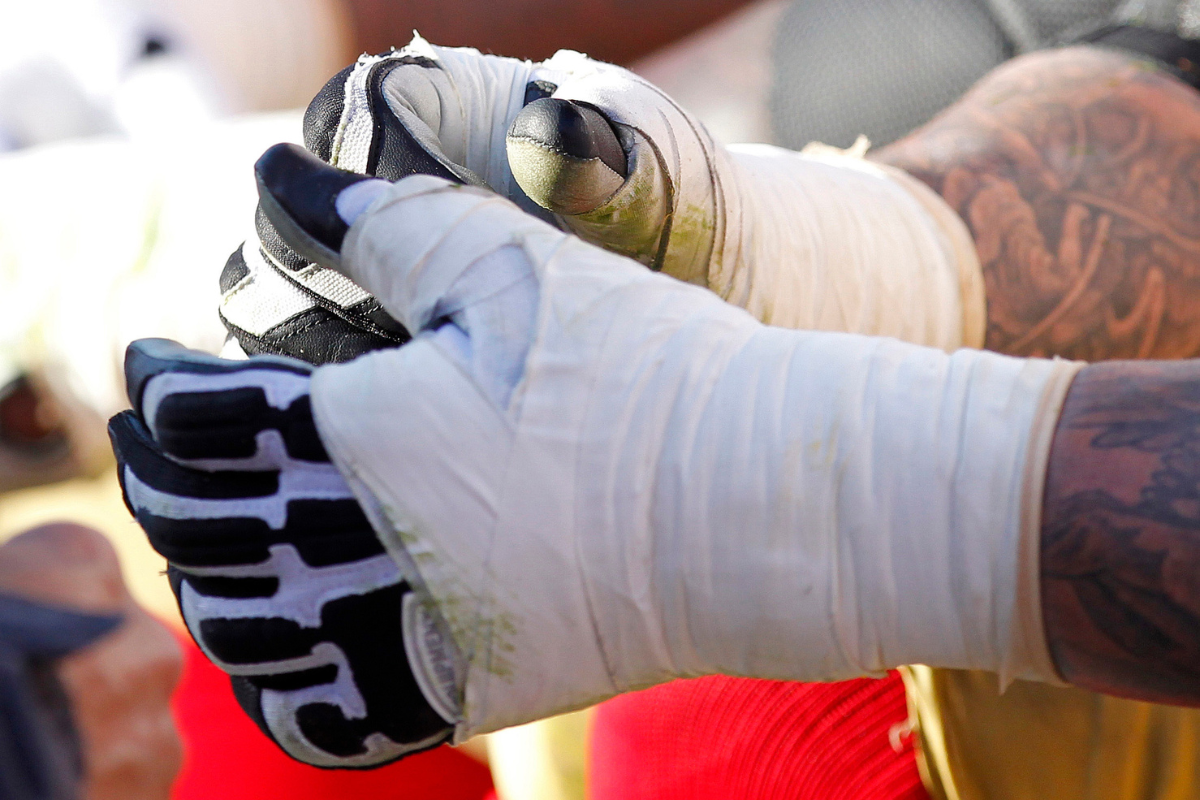
If you watch enough football, you’ll notice it everywhere: white tape on wrists, forearms, hands, and sometimes all the way up the arms. It shows up on quarterbacks, receivers, linemen, linebackers, and defensive backs at every level of the sport.
So why do football players tape their arms?
The short answer is that players usually do it for support, comfort, grip-related function, and minor injury management. In some cases, it is also part of a player’s routine or personal style. Tape can help stabilize a sore area, protect joints and soft tissue, and give players a more secure feel during contact, even though experts caution that tape is not a magic injury-prevention tool.
This is the most common reason.
Football puts a lot of stress on the upper body. Players are constantly blocking, shedding blocks, tackling, stiff-arming, reaching, and absorbing contact. That can leave the wrists, thumbs, hands, and forearms sore even if there is no major injury.
Tape can provide a sense of added support to an unstable or irritated area. That is especially helpful around the wrist, where sprains involve the ligaments surrounding the joint. Mayo Clinic notes that wrist sprains affect the ligaments around the wrist joint, and supportive measures like splints or braces are commonly used early on; athletic tape serves a similar practical role in sports by helping reinforce the area during activity.
Not every football injury is serious enough to keep a player off the field like a concussion. Many players deal with minor sprains, strains, jammed fingers, sore wrists, thumb issues, and nagging forearm pain during the season.
In those cases, tape can be part of a player’s game-day management routine. It may help limit excessive movement, reduce discomfort, and make the area feel more protected. That is one reason athletic trainers and sports medicine staff use taping as a temporary support tool rather than a permanent fix. Research and clinical guidance suggest taping may offer some support and pain relief, but the effect is usually modest, and it should not be treated as a cure-all.
Football is a violent sport, and confidence matters. My old football coach always said something that stuck with me: “Look good, feel good, play good.” And it’s true. When you look good, you feel confident, and when you feel confident, you perform better. That’s true for anything in life but especially in sports.
Even when the physical effect of tape is limited, some players simply feel better wearing it. If a taped wrist or forearm makes a player more confident striking a blocker, catching a pass, or finishing a tackle, that matters. Cleveland Clinic notes that some athletes report feeling more comfortable being active with supportive tape because of the added sense of support.
That does not mean tape turns an injured arm into a healthy one. It means that the combination of light support, compression, and routine can help players trust the area more.
Sometimes the tape is not just for the arm itself.
Players also use tape to hold small pads, wrist supports, or protective wraps in place. Around the hands and wrists, tape can help keep gear from shifting during a game. Football rules also specifically address what kinds of tape are allowed on the hands and arms, which tells you how common it is in the sport. The NFL rulebook allows players to use opaque white, black, or one dominant club color tape on the hands and arms, subject to uniform rules.
Not every piece of tape is strictly medical.
Some players tape the same way every game because it has become part of their routine. Others like the feeling of compression or the cleaner feel on their wrists and forearms. And yes, style plays a role too. Football has always had an element of personal identity in equipment choices, and tape has become part of that look for many players.
That does not mean it is purely cosmetic. Usually it is a mix of function and habit.
This is where the answer gets more nuanced.
A lot of fans assume tape is mainly there to prevent injuries. That is only partly true.
According to USA Football, when an injury occurs, taping and bracing may be required, but research does not show that there is a brace or tape mechanism that will completely prevent injury. That is an important distinction. Tape may help support an area, reduce risky movement, or help a player manage an existing issue, but it is not a guarantee that an injury will not happen.
So the better way to say it is this: tape may help support vulnerable areas, but it is not a foolproof injury-prevention device.
Wrist tape is especially common because the wrist takes a beating in football.
Linemen punch and absorb hand contact on nearly every snap. Ball carriers fight through tackles. Defenders grab, wrap, and clamp down. Receivers extend for catches and brace through collisions. Over time, that can create soreness or instability.
Taping the wrist can make it feel more secure and may help limit certain uncomfortable motions. That is why wrist taping is one of the most common forms of athletic taping across contact sports.
When players tape higher up the arm, there are usually a few possible reasons:
Some players also use elastic therapeutic tape, while others use more rigid athletic tape. Those serve slightly different purposes. Kinesiology-style tape is designed to allow more movement while still providing light support, and Cleveland Clinic notes that it may help some people feel more comfortable being active, though the evidence is mixed and not strong enough to make sweeping claims.
Almost every position does it, but the reasons can vary.
Offensive and defensive linemen use their hands and wrists constantly. They are probably the clearest example of players taping for support and repeated contact.
These players may tape wrists, fingers, or forearms because of catches, hand fighting, and tackling.
These positions take a lot of direct contact and often deal with hand, wrist, and forearm wear and tear.
Quarterbacks sometimes tape the wrist or forearm for comfort, support, or to secure accessories. Some also wear wristbands with play sheets, which are specifically allowed under football rules.
Fans sometimes lump everything together, but not all arm gear is the same.
What looks like “tape” could actually be:
That matters because each serves a different purpose. Tape is usually about support, securing something, or protecting an area. A wrist coach is for play calls. A sleeve is more about compression and coverage.
Football players tape their arms mainly to support the wrist, hand, or forearm, manage minor injuries, improve comfort during contact, and secure protective gear or wraps. Some also do it out of routine or style.
The key point is that tape is usually a practical support tool, not a miracle fix. It can help players feel more stable and more comfortable, but it does not make them injury-proof.
It can help with support, comfort, and minor injury management, but it does not fully prevent injuries.
Because the wrists absorb a lot of contact and strain. Tape can help the area feel more stable and protected.
Sometimes style is part of it, but most players use tape for a practical reason first, such as support, protection, or routine.
No. Some players use rigid athletic tape, while others use elastic therapeutic tape, sleeves, or wristbands for different purposes.
A small SEO note: I would also use these secondary phrases naturally in the post or Rank Math fields:
If you want, I can also turn this into a slightly more clicky Stadium Rant-style version with stronger intro and headline options.
If you love sports, download Stadium Rant from the Apple App Store and join one of the fastest-growing social sports communities. Be sure to follow us on socials too — you can find all our profiles on our Linktree.
