
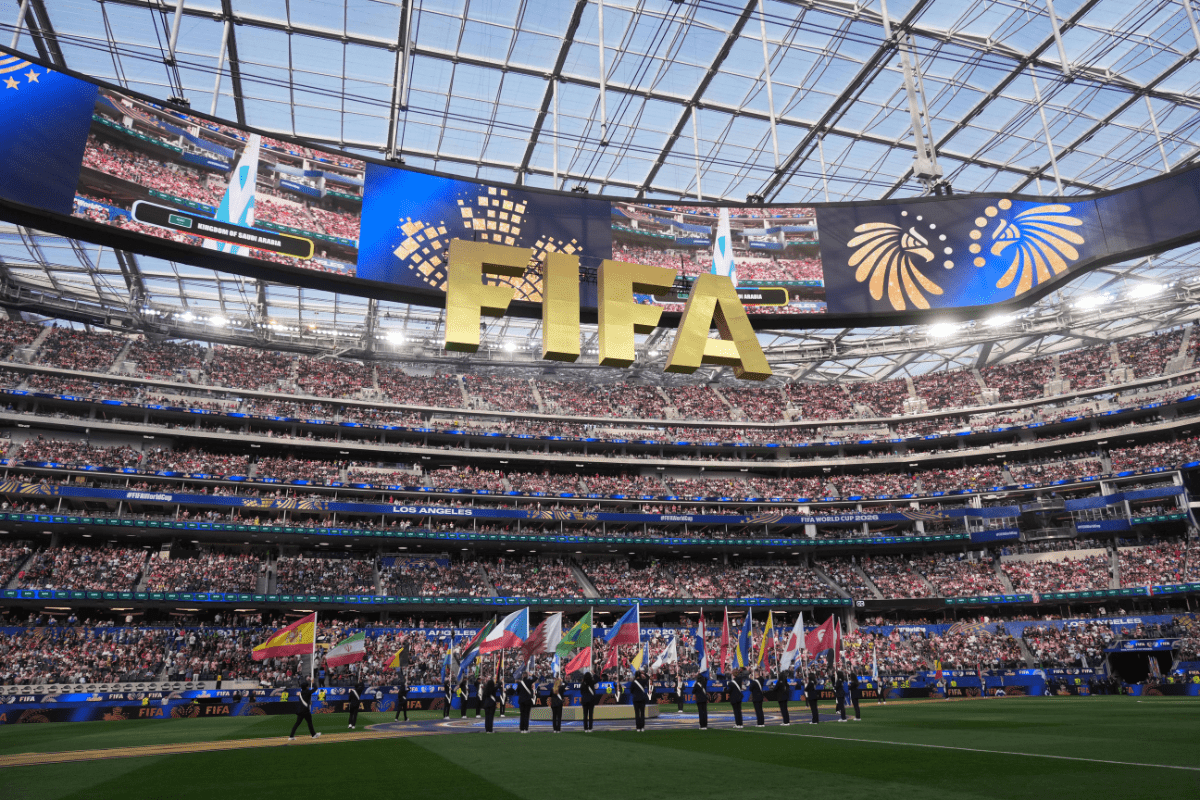
Every four years, the planet stops to watch one tournament. Offices empty out, entire countries paint themselves in their national colors, and a single match can bring billions of people to the same screen at the same moment. That tournament is the FIFA World Cup, and it is, by almost any measure, the biggest sporting event on Earth.
If you’ve heard people talk about the World Cup but never quite understood what it is, how it works, or why it matters so much, this guide breaks it all down: the history, the format, and everything that makes it the most-watched competition in sports.
What is the World Cup?
The World Cup is an international football (soccer) tournament that crowns the best national team in the world. It is run by FIFA, the sport’s global governing body, and it brings together teams that represent their countries rather than club teams that represent cities.
That distinction is the heart of its appeal. When the World Cup is on, you aren’t watching Real Madrid or Manchester City. You’re watching Brazil, France, Argentina, and dozens of other nations, with players who normally compete against each other now wearing the same shirt for their country. National pride, not club rivalry, is what’s on the line.
When most people say “the World Cup,” they mean the men’s tournament. There is also a hugely popular Women’s World Cup, covered later in this guide.
A brief history of the World Cup
The idea of a true world championship for football took shape in the 1920s, driven largely by FIFA president Jules Rimet. The first tournament was held in 1930 in Uruguay, with just 13 invited teams. The host nation won, beating Argentina in the final, and a tradition was born.
The competition grew quickly, though it was paused during the 1940s because of World War II, with no tournaments held in 1942 or 1946. When it returned, it expanded steadily in size and global reach, adding teams from more continents and becoming the worldwide spectacle it is today.
The original prize was the Jules Rimet Trophy. Brazil earned permanent possession of it in 1970 after winning their third title, a reward written into the early rules. A new prize, the FIFA World Cup Trophy still awarded today, was introduced in 1974.
Over the decades, the World Cup became more than a sporting event. It produced some of the most iconic moments in all of sports and turned players like Pelé, Diego Maradona, Zinedine Zidane, and Lionel Messi into global legends.
How the World Cup works
The tournament unfolds in two big phases that play out over years, not weeks. Most fans only watch the final stage, but the journey to get there is enormous.
Qualifying
Long before the main event, hundreds of national teams compete in regional qualifying matches to earn one of the limited spots in the finals. These qualifiers are organized by continent through FIFA’s six regional confederations, covering Europe, South America, North and Central America, Africa, Asia, and Oceania.
Only a fraction of teams make it through. The host nation (or nations) typically qualifies automatically, but everyone else has to earn their place over a long campaign. Qualifying can take a couple of years and is its own dramatic story, with traditional powers sometimes failing to make it and smaller nations occasionally breaking through.
The group stage
The teams that qualify gather in the host country for the tournament itself, which begins with the group stage. Teams are drawn into small groups and play a round-robin within their group, meaning each team plays every other team in the group once.
Wins, draws, and losses earn points, and the top teams in each group advance. This stage rewards consistency. A single bad result usually isn’t fatal, but a team has to perform across multiple matches to move on.
Under the current 48-team format, the World Cup features 12 groups of four teams. The top two from each group, plus the best-performing third-placed teams, advance to the knockout rounds. This expanded structure was introduced for the 2026 tournament, growing the event from 32 teams and adding more matches and more nations than ever before.
The knockout stage
Once the groups are settled, the tournament switches to single-elimination knockout rounds. From here, every match is win-or-go-home. There are no second chances.
The knockout bracket works down through rounds (such as the round of 32, round of 16, quarterfinals, and semifinals), with the field cutting in half each time. If a knockout match is tied after regulation, it goes to extra time, and if it’s still level, it’s decided by a penalty shootout. The drama of a shootout, with the whole tournament riding on a single kick, is part of what makes the World Cup unforgettable.
The final
The two teams that survive the entire gauntlet meet in the final, a single match watched by hundreds of millions of people around the world. The winner is crowned world champion and lifts the trophy. For most players, it is the highest honor the sport can offer.
How often is the World Cup held?
The World Cup is held every four years. That long gap is a big part of why it feels so special. Unlike club leagues that play every season, the World Cup is a rare event, and a player only gets a handful of chances across an entire career to win it.
The four-year cycle also means hosting rotates around the globe, giving different countries and continents the chance to stage the tournament. The 2026 World Cup, for example, is being co-hosted by the United States, Canada, and Mexico, the first time three nations have shared hosting duties.
Which countries have won the most World Cups?
A small group of nations has dominated the tournament’s history. The most successful is Brazil, the only country to win it five times. Germany and Italy have each won it four times, and Argentina has won it three times.
Uruguay and France have two titles each, while England and Spain have each won it once. Winning even a single World Cup places a country in rare company, and most nations have never won it at all.
The trophy
The current prize, the FIFA World Cup Trophy, is one of the most recognizable objects in sports: a gold figure of two players holding up the Earth. The winning captain lifts it on the field after the final, and the moment is one of the most replayed images in football.
The trophy itself stays with FIFA. Winning nations receive a replica, but the celebration of hoisting the real thing is the image that defines a champion.
The Women’s World Cup
Alongside the men’s tournament, FIFA runs the Women’s World Cup, which has grown into a major global event in its own right. The first edition was held in 1991, and like the men’s competition it takes place every four years.
The United States has been the most successful nation in the women’s game, with multiple titles, though the field has become far more competitive as the sport has grown worldwide. The Women’s World Cup now draws record crowds and television audiences, and it has produced its own generation of global stars.
Why the World Cup matters
Beyond the football, the World Cup is a cultural event. It unites people across language, geography, and politics around a shared spectacle. For many fans, it carries memories tied to specific tournaments: where they watched, who they watched with, and the goals they’ll never forget.
It’s also the rare stage where a smaller nation can shock a giant, where careers are defined in 90 minutes, and where the entire world is genuinely watching the same thing at the same time. That combination of scale, stakes, and surprise is why it stands alone.
Frequently asked questions
What is the World Cup in simple terms? It’s a tournament that decides the best national football team in the world, held by FIFA every four years.
How often is the World Cup played? Every four years.
Who has won the most World Cups? Brazil, with five titles.
When was the first World Cup? The first FIFA World Cup was held in 1930 in Uruguay, which also won it.
How many teams play in the World Cup? Under the current format introduced in 2026, 48 teams reach the finals, after a long qualifying process involving hundreds of national teams.
Is there a Women’s World Cup? Yes. The Women’s World Cup began in 1991 and is also held every four years.
The bottom line
The World Cup is football at its biggest: nations instead of clubs, four years of buildup, and a single champion left standing at the end. Whether you’re a lifelong fan or watching your first tournament, it’s the one event that turns the entire world into a stadium.
If you’ve got takes on who’s going to win, who’s overrated, or which dark-horse nation is about to shock everyone, Stadium Rant is built for exactly that kind of debate. Jump in and make your case.
