
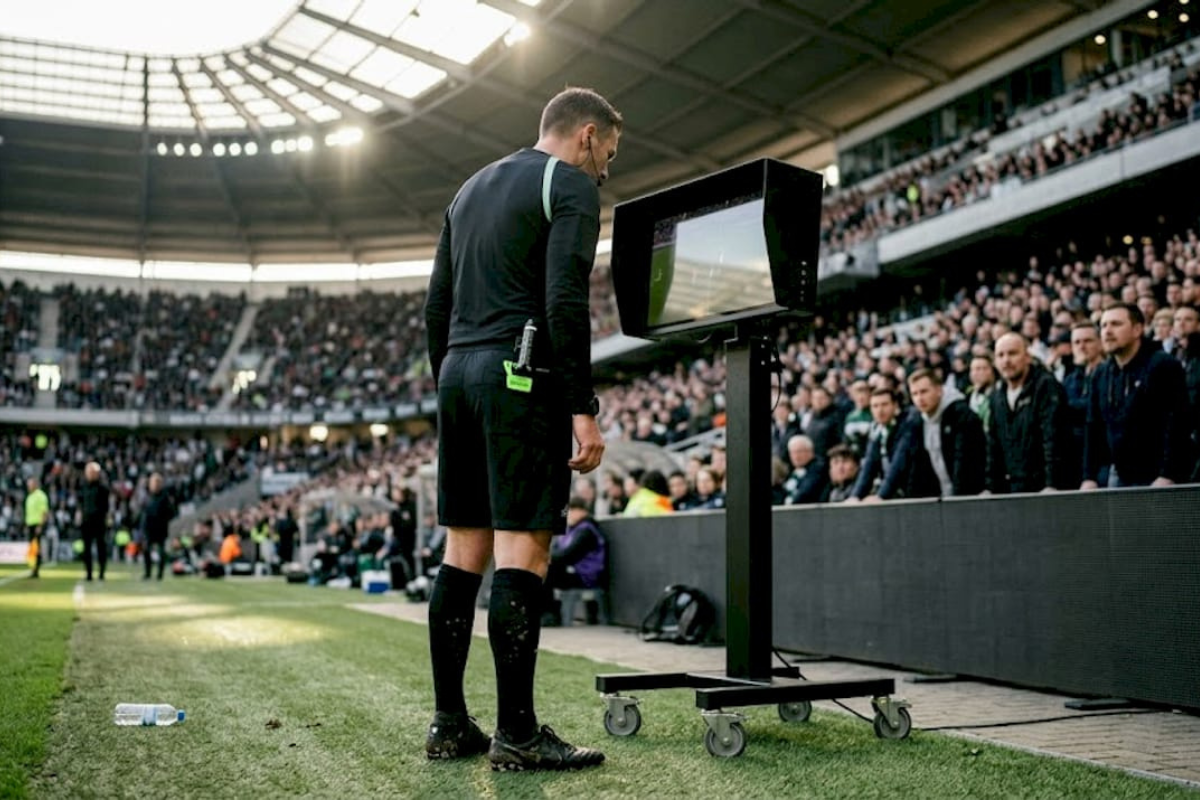
When referees in the English Premier League actually walk over to the pitchside monitor and review a call, they overturned their original decision in the vast majority of cases. That number is staggering when you think about it. It means the original call on the field was almost always wrong once a second look was taken. VAR, the Video Assistant Referee system, has quietly become one of the most consequential forces in modern soccer. Love it or hate it, you need to understand how it works to truly follow the game today.
| Point | Details |
|---|---|
| VAR catches major errors | The Video Assistant Referee helps referees spot and correct significant mistakes in real time. |
| Most VAR reviews result in reversals | Around 95% of VAR pitchside reviews lead referees to change their original decision. |
| VAR is not flawless | Despite improved fairness, controversial calls and delays still spark debate among fans. |
| Referees remain in control | The on-field referee always makes the final decision, even with VAR’s advice. |
Now that you know why VAR is so important, let’s break down what it actually is and how it’s used during a match.
VAR stands for Video Assistant Referee. It is a system introduced by FIFA to reduce clear and obvious errors in match-deciding moments. The idea is straightforward: a dedicated team of officials watches live footage from multiple camera angles and communicates with the on-field referee when something looks wrong. The goal is not to review every single call, but to catch the big mistakes that change the outcome of a game.VAR works via a video team (VAR and AVARs) in a remote video operation room that communicates only when a reviewable incident occurs. That video operation room is typically located off-site, sometimes miles from the stadium. The team has access to every broadcast camera feed, plus dedicated VAR cameras placed around the pitch at specific angles. They watch the game in real time and flag anything that looks like a clear error.
The four situations where VAR can intervene are:
Here is a quick breakdown of how the VAR system is structured:
| Component | Role |
|---|---|
| VAR (Video Assistant Referee) | Lead reviewer; communicates with on-field referee |
| AVAR (Assistant VAR) | Supports VAR; monitors additional camera angles |
| Video operation room | Off-site hub with all camera feeds |
| Pitchside monitor | Screen on the touchline where referee reviews footage |
| Multiple camera angles | Provides wide, close-up, and offside-specific views |
The on-field referee remains in charge throughout the entire process. VAR does not make decisions. It advises. The referee can accept the advice without leaving the field, or walk over to the pitchside monitor to review the footage personally. That distinction matters a lot, and we will get into it more in the next section.
With the basics covered, let’s take a closer look at how the review plays out in a real match.
The process is more structured than most fans realize. It is not just someone in a back room hitting rewind whenever they feel like it. There is a specific protocol that governs every single review. Here is how it unfolds from start to finish:
The VAR team watches multiple camera angles, signals the on-field referee, and the referee can either accept the recommendation or do an on-field review at the pitchside monitor. One important nuance: the referee is not required to go to the monitor. In many cases, the VAR communicates a recommendation and the referee simply accepts it, overturning or upholding the call without ever leaving the field.

Pro Tip: When you see a referee touch their earpiece and pause after a goal, that is the VAR team running a silent check. If the referee signals play to continue without going to the monitor, the check found no error.
This step-by-step process is designed to keep disruptions minimal. In theory, a silent check takes only a few seconds. An on-field review can take two to three minutes, which is where most fan frustration comes from. The longer the wait, the louder the complaints in the stands.
Now that you know how the process works, let’s dive into the moments when VAR really makes a difference during a game.
VAR is not a catch-all safety net. It is deliberately limited to four specific categories of incidents, as outlined above. This is intentional. FIFA and the International Football Association Board (IFAB) designed the system to intervene only when the stakes are highest, not to second-guess every foul call or yellow card.
Here is a comparison of what VAR does and does not cover:
| Situation | VAR can review? |
|---|---|
| Goal with potential offside | Yes |
| Penalty kick decision | Yes |
| Direct red card offense | Yes |
| Mistaken player identity | Yes |
| Yellow card for simulation | No |
| Throw-in direction | No |
| Corner vs. goal kick | No |
| Indirect free kick location | No |
The “clear and obvious error” standard is the key phrase. VAR is not supposed to step in for borderline calls. It is supposed to correct blatant mistakes. In practice, that line gets blurry fast.
“VAR is only meant to correct clear and obvious errors, not to re-referee the game.” — FIFA VAR protocol guidelines
Some real-world examples show how impactful this can be. In the 2019 Champions League, multiple high-profile decisions altered the course of knockout ties. In the 2022 World Cup in Qatar, VAR overturned goals and awarded penalties that shifted entire group stage standings. These were not minor tweaks. They were game-changing moments.
VAR works via a video team that communicates only when a reviewable incident occurs, which means most of the game flows without any interference. But when it does step in, the stakes are almost always enormous.

The data backs this up. Pitchside monitor consultations resulted in overturned decisions in the vast majority of cases studied in the Premier League, which tells you just how significant those moments are. If the referee goes to the monitor, something is almost certainly about to change.
Key scenarios where VAR consistently makes an impact:
Understanding how and when VAR is used sets the stage to look at its bigger impact on the sport.
Let’s start with the accuracy argument, because the data is genuinely compelling. Empirical studies of Premier League decisions found that referees overturned their original call in the vast majority of cases when they consulted the pitchside monitor. That is a remarkable number. It tells you that VAR is catching real errors, not just nitpicking.
Key accuracy improvements VAR has brought:
Pro Tip: If you want to track how VAR is affecting your club’s season, most major soccer analytics sites now log every VAR decision by team, including how many decisions went for or against each side. It is a fascinating rabbit hole.
But accuracy alone does not tell the whole story. The controversy around VAR is real and it is loud.
The biggest complaint is time. A VAR review can stop the game for three to five minutes in some cases. For fans in the stadium, that means standing around waiting, often without any clear communication about what is being reviewed or why. The atmosphere deflates. Goals that should be celebrated immediately get put on hold. Players and coaches look confused. It disrupts the natural rhythm of the game in a way that many fans find genuinely frustrating.
There is also the question of consistency. Even with video technology, two different referees can look at the same footage and reach different conclusions. The “clear and obvious error” standard is subjective by nature. What looks clear to one official might look borderline to another. This inconsistency has fueled accusations of bias and incompetence, sometimes directed at the VAR team, sometimes at the on-field referee.
Fan perspectives are split right down the middle. Some fans appreciate the accuracy improvements and feel that getting the call right matters more than avoiding a short delay. Others argue that soccer’s beauty lies in its flow and spontaneity, and that VAR kills both. The debate is not going away anytime soon.
The fan experience in the stadium has taken a particular hit. Broadcast viewers at home get replays and commentary to explain what is happening. Stadium fans get silence and confusion. Some leagues have started displaying VAR review information on big screens to address this, but the solution is still inconsistent across competitions.
With the facts covered, let’s take a step back and consider what all this means for soccer’s future.
Here is the uncomfortable truth that most VAR coverage glosses over. That ~95% overturn rate after pitchside monitor consultations is not just proof that VAR works. It is also proof that referees were making clearly wrong calls at an alarming rate before the monitor review even happened. Think about that for a second. If the call was so obviously wrong that reviewing it on a monitor led to a reversal almost every single time, why did the referee make that call in the first place?
That question cuts both ways. It validates VAR as a necessary correction tool. But it also raises serious concerns about referee training, the speed of the game, and whether the “clear and obvious error” threshold is being applied consistently. The technology is only as good as the people operating it.
We also think VAR is fundamentally changing how fans watch soccer, and not always for the better. Celebrating a goal now comes with an asterisk. You wait. You watch the referee’s ear. You hold your breath. That hesitation is new to soccer, and it changes the emotional experience of the sport in ways that are hard to quantify but very easy to feel.
The debate over VAR is not really about the technology. It is about what kind of game we want soccer to be. Perfectly accurate, or perfectly alive?
If this breakdown of VAR got your wheels turning, there is a lot more to explore in the world of soccer and global sports. The game is evolving fast, and so is the talent shaping it. Check out our coverage of international sports trends to see how global players are reshaping leagues across the board.
Stadium Rant covers the full spectrum of sports analysis, from soccer’s biggest controversies to league-wide shifts happening right now. If you want a broader look at how sports organizations handle major structural changes, our WNBA agreement analysis is a great example of how collective decisions reshape entire sports landscapes. Keep reading, keep debating, and never stop questioning the call.
VAR stands for Video Assistant Referee, a system that uses video technology to review and help correct crucial decisions during soccer matches. The VAR team operates from a remote video room and communicates with the on-field referee only when a reviewable incident occurs.
VAR is used only for potentially match-changing moments like goals, penalties, direct red cards, or mistaken identity calls. The system communicates only when a reviewable incident occurs, leaving the rest of the game uninterrupted.
In English Premier League studies, referees overturned decisions in the vast majority of cases after a VAR pitchside monitor review, reflecting just how significant those consultations are.
No, while VAR improves decision accuracy, some calls remain controversial or difficult to interpret even with video replay. The “clear and obvious error” standard is still subject to human judgment.
Yes, the on-field referee has the final say and can reject the VAR’s recommendation after reviewing the video footage. The referee can accept the recommendation or conduct an on-field review at the pitchside monitor before making a final call.
