
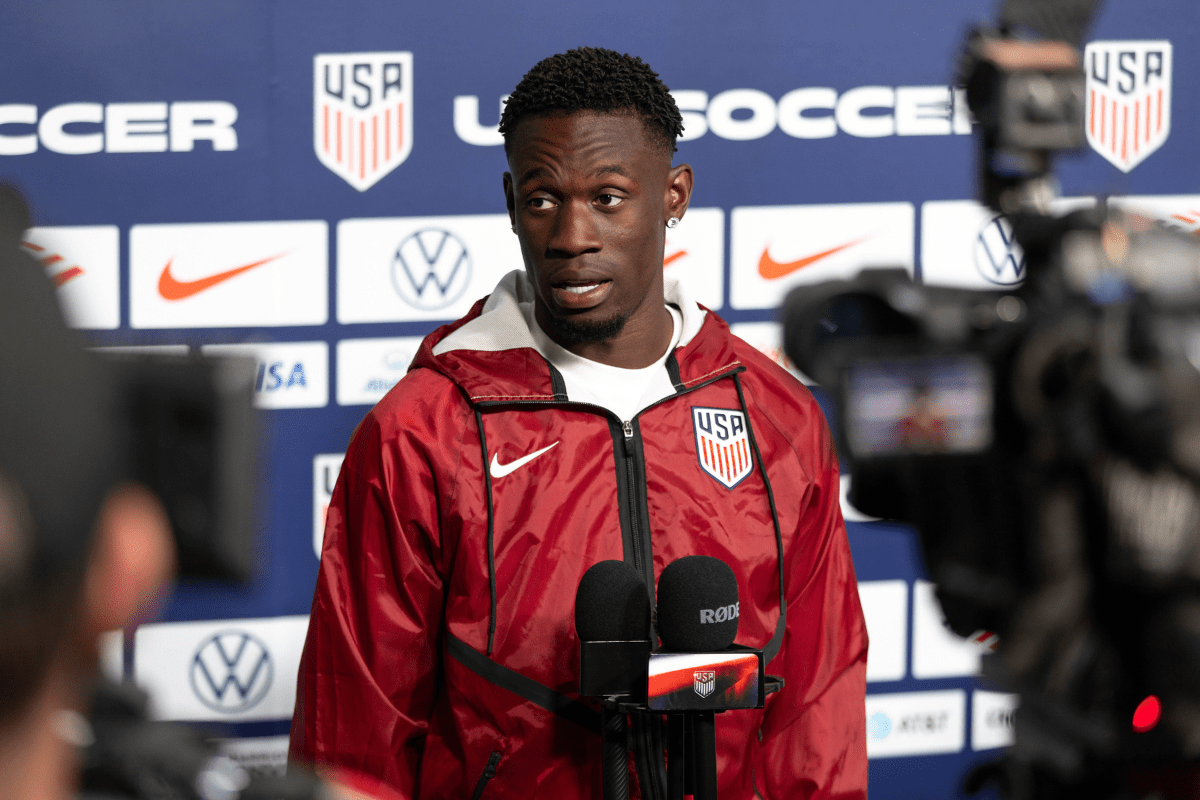
The most controversial off-field story of the 2026 World Cup just reached its climax, and it has nothing to do with a goal. With the Balogun red card overturned by FIFA, and Belgium’s formal appeal now rejected, USMNT striker Folarin Balogun is cleared to play in the Round of 16 in Seattle. The ruling has handed the United States its most dangerous attacker for a knockout showdown, and it has thrown European soccer into open revolt. Here is how a single VAR decision spiraled into a global firestorm.
The saga started in the group stage. Balogun had just put the United States ahead against Bosnia and Herzegovina with his third goal of the tournament, a strike that underlined why he has been one of the most electric players of this World Cup. Then, in the 64th minute, Brazilian referee Raphael Claus was sent to the pitchside monitor by VAR. After the review, Claus produced a red card for Balogun dragging his cleats down the back of defender Tarik Muharemovic’s leg and onto his foot.
Balogun looked stunned. His teammates were furious. The United States, down to 10 men, dug in and won 2-0 anyway to book a Round of 16 date with Belgium. But under FIFA’s rules, a straight red card carries an automatic one-game suspension, and that math was brutal for American fans. The tournament’s hottest striker was set to watch the biggest game of the summer from the stands. Stadium Rant even previewed the matchup around that reality in our USMNT vs. Belgium World Cup preview, when Balogun’s absence looked locked in.
Then everything changed. FIFA’s Disciplinary Committee reversed course and suspended Balogun’s one-game ban, attaching a probationary period of one year, which made him available for the Belgium match roughly a day before kickoff. Reversals of automatic red card bans almost never happen at a World Cup, and the timing set off alarm bells across the sport.
The reason it happened is what turned a soccer story into a political one. President Donald Trump confirmed to reporters that he personally called FIFA President Gianni Infantino to ask for a review of the card and the resulting suspension. “I asked for a review because I didn’t think it was a foul,” Trump said. Whatever your read on the decision, a sitting U.S. president intervening in a FIFA disciplinary matter during a World Cup on home soil is genuinely without precedent.
Belgium was not going to let it slide. The Royal Belgian Football Association filed a challenge to the reversal, arguing the process that cleared Balogun was improper and that he should serve the ban like any other player. On Monday, FIFA shut the door.
FIFA’s Appeal Committee ruled that the Belgian federation’s challenge was “rendered inadmissible on the grounds that the RBFA is not a party to the proceedings and, as such, has no standing to appeal the decision.” In plain English, FIFA decided Belgium did not even have the right to contest a suspension that was not theirs to begin with. The appeal was dead on procedure, not merits, which only deepened the sense among critics that the outcome was decided before the paperwork was filed. With the Balogun red card overturned and the appeal rejected, the striker is free to face Belgium.
European soccer’s governing body did not hold back. UEFA blasted the reversal as “unprecedented, incomprehensible and unjustifiable,” and said FIFA had “crossed a red line.” You can read the full scope of the backlash in ESPN’s report on UEFA’s response, and it is scathing.
The core worry from FIFA’s critics is not really about one striker or one red card. It is about the integrity of the competition. If a suspension can be wiped away after a phone call from a head of state, opponents like Belgium argue, then the rulebook does not apply equally to everyone. FIFA and Infantino have defended the review as a legitimate use of the disciplinary process, and Trump has stood firmly behind his call, but the optics have handed the tournament its ugliest controversy. Belgium, understandably, feels it is walking into a knockout game where the deck was reshuffled at the last minute.
Strip away the politics for a moment, and the on-field impact is enormous. Balogun has been the engine of this American attack, and getting him back for a knockout game is the difference between a team that can genuinely threaten Belgium and one that would have been leaning on backups against a talented European side. He gives the United States a proven finisher, a focal point to build around, and the kind of confidence that a deep run requires.
The flip side is the pressure and the noise. Balogun now takes the field as the most scrutinized man at the World Cup, with every touch dissected and a hostile European soccer establishment watching for him to justify the firestorm. Belgium will be motivated beyond belief, treating this as a grudge match with a chip on its shoulder. That is a heavy load for any player to carry into a win-or-go-home fixture.
The Balogun red card overturned saga will be argued about long after this World Cup ends. Supporters see a bad call getting corrected. Critics see a dangerous precedent and a governing body bending to political pressure. Both things can feel true at once, and that tension is exactly why this story has swallowed the tournament. For now, the ruling stands, Belgium’s appeal is finished, and Folarin Balogun is cleared to play. The only verdict left is the one that gets decided on the field in Seattle, and after everything it took to get him there, the whole soccer world will be watching.
If you love sports, download Stadium Rant from the Apple App Store and join one of the fastest-growing social sports communities. Be sure to follow us on socials too — you can find all our profiles on our Linktree.
