
Looking for the best 2026 Dynasty Fantasy Football TE Rankings? You’ve come to the right place. Whether you’re building a dynasty startup, preparing for your rookie draft, or deciding which tight ends are worth trading for, these rankings are built to help you stay one step ahead of your league. Every player has been evaluated based on projected target share, offensive role, quarterback play, touchdown upside, and long-term dynasty value—not simply last year’s fantasy finish.
If you want to check out more of my rankings, my RB and WR articles are available now!
The first thing I look at is target share and route participation. If a tight end isn’t consistently running routes, he can’t score fantasy points from the sideline. From there, I evaluate yards per route run and targets per route run, two of the strongest indicators of a player’s efficiency and ability to earn opportunities rather than simply benefiting from volume.
Touchdowns separate the elite from the average, so I put a heavy emphasis on red-zone targets and end-zone targets. Those high-value opportunities often determine who finishes as a weekly TE1. I also value versatility, looking at how often a player is deployed from the slot versus inline because the tight ends who move around the formation tend to create more mismatches and command more consistent targets.
Finally, I weigh age, quarterback stability, offensive philosophy, and long-term dynasty outlook before making my final adjustments. Talent absolutely matters, but in dynasty fantasy football, I want tight ends who have the opportunity to become offensive centerpieces—not just athletic prospects with theoretical upside.
These are the tight ends I want to build around. Each has the combination of 20%+ target-share potential, 85%+ route participation, and legitimate double-digit TD upside to create a weekly positional advantage. These are cornerstone dynasty assets, and I’m not moving them without a massive return.
| Target Share % | Targets | Catch % | Receptions | Yards per Reception | Receiving Yards | Receiving TDs |
| 28.0% | 151 | 74% | 112 | 10.6 | 1184 | 10.0 |
Brock Bowers is the easiest TE1 decision I’ve made in dynasty. The Raiders finally have stability at quarterback and a much better offensive system, but the biggest reason he’s my top-ranked tight end is opportunity. Las Vegas still lacks a true alpha wide receiver, leaving Bowers as the clear focal point of the passing attack. Better quarterback play should create more efficient scoring drives without taking meaningful volume away from him.
The numbers already back up that projection. In 2025, Bowers posted a 23.6% target share (2nd among tight ends), ran a route on 89.8% of passing plays (5th), commanded a 40.5% red-zone target share, and finished 5th in first-read targets despite missing time with a knee injury. He also ranked 5th among qualifying tight ends with an 82.2 PFF receiving grade, showing his production wasn’t simply volume-driven.
At just 23 years old, Bowers checks every box I look for in a dynasty cornerstone. Elite talent, elite volume, an improving offense, and very little competition for targets. That’s why he’s my TE1 and one of the safest dynasty assets in fantasy football. the
| Target Share % | Targets | Catch % | Receptions | Yards per Reception | Receiving Yards | Receiving TDs |
| 27.0% | 156 | 72% | 112 | 10.0 | 1124 | 7.0 |
If Jacoby Brissett starts all 17 games, Trey McBride has a legitimate shot to finish as the overall TE1. Brissett peppered McBride with targets throughout 2025, and Arizona’s offense completely revolved around him. My only hesitation is quarterback uncertainty.
If the Cardinals decide to make a change during the season, there’s no guarantee the next quarterback feeds McBride with the same consistency. That’s the only thing keeping him behind Brock Bowers on my board. The metrics are exactly what you want from an elite dynasty tight end.
McBride led all tight ends with 163 targets, 126 receptions, 1,239 receiving yards, and 695 routes run in 2025 while also finishing 1st in target share (25.4%), 1st in red-zone targets (32), and 1st in first-read share (33.8%). Simply put, no tight end was asked to do more for his offense than Trey McBride.
I love the player and the talent. I’m just slightly more confident in Brock Bowers’ long-term offensive environment. If Brissett keeps this job and Arizona continues funneling the offense through McBride, don’t be surprised if he’s the one sitting at TE1 when we do these rankings again next year.
| Target Share % | Targets | Catch % | Receptions | Yards per Reception | Receiving Yards | Receiving TDs |
| 20.0% | 100 | 73% | 73 | 13.7 | 1003 | 11.0 |
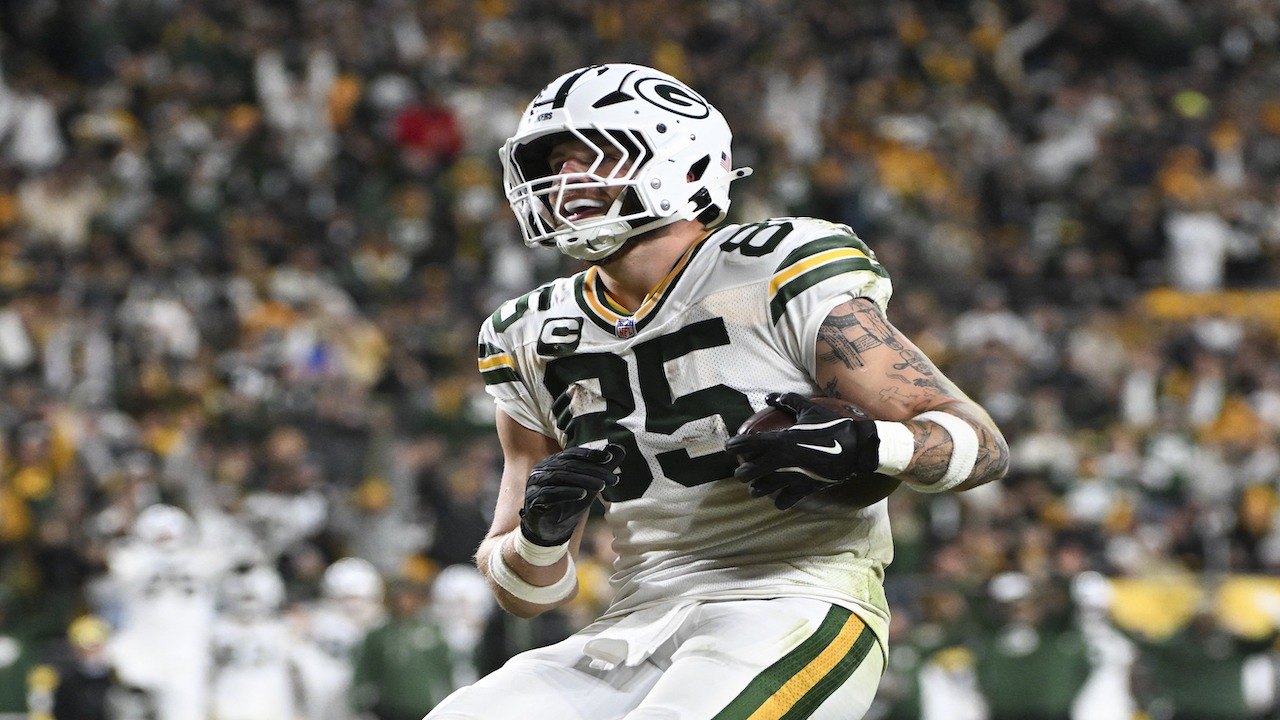
I might be the highest fantasy manager on Tucker Kraft, and I’m okay with that. When healthy, I don’t think he should come off the field. He’s one of the rare tight ends who can block well enough to play every snap while also being explosive enough to create chunk plays like a wide receiver.
Matt LaFleur has continued to expand his role every season, and I think 2026 is the year Green Bay finally treats him like one of the focal points of the offense. The underlying metrics scream breakout.
Despite playing just eight games in 2025, Kraft averaged 15.3 yards per reception, produced 10.8 yards after the catch per reception, caught 80% of his targets, and posted a perfect 157.2 passer rating when targeted. He also generated 489 receiving yards and six touchdowns on just 40 targets, showing just how efficient he can be when the ball comes his way.
There are still mouths to feed in Green Bay, but I think Kraft’s versatility separates him from the rest of the group. He doesn’t need 150 targets to become an elite fantasy tight end. If he stays healthy for 17 games, I believe we’re talking about one of the biggest breakouts in fantasy football, which is why he’s my TE3 heading into the season.
| Target Share % | Targets | Catch % | Receptions | Yards per Reception | Receiving Yards | Receiving TDs |
| 21.0% | 121 | 66% | 80 | 11.8 | 940 | 8.0 |
I absolutely love this situation for Colston Loveland.
Ben Johnson has already shown he knows how to feature an elite receiving tight end, and now he gets one of the most complete young players at the position catching passes from Caleb Williams. Loveland can win at every level of the field. He’s too athletic for linebackers, too big for defensive backs, and already looks like one of Caleb’s favorite targets. I think this connection is only scratching the surface. The Bears’ heavy use of multiple-tight-end personnel under Johnson should also keep Loveland on the field nearly every snap.
The rookie numbers were extremely encouraging. Loveland earned an 83.3 PFF receiving grade (3rd among qualifying tight ends), averaged 12.3 yards per reception, recorded 713 receiving yards despite missing time, and posted a 123.1 passer rating when targeted with just one drop all season. His 9.5-yard average depth of target also shows Chicago isn’t using him as a check-down option—they’re asking him to make impact plays downfield.
I wouldn’t be shocked if Loveland finishes higher than TE4 this season. The combination of Ben Johnson’s scheme, Caleb Williams’ continued development, and Loveland’s ability to create mismatches gives him legitimate overall TE1 upside for years to come.
| Target Share % | Targets | Catch % | Receptions | Yards per Reception | Receiving Yards | Receiving TDs |
| 25.0% | 128 | 66% | 85 | 12.1 | 1024 | 6.0 |
Tyler Warren has everything I look for in a future elite dynasty tight end. Indianapolis has already made him a focal point of the passing game, and his ability to line up all over the formation makes him a nightmare matchup. If his target share continues to grow, I think he’ll be in the conversation with the top four tight ends sooner rather than later.
The metrics already support that jump. Warren posted an 87.3 PFF receiving grade, averaged 2.41 yards per route run (3rd among qualifying tight ends), earned a 22.8% target rate per route run, caught 76.5% of his targets, and forced 14 missed tackles after the catch during his rookie season. He also saw 17 red-zone targets, showing the Colts already trust him in scoring situations. (PFF, Fantasy Points Data)
Warren already looks like one of the league’s next great tight ends. If the Colts continue building the offense around him, I think TE5 could end up looking conservative by this time next year.
These tight ends have everything they need to finish as elite fantasy options, but each comes with at least one question keeping them out of the untouchable tier. Whether it’s a smaller sample size, target competition, or proving they can sustain high-end production, they’re just one step away from joining the very top of the dynasty landscape.
| Target Share % | Targets | Catch % | Receptions | Yards per Reception | Receiving Yards | Receiving TDs |
| 23.0% | 126 | 65% | 82 | 11.1 | 906 | 5.0 |
Harold Fannin immediately proved he belongs, finishing his rookie season with 107 targets, 72 receptions, 731 yards, and six touchdowns. More importantly, he showed an elite ability to earn opportunities, ranking 5th among TEs in target share (19.4%), 4th in first-read share (22.3%), and 12th in yards per route run (1.81).
Now Cleveland brings in Todd Monken and adds first-round WR KC Concepcion and second-round WR Denzel Boston. That’s more competition for targets, but it’s also a much more dangerous collection of weapons around Fannin.
I’m betting Fannin remains one of the focal points of the offense while becoming a more efficient player in Year 2. Monken’s history of utilizing tight ends makes the fit even more interesting. The target ceiling may be slightly lower because of the added weapons, but the overall offensive ceiling should be much higher. That’s enough for me to rank Fannin as my TE6 comfortably.
Are we finally allowed to trust Kyle Pitts again? I’m getting dangerously close.
Pitts quietly put together a legitimate bounce-back season in 2025 with 88 catches, 928 yards, and five TDs. More importantly, his 22.7% target share ranked 4th among TEs, his 90.4% route participation ranked 4th, and he finished 2nd at the position in air yards.
Now Atlanta brings in Kevin Stefanski and Tommy Rees, a coaching combination that leaned heavily on tight ends in Cleveland. Stefanski has already talked about Pitts’ versatility, including using him inline, from the slot, outside, and even from the backfield.
There are still reasons I’m stopping at TE7. Drake London and Bijan Robinson aren’t going anywhere, and the Falcons still haven’t officially settled the Michael Penix Jr./Tua Tagovailoa QB competition. But Pitts finally looks like he’s being put in an offense capable of maximizing what made him such a ridiculous prospect in the first place. At 25, I’m willing to buy back in.
| Target Share % | Targets | Catch % | Receptions | Yards per Reception | Receiving Yards | Receiving TDs |
| 22.0% | 118 | 68% | 80 | 11.6 | 933 | 6.0 |
Isaiah Likely is finally getting the opportunity dynasty managers have been waiting for.
After four years behind Mark Andrews, Likely followed John Harbaugh to the Giants, where New York made him one of the NFL’s highest-paid tight ends. That investment matters. He’s going from a complementary role to an offense that should give him every opportunity to establish himself as a featured weapon alongside Jaxson Dart.
The projection requires a significant increase in volume. Likely ran a route on just 57.8% of Baltimore’s pass plays in 2025 with an 11.2% target share, but we’ve seen the playmaking ability when he’s involved. In 2024, he produced 477 yards and six TDs on only 58 targets, averaging 1.54 yards per route run.
That’s the bet at TE8: what happens when Likely finally gets starter-level routes? There’s more projection involved here than with the names above him. Still, the combination of talent, investment, and a wide-open opportunity makes him one of my favorite breakout bets at the position.
This is where I’m going to lose some people. LaPorta is lower than consensus, while Kelce and Andrews are much higher than most dynasty rankings. I’m prioritizing what these guys can still do for your lineup over simply chasing age. Every TE in this tier has 100+ target potential or legitimate double-digit TD upside, but age, injuries, role, or target competition keeps them outside my top eight.
| Target Share % | Targets | Catch % | Receptions | Yards per Reception | Receiving Yards | Receiving TDs |
| 19.0% | 108 | 74% | 80 | 11.3 | 904 | 8.0 |
I still think Sam LaPorta is an elite NFL tight end. I’m just not convinced he’s going to consistently get the volume needed to be an elite dynasty fantasy tight end.
Before his 2025 back injury, LaPorta was extremely efficient: 2.00 yards per route run (5th among TEs), an 83% route participation rate, and a 20.1% target rate. PFF also gave him an 83.2 receiving grade, 4th among qualified TEs.
The good news is new OC Drew Petzing comes from an Arizona offense that featured Trey McBride heavily and used 12 personnel on 29% of its snaps last season. The problem is Detroit still has Amon-Ra St. Brown, Jameson Williams, and Jahmyr Gibbs competing for touches.
Add the back surgery and his current hip issue, and TE9 is where I’m comfortable. The talent is absolutely better than TE9—the combination of health and target competition is what pushes him down my rankings.
| Target Share % | Targets | Catch % | Receptions | Yards per Reception | Receiving Yards | Receiving TDs |
| 20.0% | 103 | 72% | 74 | 12.0 | 886 | 7.0 |
Yes, Travis Kelce is old. No, I don’t care nearly as much as the consensus does. Even in a down 2025 Chiefs offense, Kelce finished with 108 targets, 76 receptions, and 851 yards, ranking 4th among TEs in receiving yards. He still commanded a 19.7% target share, ran 525 routes, and earned 62 first-read targets.
The bigger question for me is Patrick Mahomes. He’s working back from ACL/LCL surgery, but he’s taken the first-team training-camp reps and is targeting a Week 1 return. If Mahomes is healthy, I’m still betting on the connection we’ve watched dominate fantasy football for years.
Kelce doesn’t need to be the athlete he was five years ago. He needs Andy Reid, Mahomes, routes, and high-value targets. At TE10, I’m willing to take another championship-caliber season while the rest of dynasty worries about his birth certificate.
| Target Share % | Targets | Catch % | Receptions | Yards per Reception | Receiving Yards | Receiving TDs |
| 23.0% | 116 | 69% | 80 | 12.1 | 967 | 8.0 |
Mark Andrews at TE11 is another ranking where I’m choosing production over age.
2025 was ugly: Andrews finished with just 48 catches for 422 yards and five receiving TDs. His usage also fell to a 17.2% target share and 69.4% route participation. But there were still signs that Lamar Jackson trusted him where it matters most—Andrews had 14 red-zone targets and a 26.4% red-zone target share.
That’s the bet here. I’m projecting his route participation and target share to rebound while his red-zone role remains intact. We’re only one year removed from 11 receiving TDs in 2024, and Andrews has scored 56 receiving touchdowns over his career.
He’s 31, so I’m not pretending there’s huge long-term value here. But if you’re trying to win a dynasty championship in 2026, I’ll happily take another shot on the Lamar-Andrews connection at TE11.
| Target Share % | Targets | Catch % | Receptions | Yards per Reception | Receiving Yards | Receiving TDs |
| 17.0% | 92 | 74% | 68 | 8.2 | 556 | 7.0 |
Jake Ferguson isn’t an elite talent at the position, but his role with Dak Prescott keeps him firmly in my top 12.
Ferguson finished 2025 with 102 targets, 82 receptions, 600 yards, and eight TDs, but the efficiency wasn’t great at just 1.27 yards per route run. Where he makes his money is near the goal line. Ferguson saw 24 red-zone targets, 2nd among TEs, and turned that opportunity into seven red-zone TDs.
The problem is his ceiling. Ferguson had only a 16.8% target share and 15.8% first-read share, with CeeDee Lamb and George Pickens clearly ahead of him in the passing-game hierarchy.
I’m not expecting Ferguson to become a 1,000-yard tight end suddenly. I’m betting on Dak, consistent routes, and one of the better red-zone roles at the position. Give me another 100-target season with eight-to-nine touchdowns, and Ferguson can continue giving you reliable TE1 production without ever becoming a true difference-maker.
This tier is filled with tight ends I still believe have another level in them. The talent and opportunity are there, but the consistent production hasn’t been. Each has a realistic path to becoming a reliable dynasty TE1, but 2026 feels like the year they need to prove it before I’m willing to invest any higher.
| Target Share % | Targets | Catch % | Receptions | Yards per Reception | Receiving Yards | Receiving TDs |
| 16.0% | 91 | 71% | 65 | 10.4 | 675 | 5.0 |
Maybe all Chig Okonkwo needed was to get out of Tennessee.
Okonkwo signed a three-year deal with Washington, where he enters 2026 as the Commanders’ primary receiving tight end. The team has specifically discussed using his athleticism more in space and downfield, while John Bates handles more of the blocking. Even better, reports throughout the offseason have indicated that Okonkwo is quickly developing chemistry with Jayden Daniels.
The underlying numbers explain why I’m willing to give him another chance. In 2025, Chig caught 56 passes for 560 yards and six TDs on 79 targets, while being targeted on 20.7% of his routes despite just a 60.9% route participation rate.
That’s the upside here. Give an explosive tight end more routes, fewer blocking responsibilities, and a massive quarterback upgrade, and we may finally get the breakout we’ve been waiting for. There’s more competition after Washington added weapons, so I’m keeping expectations reasonable, but TE13 feels like the perfect spot to bet on the new situation.
| Target Share % | Targets | Catch % | Receptions | Yards per Reception | Receiving Yards | Receiving TDs |
| 13.2% | 72 | 74% | 54 | 13.2 | 707 | 7.0 |
Dalton Kincaid might be the most frustrating tight end in these rankings. The talent and efficiency scream top-five upside, but Buffalo still hasn’t given him the workload to match.
Kincaid averaged 2.70 yards per route run and 14.6 yards per reception in 2025, while his 25.9% target rate ranked 1st among TEs. The problem was a 51.1% route participation rate and another injury-shortened season. (playerprofiler.com)
That’s why he’s TE14. Playing with Josh Allen gives him a massive ceiling, but I need Buffalo to actually put him on the field consistently. If his route participation finally climbs toward 70%, this ranking could look way too low. Until then, Kincaid gets one more chance.
| Target Share % | Targets | Catch % | Receptions | Yards per Reception | Receiving Yards | Receiving TDs |
| 15.0% | 83 | 66% | 55 | 11.6 | 634 | 4.0 |
Kenyon Sadiq is one of the most exciting young tight ends in dynasty, but I’m pumping the brakes on expecting an immediate breakout.
The Jets invested the 16th overall pick in Sadiq, and it’s easy to understand why. He ran a ridiculous 4.39 forty, the fastest ever recorded by a TE at the Combine, after finishing his final Oregon season with 51 catches, 560 yards, and eight TDs.
The problem is opportunity. Sadiq missed most of the offseason and training camp recovering from hernia surgery, and he still has Mason Taylor competing for TE snaps alongside Garrett Wilson and fellow first-round rookie Omar Cooper for targets.
Long-term, I love the upside. Frank Reich already has plans to move Sadiq around the formation and utilize more 12-personnel, which is exactly how you maximize this type of athlete. I’m just not projecting him to walk into an elite target share immediately. TE15 is more about what Sadiq can become than what I expect him to be from Day 1.
| Target Share % | Targets | Catch % | Receptions | Yards per Reception | Receiving Yards | Receiving TDs |
| 15% | 78 | 75% | 59 | 9.3 | 546 | 5.0 |
AJ Barner isn’t the flashy name in this tier, but I think there’s more here than dynasty managers realize.
Barner took a legitimate step forward in 2025, finishing with 52 catches, 519 yards and six TDs on 68 targets. More importantly, he was already on the field consistently with a 78.8% snap share and 78.3% route participation rate, while seeing 13 red-zone targets.
Now new OC Brian Fleury appears ready to keep tight ends heavily involved. Seattle has maintained its 12-personnel concepts while expanding the route trees and movement for Barner and Elijah Arroyo throughout camp.
The concern is target competition. Jaxon Smith-Njigba, Cooper Kupp, and Arroyo are all going to demand opportunities. I’m not projecting Barner to become an elite target earner suddenly, but another jump in volume combined with his red-zone role makes him an interesting TE16 with room to climb.
Brenton Strange is my favorite bet to make a significant jump up the dynasty TE rankings by this time next year.
The breakout already started in 2025. Strange finished with 46 receptions for 540 yards in only 12 games, improving from 10.3 to 11.7 yards per reception from the year before. (pro-football-reference.com) The underlying usage was encouraging too: 20.1% targets per route run, 1.69 yards per route run, and a 76.7% catch rate. (sumersports.com)
Now I’m betting on another step forward in Year 2 of Liam Coen’s offense with Trevor Lawrence. Strange has continued making plays throughout camp, including emerging as one of Lawrence’s primary targets when Jacksonville’s receiving corps has been shorthanded.
He’s not in my Top 16 yet because I need to see the target share climb from 15.8%. But if Strange pushes toward 18–20% while maintaining his efficiency, we’re probably talking about him as a Top-12 dynasty TE entering 2027.
George Kittle is the perfect buy-low for a contender because dynasty managers are scared of exactly what they should be scared of: age and the Achilles injury. He turns 33 this season and is still working his way back from the torn Achilles he suffered in January, although he returned to practice in late August.
But when Kittle was on the field in 2025, he was still elite. He earned a 91.2 PFF receiving grade, 1st among TEs, while commanding a 22.8% target share and being targeted on 24.6% of his routes. He finished with 57 catches, 628 yards, and seven TDs in only 11 games.
I’m not buying Kittle expecting five more elite seasons. I’m buying because his injury and age have crushed his dynasty price while his ability hasn’t disappeared. If you’re competing in 2026 and can absorb the risk, Kittle is exactly the type of aging asset I’m willing to buy at a discount.
Juwan Johnson feels like one of those late-round tight ends everyone ignores because the name isn’t exciting enough.
He quietly had a career year in 2025 with 77 receptions for 889 yards, while seeing 102 targets and establishing himself as a legitimate part of the Saints’ passing game.
The situation looks even better early in 2026. First-round WR Jordyn Tyson is expected to miss roughly two months with a hamstring injury. He has been placed on IR, leaving Chris Olave as the clear No. 1 receiver and creating additional opportunities underneath.
Johnson already has chemistry with Tyler Shough, and Kellen Moore showed last season that he’s willing to feature him. I’m not expecting another massive breakout—I just need 2025 to not be a fluke. At his price, that’s exactly the type of late-round TE bet I want.
Every dynasty ranking is a projection, not a prediction. If your rankings look exactly like everyone else’s, you’re not creating an edge—you’re simply following the market. That’s why you’ll notice several tight ends on my board ranked much differently than the current FantasyPros Expert Consensus.
I’m considerably higher on veterans like Travis Kelce and Mark Andrews because I still believe elite production matters more than age when you’re trying to win championships. Dynasty managers often move on from productive players a year too early, and I’d rather squeeze out one more elite season than chase upside that may never materialize.
On the other side, I’m lower than consensus on players like Kenyon Sadiq and Sam LaPorta. That isn’t because I dislike the talent. I simply need to see a more consistent path to elite target volume before valuing them as cornerstone dynasty assets.
You don’t have to agree with every ranking—that’s the point. These aren’t consensus rankings with a few small tweaks. They’re my projections of where these players will be valued one year from now, not where the market values them today. That’s where dynasty leagues are won.
Tight end is finally becoming a position worth building around in dynasty. Brock Bowers and Trey McBride have already established the standard, but the amount of young talent behind them is what makes these rankings so interesting. Even consensus rankings have five tight ends inside the overall dynasty Top 50 right now.
My biggest takeaway: don’t blindly chase youth at tight end. I’m willing to bet on Tucker Kraft’s breakout, Isaiah Likely’s opportunity and Harold Fannin’s development, but I’m also perfectly comfortable riding Travis Kelce, Mark Andrews or George Kittle if they can still help me win championships.
The position changes quickly. Routes, target share, quarterback play and red-zone opportunities can turn a TE15 into a TE5 in one season. Find the players your league is undervaluing, take your shots, and don’t be afraid to disagree with consensus. That’s the whole point. Rant About It.
If you love sports, download Stadium Rant from the Apple App Store and join one of the fastest-growing social sports communities. Be sure to follow us on socials too — you can find all our profiles on our Linktree.
