

Xabi Alonso‘s Chelsea suffered a 3-0 defeat to Brentford, and when Alonso was asked directly about Levi Colwill’s post-match admission that Chelsea had been “bullied” at set pieces, he broadened the diagnosis considerably rather than simply agreeing.
The frustrating part for Chelsea was that the first half had been competitive enough to suggest the game was there to be won, before Chelsea collapsed almost entirely after the break. Alonso’s press conference explained exactly why.

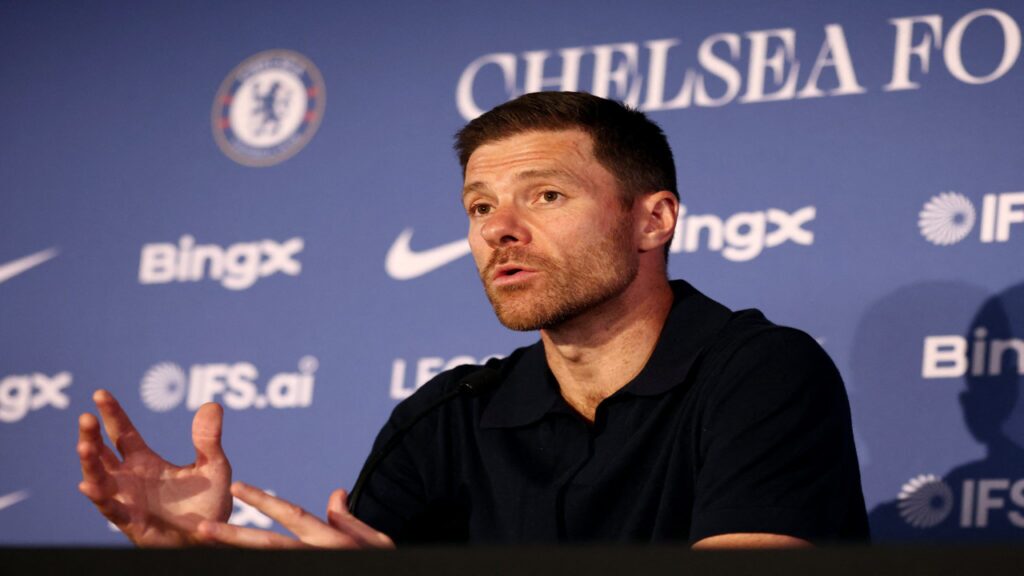
Asked to respond to Colwill’s comments, Alonso didn’t limit the problem to set pieces. “It was not just set-pieces [where we weren’t good enough],” he said.
“It was also in defensive duels, in the build-up, in controlling games. We conceded the first goal and then we lost shape and conceded on a transition.
To be able to understand the game and know what it takes to compete until the end. It’s a process,” according to TalkChelsea’s report on the press conference.
He was equally direct about the shift between halves: “We dropped our consistency, our competitive mentality needed in the second-half,” and added, “The small details can be decisive,” as reported by Legit.ng.
That’s a notably more expansive admission than Colwill’s. Where the defender pointed specifically at set-piece defending, Alonso identified a chain reaction.
The sequence suggests how quickly Chelsea’s problems compounded: the set-piece failure was followed by a loss of shape and then a second goal on the counter.
The goals themselves back up that reading. Mikkel Damsgaard’s corner in the 61st minute found two unmarked Brentford players, with Jaidon Anthony finishing from close range.
Within 22 minutes, Chelsea had lost possession trying to push for an equalizer, and Brentford broke quickly through Kevin Schade; Emiliano Martínez saved the initial effort, but Igor Thiago converted the rebound.
Fabio Carvalho added a third in stoppage time. Three different failure modes — a set piece, a transition, and a stoppage-time capitulation — inside a 30-minute stretch is exactly the pattern Alonso’s four-part answer was describing.
This defeat didn’t happen in isolation. Chelsea have struggled to keep clean sheets for most of this season, and Saturday’s collapse extends a pattern that’s already been the subject of Alonso’s own public frustration once before this month.
After a 2-2 draw with Hull City prompted him to admit his side couldn’t sustain a strong performance for more than 15 or 20 minutes at a time.
The specifics change — set pieces against Brentford, game management against Hull — but the underlying theme doesn’t: a Chelsea team capable of playing well in bursts, without yet being able to string those bursts together into a full 90-minute performance.
Alonso’s own phrase for it, “it’s a process,” has now been used to explain more than one defensive breakdown this season.
Some of the collapse is explained by who wasn’t on the pitch. Reece James’ hamstring injury was a late fitness withdrawal, with Alonso detailing the timeline:
“He’s had a little injury in his hamstring. He tried and we waited until this morning. He tried to make it but he couldn’t. Now we have enough time to prepare for the next one.
He was just short of recovering,” Alonso told reporters, per LiveScore. James is central to Chelsea’s tactical setup, both in possession and as part of the defensive structure, and his absence forced a reshuffle at short notice rather than a planned rotation.
João Pedro’s absence through injury compounded the problem in attack. Alonso explained the reasoning behind Danny Welbeck’s inclusion in his place:
“You have another front three with Danny and Pedro. I think we wanted to have a good enough squad to deal with injury, in this case Joao. Danny has connections and scored here last season — we are prepared for tonight,” per the same report.
João Pedro has since withdrawn from Brazil’s squad for their upcoming international friendlies because of the injury, according to Reuters.
Losing two players as central to the team’s setup as James and Pedro in the same week goes some way toward explaining why Alonso’s side looked less cohesive than it had in recent matches, even before considering how it eventually lost the game.
The frustrating part of Alonso’s explanation is how good Chelsea actually looked before the break
Jordan Henderson made his Chelsea debut against his former club, and his composure and control during the opening 45 minutes as the standout contribution of that half.
Alongside Valentín Barco in a reshuffled midfield, Henderson gave Chelsea a level of control they’d been missing in recent weeks, and the team went in level at half-time having competed well.
That makes Alonso’s own framing — “we lost shape” rather than “we were always second best” — the more accurate read on what actually happened than a simple story of Brentford being the better team throughout.
Alonso’s response to Colwill was more revealing than a simple confirmation would have been. By naming defensive duels, build-up play and game control alongside set pieces, he described a team that lost its structure everywhere at once rather than one problem area.
Alonso’s description of the situation as “a process” suggests he believes the problems can be addressed through work during the international break.
With a three-week break now underway, Chelsea have time to do exactly that. Whether Henderson’s calming first-half influence and a fully fit James and Pedro are enough to prevent a repeat is the question Chelsea’s next match will actually answer.
