
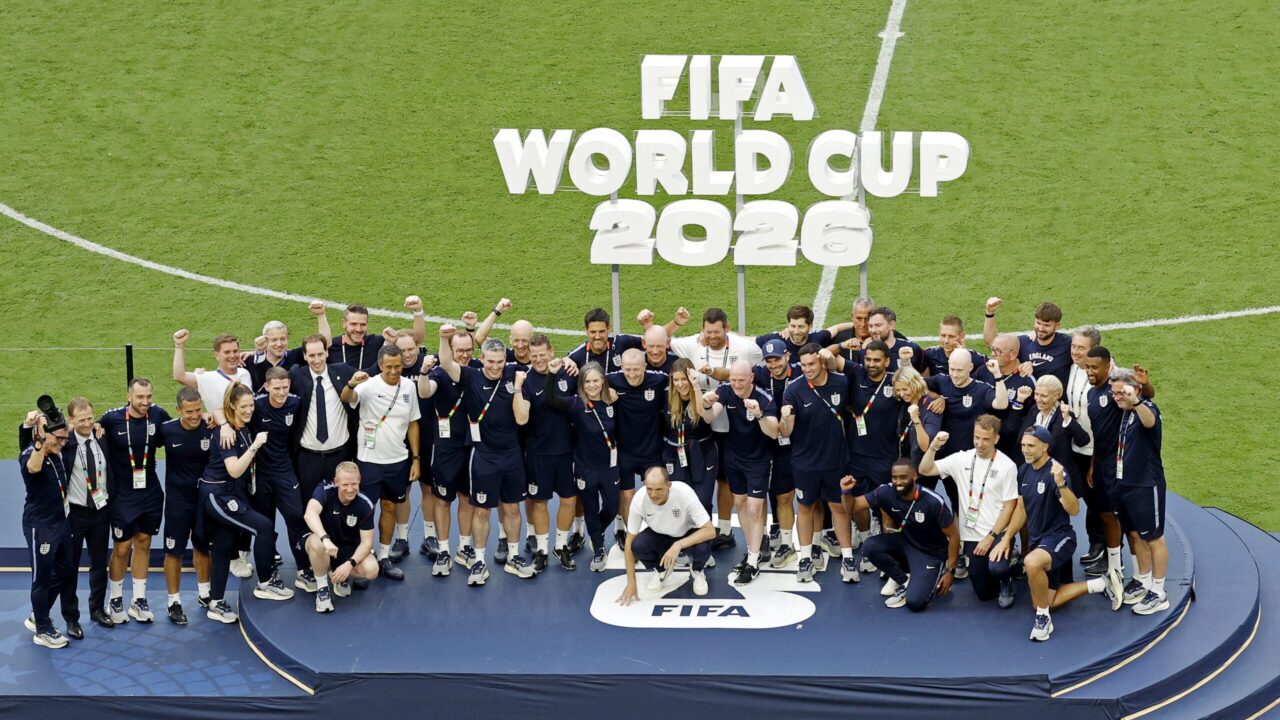
Three days after Wayne Rooney, Alan Shearer and Zlatan Ibrahimović tore into Thomas Tuchel’s tactics in the Argentina defeat, the England manager sent out a starting XI for the third-place playoff against France that looked almost nothing like the one that lost the semifinal.
The result was a 6-4 win that produced the most goals in a World Cup game since 1982. Here’s exactly what changed between the two matches, and what it did and didn’t prove.
The criticism after the Argentina semifinal was specific and consistent. Tuchel sent on a wave of defensive substitutions in the 82nd minute while England led 1-0, and the team sat back, lost possession, and conceded twice in the closing stages.
Pundits across multiple outlets said the same thing in different words: England stopped trying to win the moment they were ahead.
Against Argentina, Thomas Tuchel set up in a 4-2-3-1: Jordan Pickford in goal; Reece James, John Stones, Marc Guéhi, and Djed Spence across the back four;
Declan Rice and Elliot Anderson holding in midfield; Morgan Rogers, Jude Bellingham, and Anthony Gordon in support of Harry Kane, with Rogers playing on the right and providing the cross for Gordon’s opening goal.
Bukayo Saka started on the bench that night. It was a conservative, balanced shape built to control the game.
Against France, Tuchel tore that template up. Kane and Bellingham, England’s two most important attackers, both started on the bench, with Rice captaining the side in Kane’s absence.
In their place, Rice sat as the lone holding midfielder behind Morgan Rogers and Eberechi Eze operating as genuine twin No. 10s, with Saka and Marcus Rashford both sent to attack in behind France’s defense and Ivan Toney leading the line — a front-loaded shape with far more bodies committed forward than defensive security behind them.
| vs. Argentina | vs. France |
|---|---|
| 4-2-3-1, two holding midfielders | Front-loaded shape, one holding midfielder |
| Defensive substitutions at 82′ | Attacking substitutions at 79′ |
| Protected a 1-0 lead | Kept attacking after leading 4-3 |
| Kane started | Kane rested on the bench |
| Bellingham started | Bellingham introduced as an attacking sub |
| Rogers on the right, supporting Kane | Rogers central as a No. 10 alongside Eze |
Rogers and Eze together gave England two players comfortable receiving the ball between the lines rather than out wide, which meant France’s midfield had to choose between stepping up to press them or dropping deeper to protect the space in behind.
Either choice opened space somewhere else for Saka and Rashford to run into. That double-No.-10 setup is the single clearest tactical difference between the two matches.
The lineup mattered less than what happened once the game turned tense — because it turned tense fast. England raced to a 4-0 halftime lead, but Kylian Mbappé pulled two goals back either side of a Bradley Barcola strike, and by the 66th minute it was a one-goal game at 4-3.
That’s close to the exact situation Tuchel faced against Argentina: a narrow lead, time still on the clock and a decision to make.
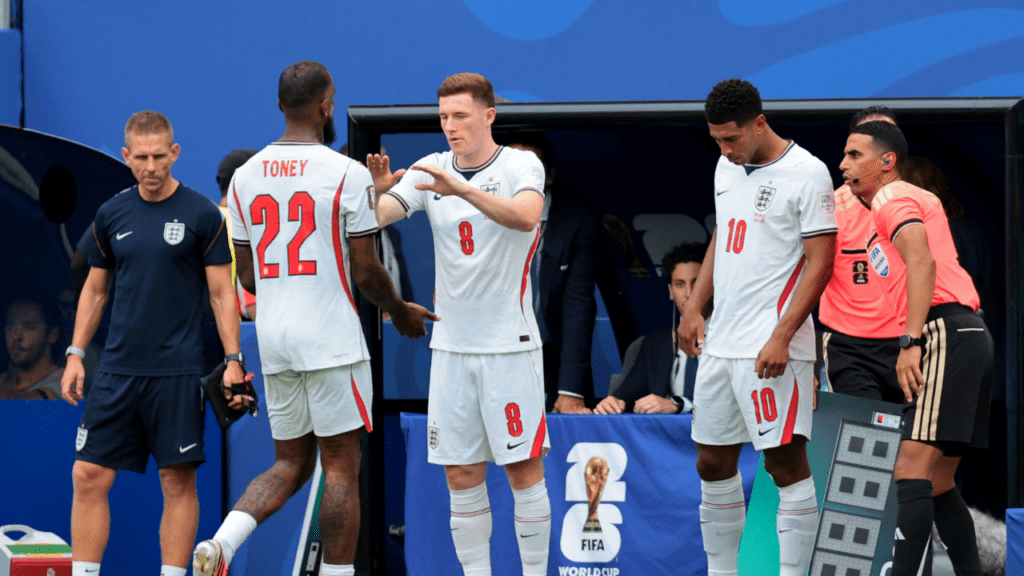
This time, he didn’t retreat. Tuchel brought on Bellingham and midfielder Elliot Anderson in the 79th minute as attacking reinforcements rather than defensive cover, and England kept pushing for more goals instead of protecting what they had.
Bukayo Saka completed his hat trick from the penalty spot in the 87th minute to make it 5-3, and even after France pulled another goal back in stoppage time, Bellingham answered immediately with England’s sixth.
Tuchel didn’t dodge the contrast afterward. Addressing the criticism directly, he said the best response to scrutiny “is to react on the pitch and get the next win. Talking doesn’t get you points.”
He also pointed to what the result meant for the program, calling it “the first medal for 60 years, the best World Cup on foreign soil.”
On the mentality his players showed fighting through a chaotic, exhausting match, he offered “a massive compliment and full respect — the mentality that we showed.”
The win doesn’t erase every question, and some of the strongest conclusions here are interpretation rather than settled fact.
England nearly surrendered a 4-0 halftime lead entirely, and some of the same voices who criticized Tuchel’s caution against Argentina have pointed out that conceding four goals in a single half raises a different kind of game-management concern.
Reading this result as proof Thomas Tuchel “was listening” to his critics is a reasonable interpretation of the lineup and substitutions
It isn’t confirmed by anything he’s said directly, and going from too passive to nearly too open in the space of one match is at least as much evidence of a team still searching for balance as it is evidence of a lesson learned.
Whether an attacking, high-risk approach like this is repeatable is a separate question from whether it worked once.
A back line built to defend a low-stakes third-place game against a rotated France side is not the same test as protecting a lead against a full-strength opponent in a final.
The clearest takeaway isn’t that Tuchel has found a fixed new identity — it’s that he has more than one gear available.
The next competitive window, the Nations League in seven to eight weeks, will show which one he reaches for when there’s something concrete on the line again.
Thomas Tuchel has already confirmed he intends to continue in the role, with his sights set on the Nations League and, beyond that, the 2028 European Championship.
For now, the manager who was booed at kickoff walked away with England’s best World Cup finish since 1966 — and a lineup that, whatever else it did, directly contradicted the specific criticism aimed at him days earlier.
