
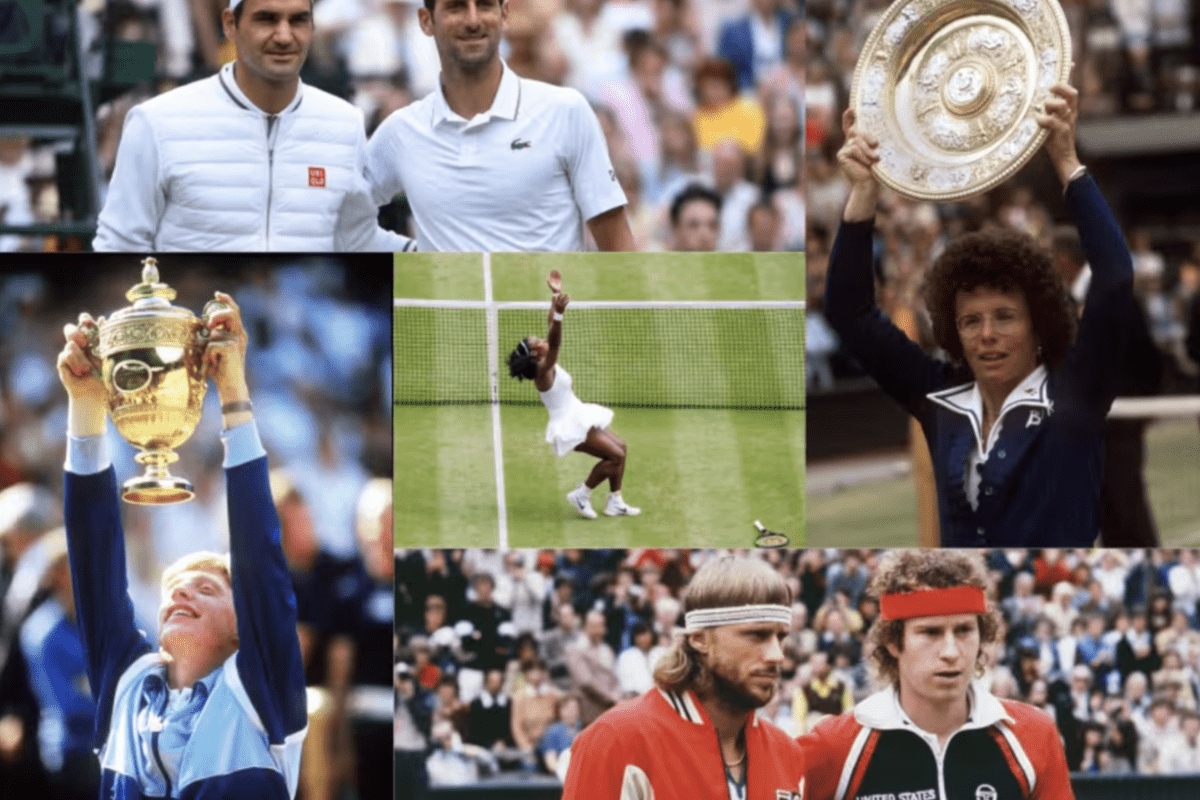
Not all iconic sports tournaments launched with fanfare. Many began as underfunded experiments, regional novelties, or ideas that drew more skepticism than support. The organizations behind today’s most-watched competitions didn’t start with billion-dollar broadcast deals and sold-out stadiums — they started with empty arenas, reluctant investors, and formats that barely held together from one season to the next.
Here’s how six of the world’s most recognizable sporting competitions went from uncertain beginnings to global institutions.
Founded: 1877
It’s hard to imagine Wimbledon as anything other than the pinnacle of professional tennis. The grass courts, the strict dress code, the royal box — it carries an air of tradition that feels like it was always meant to be. But the tournament started as a casual competition among members of the All England Croquet and Lawn Tennis Club, a private club that had nothing resembling a grand vision for what it was creating.
The first edition attracted 22 players. No prize money was on offer. Around 200 spectators watched the final — roughly the size of a school assembly. For years, it was seen as leisurely entertainment for the British upper class, a polite way to spend an afternoon rather than a serious sporting contest.
Women’s singles didn’t appear until 1884, and international recognition came even later. The tournament evolved slowly, shaped as much by social change as by sporting ambition. As tennis grew into a competitive discipline rather than a pastime, Wimbledon grew with it — and eventually ahead of it.
Today it draws millions of viewers worldwide, distributes tens of millions of dollars in prize money each year, and remains the most prestigious title in tennis. The fact that it began with a few dozen amateurs on a private lawn makes that trajectory all the more remarkable.
The rise of these leagues mirrors a broader shift in how people access sport. Where fans once relied entirely on attending games in person or catching fragmented radio coverage, the options today are almost overwhelming. Streaming platforms, sports betting apps, fantasy leagues, and dedicated fan communities have transformed passive viewership into active participation.
For sports fans, platforms like Reveryplay have become part of that ecosystem. If you already have an account, the Reveryplay inloggen process is straightforward — and once inside, the platform offers access to a wide range of sports content and interactive features that reflect just how far fan engagement has come since those 200 spectators gathered to watch a Wimbledon final in 1877.
Founded: 1950
When the idea of a global Grand Prix championship was first floated after World War II, skepticism was reasonable. Motorsport in that era was genuinely dangerous — fatalities were not uncommon, safety standards were minimal, and the infrastructure for a coordinated international series barely existed.
The first Formula 1 World Championship season consisted of seven races, opening at Silverstone in front of an enthusiastic but modest crowd. What existed looked less like a unified series and more like a loose collection of regional races that happened to share a points table. Teams operated on tight budgets, technology was raw, and the concept of Formula 1 as a commercial product was still years away.
Few believed the series would survive long-term. The dangers alone seemed likely to end it. But safety standards gradually improved, manufacturers began investing seriously in the technology, and the racing itself delivered the kind of drama that proved impossible to ignore. By the 1970s and 1980s, Formula 1 had developed genuine global reach. Legendary rivalries — Hunt and Lauda, Senna and Prost — gave the sport personalities that transcended motorsport circles.
Today it operates as a worldwide spectacle with races on nearly every continent, multi-billion dollar commercial agreements, and a fanbase that has grown significantly younger in recent years thanks to broader media coverage and new digital audiences.
Founded: 1930
When FIFA pushed to establish a standalone world football championship, the response from European football associations was largely indifferent — or outright resistant. The dominant view at the time was that the Olympic football tournament already served that purpose adequately. A separate competition felt unnecessary, and the logistics made it worse.
The first World Cup, held in Uruguay in 1930, attracted just 13 teams. Only four were from Europe. The journey by steamship took weeks, the costs were significant, and most European federations simply decided it wasn’t worth the effort. Uruguay, as both host nation and reigning Olympic champion, went on to win the tournament — but the competition itself was widely seen as a regional event rather than a genuine world championship.
By 1934, hosted in Italy, the tournament looked different. European nations showed up, competition intensified, and the event began developing the identity FIFA had always hoped for. The interruption of World War II paused momentum, but when the competition resumed in 1950, it returned with genuine global weight behind it.
Today the FIFA World Cup is the most-watched sporting event on the planet, with the final alone drawing audiences that exceed a billion viewers. It took decades to get there, and it started with a steamship journey that most teams couldn’t be bothered to make.
Founded: 1920
The American Professional Football Association — the organization that would eventually become the NFL — looked nothing like a professional league in its early years. Teams played unequal numbers of games. Rules varied between cities. Franchises appeared and disappeared between seasons. There was no coherent structure, no meaningful media coverage, and attendance at games was negligible. The first NFL game reportedly drew no spectators at all.
For decades, professional football couldn’t compete with baseball for cultural relevance in the United States. Baseball had history, established stars, and a devoted national following. Football, by comparison, was disorganized and looked amateur even when it wasn’t trying to be.
What changed everything wasn’t a rule overhaul or a charismatic commissioner — it was television. As broadcast networks began filling weekend programming with NFL games in the 1950s and 1960s, football found its ideal format. The sport was built for television in ways that baseball wasn’t: defined time slots, continuous action, and a season structure that built toward a single climactic event.
The Super Bowl became that event. What began as a league championship game gradually evolved into the most-watched television broadcast in the United States each year — a cultural moment that extends well beyond sport. Today the NFL generates more revenue than any other sports league in the world, which makes its chaotic, near-invisible beginnings feel almost fictional by comparison.
Founded: 1946 (as the BAA) / 1949 (merged into the NBA)
The road to the NBA’s current status as a global entertainment brand ran through some genuinely difficult early years. The Basketball Association of America launched in 1946 into direct competition with the rival National Basketball League, and neither organization was thriving. Franchises folded regularly. Arenas sat half-empty. Basketball was widely regarded as a college sport — something you followed while your team was in school, then largely forgot about.
The 1949 merger that created the NBA brought the two leagues together but didn’t immediately solve the underlying problems. Attendance remained inconsistent, television interest was limited, and the league struggled to establish a clear identity separate from the college game that still drew larger crowds and more passionate followings in many markets.
What eventually transformed the NBA wasn’t a structural fix — it was people. The arrival of Larry Bird and Magic Johnson in 1979 gave the league a rivalry with genuine national appeal, a storyline that casual fans could follow and care about. Then Michael Jordan arrived, and what had been a growing sport became something else entirely. Jordan didn’t just win championships — he made basketball a global cultural export, carrying the league’s profile to markets that had never paid attention to it before.
The NBA today operates in a different universe from those half-empty arenas of the 1950s. It is a global brand with fans across Asia, Europe, and beyond. None of that looked inevitable from where it started.
Founded: 1917
The NHL spent its formative decades as a tight-knit Canadian competition. When it began expanding into U.S. markets, the reception was lukewarm at best. Hockey had no significant sponsorship presence in American cities, television coverage was minimal, and the sport’s appeal south of the Canadian border was limited to a handful of northeastern markets where the climate at least made the concept feel familiar.
For a long stretch, the NHL was a six-team league operating with modest budgets and limited ambitions. The 1967 expansion — doubling the league overnight from 6 to 12 teams — marked a genuine shift in thinking. The league was committing to growth, and broader television distribution followed. American audiences began to engage more seriously with the sport.
The process was gradual rather than sudden. The NHL never had its equivalent of Jordan or the Super Bowl — a single moment that reframed public perception overnight. Growth came steadily, market by market, as the sport built credibility and coverage in cities far from its Canadian roots.
Every one of these leagues was once an idea that could have quietly disappeared. What separates the ones that survived from the ones that didn’t isn’t always talent or money — sometimes it’s simply the stubbornness to keep going through the years when almost nobody was watching.
If you love sports, download Stadium Rant from the Apple App Store and join one of the fastest-growing social sports communities. Be sure to follow us on socials too — you can find all our profiles on our Linktree.
