
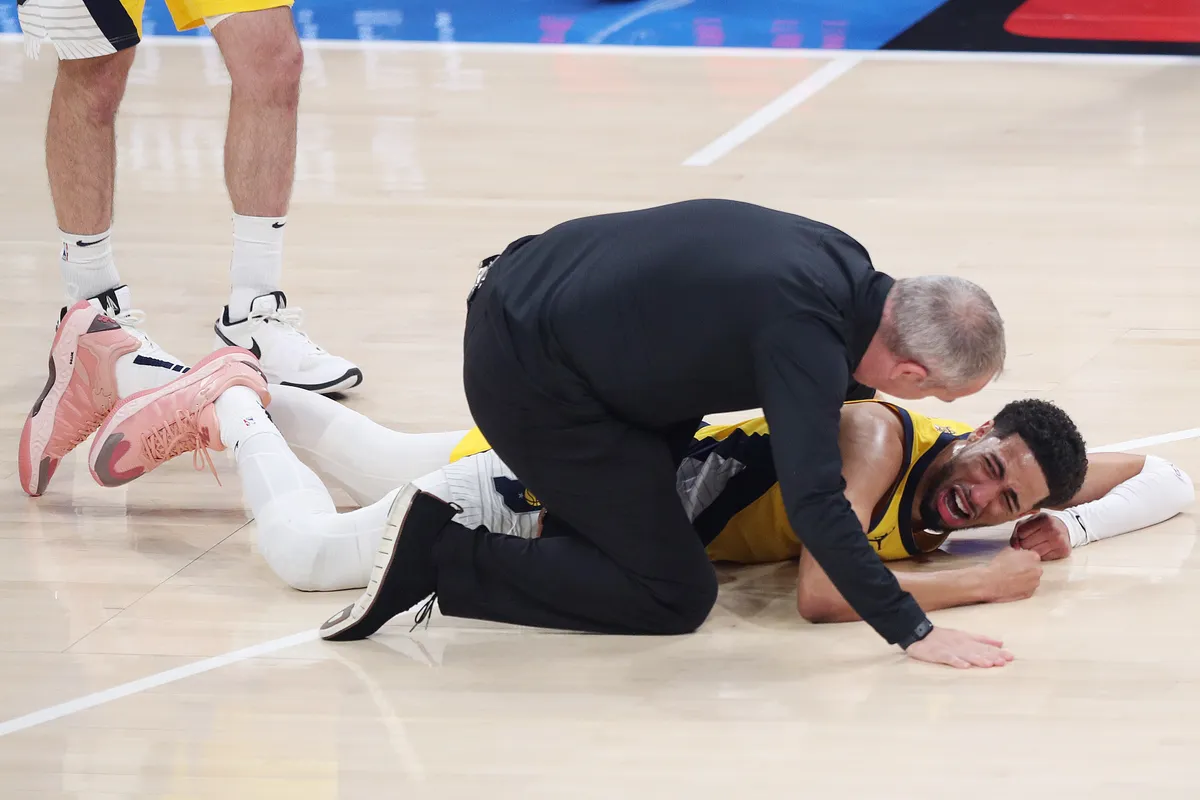
In recent years, the NBA has mishandled its marketing of players’ injuries to fans. Rather than promoting a culture that recognizes toughness and smart decision-making when players manage injuries, the NBA has painted its players as unmotivated in competing. Fans have come to believe that players don’t care enough about the regular season. This is a massive marketing misstep, damaging the image of both the league and its stars.
Much of this problem stems from how the league and media frame “load management.” In today’s NBA, players are dealing with more physical strain than ever before, thanks to increased pace, spacing, and an emphasis on transition play and isolation offense. When a player sits out with a calf strain or another minor injury, it’s not because they’re being soft. They are making a decision to protect themselves, aiming to stay healthy for the playoffs and avoid more serious injuries.
So many dudes play through risks like this in the playoffs. Everyone is pushing themselves to the limit
— matt (@sponhourm) June 23, 2025
If the NBA had a big marketing problem it’s that so many fans don’t believe that https://t.co/1IA2PsjXHL
Even mild injuries can throw off a player’s entire body mechanics, increasing the risk of more serious, career-threatening issues. When a player pushes through pain, other parts of the body often overcompensate, which can cause further injuries that ultimately sideline them for months or even years. This was made painfully clear during the most recent NBA Finals.
In Game 7, Tyrese Haliburton, who had been managing a calf strain, chose to play through the injury, under immense pressure from media, fans, and possibly the league’s own messaging around player availability. Many fans were already criticizing him, accusing him of using the calf strain as an excuse for underperformance earlier in the series. Unfortunately, Haliburton’s decision to play through the injury resulted in a torn Achilles. He will now likely miss the entire 2025–26, a massive blow for both Haliburton’s career and the Indiana Pacers.
Even more alarming is the fact that Haliburton’s injury is not an isolated case. Achilles tears have spiked dramatically across the league. In this postseason alone, stars Damian Lillard, Jayson Tatum, and Haliburton all suffered Achilles injuries. The rise in these devastating injuries suggests something deeper is happening, and it shows just how dangerous playing through even “small” injuries can be in today’s game.
Every player who tore their Achilles these playoffs wore number 0.
— BricksCenter (@BricksCenter) June 23, 2025
That jersey is cursed. pic.twitter.com/FYDkg79PAL
Instead of adjusting to reflect these realities, the NBA has doubled down on the damaging narrative. The league recently instituted a rule requiring players to appear in at least 65 games to be eligible for season awards. This rule sends an implicit message: players are sitting out without a good reason, and to be respected, they should “tough it out.” The reality is that players do want to play; they don’t sit for fun. They sit to protect themselves and their careers, often with medical advice backing those decisions.
This rule should be removed from the game. it simply does more harm than good. It’s challenging for the NBA to encourage players to sit out when they have nagging injuries, as the league wants players to play, especially for the fans. There needs to be a solution. Limiting back-to-back games is certainly a start. Other than that, solutions are much more complex, and that is what the NBA and its billions of dollars have to solve.
By suggesting otherwise, the NBA makes its own stars look bad in the eyes of fans. Why would the league want to damage the public image of the very players who drive ticket sales, television ratings, and global popularity? It simply doesn’t make sense.
The root cause of the NBA’s rising injury rate is not fully understood. One theory is that modern offensive spacing forces players into more lateral movement, with frequent cutting and shifting, which places greater strain on joints and muscles. The game’s faster pace and relentless schedule may also contribute to lingering, minor injuries that accumulate and eventually cause bigger problems.
What’s going on with the NBA⁉️
— NBA Retweet (@RTNBA) June 23, 2025
From 1990-2023, 45 NBA players suffered an Achilles tear.
In the past year alone, 8 players have tore their Achilles. 😳
(via u/FastBreakPhenom on Reddit) pic.twitter.com/OnHBMlLWSx
In other sports, injuries are much better understood. No one is complaining about football and hockey injuries, given that these sports are inherently contact sports. Nobody is complaining about pitchers’ injuries in baseball because the wear and tear on their arms is very clear. In basketball, for whatever reason, people don’t consider the wear and tear the players absorb during games. Running miles and miles, cutting hard, jumping, all of it, its taxing! People don’t understand that, and it is the NBA’s and the media’s fault.
Regardless of the exact cause, one thing is clear: the league must evolve how it addresses and communicates about injuries. Players aren’t lazy; they’re trying to survive in the most physically demanding era of NBA basketball. The sooner the league acknowledges this, the better off its players, product, and fan relationships will be.
It doesn’t matter why injuries are happening more in the NBA. The NBA needs to address the fact that they are on the rise and make changes to increase player safety and market injury prevention better. Fans are starting to come around on injury prevention as more and more players get hurt, but to the average fan, load management is still a farce.
Players will never sit out of playoff games, even through a tough injury. The only way to stop this is for the medical staff to not allow the players to play, which could be seen as a bad option, or let the players take more rest during the season to limit the load on their bodies. Load management is not the end-all be-all, but it is a start. It should be the NBA’s main goal this offseason to add more injury prevention parameters and fix their marketing that has surrounded their injury problem.
If you love sports, download Stadium Rant from the Apple App Store and join one of the fastest-growing social sports communities. Be sure to follow us on socials too — you can find all our profiles on our Linktree.
