
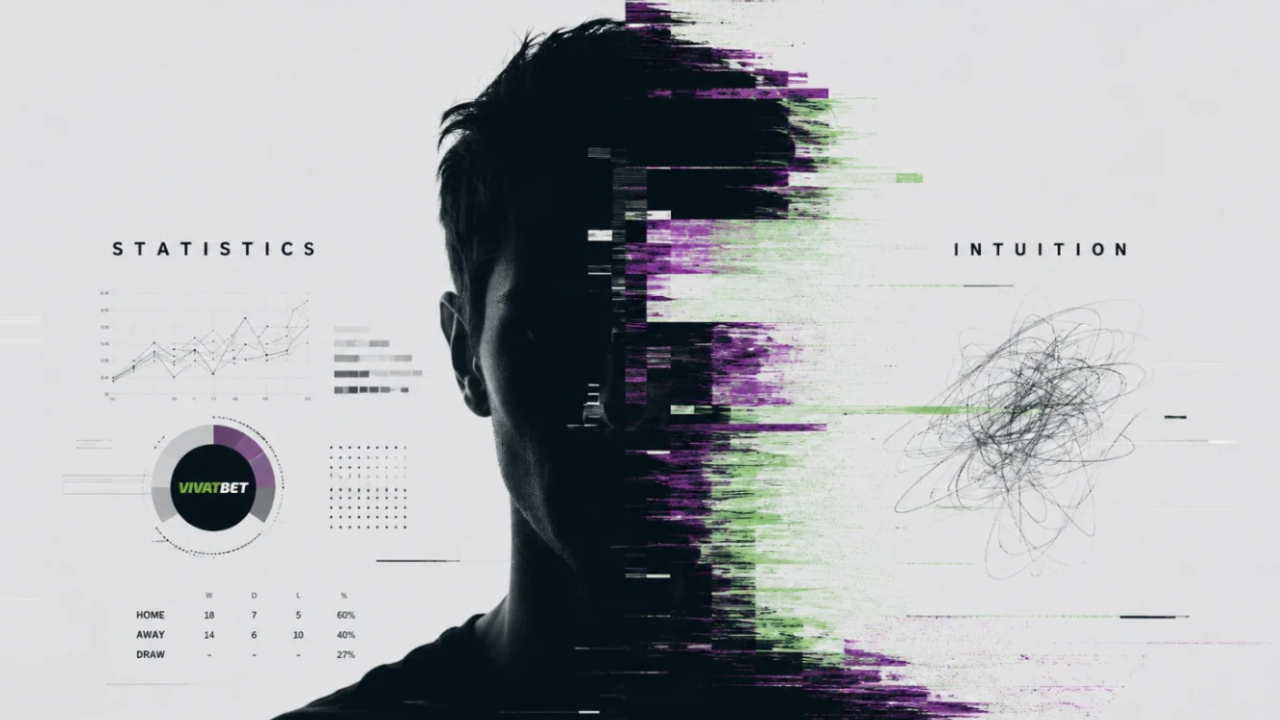
The sports world has just witnessed the largest experiment in history comparing human intuition and artificial intelligence. The 2026 World Cup, with its 48 teams, 104 matches, and new playoff format, became the perfect testing ground to determine who is better at predicting the future—neural networks or ordinary fans with their infamous “gut feeling.”
In one corner of the ring is artificial intelligence, sifting through terabytes of historical data and running tens of thousands of tournament simulations. In the other are people, armed with emotions, intuition, and sometimes a downright irrational faith in their team. And you know what turned out? Neither side landed a knockout blow. But those who bet on sports have surely noticed how the odds for World Cup matches took on a life of their own, constantly fluctuating between what the supercomputers predicted and what the crowd sensed. And this battle between two approaches—statistics versus intuition—is only just beginning to gain momentum.
Let’s take as an example the 2026 World Cup final between Spain and Argentina—a match that, while not the most spectacular, is illustrative for our purposes. The Opta supercomputer, after running 10,000 simulations, gave the “Red Fury” a 56.31% chance of winning. Other models estimated the Spaniards’ chances of lifting the trophy at anywhere from 54.6% to 16.1%—depending on the calculation method. Meanwhile, prediction markets like Polymarket—where hundreds of millions of dollars in real money were wagered on the outcome—named France as the favorite with 17%. The difference between these approaches is enormous. And it’s not because anyone is wrong. It’s simply that each method has its own philosophy.
Statistical models look to the past. They analyze:
Markets, meanwhile, look at the present. They aggregate the opinions of thousands of players who vote with their wallets and convert their bets into implied probabilities. The former is science. The latter is collective intuition multiplied by greed and fear.
To see for yourself whose approach proves more accurate in such matchups, you don’t need to delve deeply into complex mathematical calculations. Just download the Vivatbet app, where odds are updated in real time, reflecting both analysts’ raw statistics and live market sentiment. It’s a convenient tool that lets you stay on top of major sporting events and test your own predictions in practice.
There was some fuel for contemplation in the tournament outcomes. In an interesting experiment, TECNO pitted its AI assistant Ella against over 8,000 customers in a race to predict the results of upcoming matches. The result caught everyone off guard. Humans were 72.2% accurate in predicting match results (win, draw, defeat), whereas the neural network achieved 57% accuracy. Humans and AI were almost identical in their ability to forecast the final score (9.7% vs. 8.5%). That is to say, people still perform better on general issues (“who will win”) than on more particular ones (“by what score”).
There is, however, a contrasting viewpoint. Machine learning ensemble models (XGBoost, LightGBM, Random Forest) outperformed ESPN experts (57.3% vs. 73.8% accuracy) in a study of 2,847 Premier League matches. A huge disparity — 16.5 percentage points. This level of precision is the difference between a season-long loss and a 23% return every year.
Comparison of Human and AI Performance
| Study | Expert or human-generated | Artificial intelligence or model output | Difference |
| More than 8,000 individuals participated in the TECNO project | Final result: 72.2% | Final result: 57% | Humans prevailed by 15.2 percentage points in the TECNO trial |
| TECNO trial | Final score: 9.7% | Final score: 8.5% | 1.2 percentage points in support of people |
| An examination of 2,847 English Premier League matches | Outcome prediction: ESPN experts — 57.3% | Ensemble models — 73.8% | Around 16.5 percentage points in support of models |
In a single match, human intuition can beat algorithms, but across large samples, algorithms usually come out on top. This contradiction is shown clearly in the table. In one thrilling game, context and character shine, but over a prolonged championship, calculation, discipline, and the absence of a favourite side become decisive.
What follows is an explanation of the inner workings of sports prediction:
“Who is more accurate — a person or a machine?” is therefore an oversimplified question. The market attempts to combine the two viewpoints into a single number, while algorithms excel at maintaining a marathon pace and experts catch information that has not yet made it into the bookmaker’s database. Among them, there is no single flawless prophet. In its own unique manner, each one misses the point and carries its own blind spot.
| Study | Expert or human-generated | Artificial intelligence or model output | Difference |
| More than 8,000 individuals participated in the TECNO project | Final result: 72.2% | Final result: 57% | Humans prevailed by 15.2 percentage points in the TECNO trial |
| TECNO trial | Final score: 9.7% | Final score: 8.5% | 1.2 percentage points in support of people |
| An examination of 2,847 English Premier League matches | Outcome prediction: ESPN experts — 57.3% | Ensemble models — 73.8% | Around 16.5 percentage points in support of models |
If you love sports, download Stadium Rant from the Apple App Store and join one of the fastest-growing social sports communities. Be sure to follow us on socials too — you can find all our profiles on our Linktree.
