
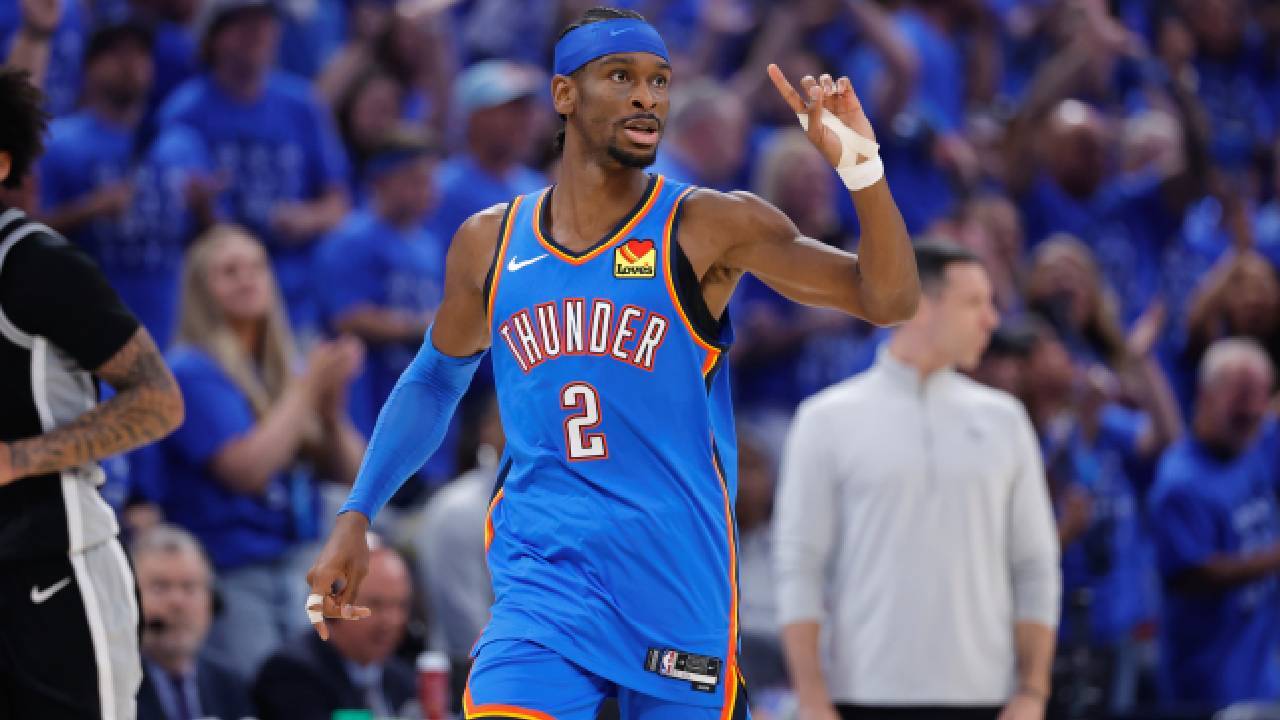
Shai Gilgeous-Alexander has reached the point where “superstar” no longer fully captures his value to the Oklahoma City Thunder. Gilgeous-Alexander is an elite scorer, late-game closer, primary playmaker, and franchise-defining leader rolled into one player.
Gilgeous-Alexander completed the 2025–26 season averaging 31.1 points, 6.6 assists, 4.3 rebounds, and 1.4 steals per game. He shot 55.3 percent from the field and 38.6 percent from three-point range while earning his second consecutive Kia NBA Most Valuable Player award. The MVP announcement also noted that he became just the 14th player in NBA history to win MVP in consecutive seasons. The bigger story is what that production has done to Oklahoma City, which finished 64–18 with the NBA’s best record and a league-best +11.1 net rating.

The Gilgeous-Alexander/Thunder partnership works because Oklahoma City does not ask its best player to solve every problem in the same way. He can get downhill, operate from the midrange, draw fouls, create passing opportunities, and manufacture shots when the original offensive action breaks down.
The defensive attention becomes a problem before Gilgeous-Alexander even receives the ball. NBA.com credited him with the league’s highest perimeter off-ball gravity at 20.1, meaning opponents pulled toward him more than expected based on the surrounding spacing.
Driving pressure creates another problem. Gilgeous-Alexander led the NBA with 14.0 points per game on drives while shooting 59.2 percent on those plays, giving Oklahoma City an offensive advantage that does not depend solely on isolation possessions.
Chet Holmgren averaged 17.1 points, 8.9 rebounds, and 1.9 blocks during the regular season while shooting 36.2 percent from three. He was also named to the All-NBA Third Team and an All-Defensive Team. This gives Oklahoma City a second player capable of affecting both ends of the floor without requiring constant touches.
Jalen Williams provides another creator who can score and facilitate when defenses send additional attention toward Gilgeous-Alexander. Williams averaged 17.1 points and 5.5 assists in 33 regular-season games, giving Oklahoma City another ball-handler capable of relieving pressure from its MVP.

Gilgeous-Alexander’s greatest advantage becomes even more obvious when the game gets tight. The NBA named him its 2025–26 Kia Clutch Player of the Year after he led the league with 175 clutch points.
The league defines clutch situations as the final five minutes of the fourth quarter or overtime when the score is within five points. Gilgeous-Alexander also averaged 6.5 clutch points per game and produced 16 go-ahead field goals in those situations.
The league breakdown provides additional context for his production when games became most important. Gilgeous-Alexander finished the season with the NBA’s highest total plus/minus at +788, more than 100 points ahead of the second-ranked player.
The Thunder reported that Gilgeous-Alexander scored his 175 clutch points on 51.5 percent shooting over 125.1 clutch minutes. Oklahoma City also posted a 124.5 offensive rating and +23.8 net rating during clutch situations, both among the NBA’s best marks.

The Thunder’s greatest advantage is that Gilgeous-Alexander does not have to carry an aging roster toward one final championship opportunity. Oklahoma City instead has an MVP at the center of a young core that has already demonstrated an ability to win at the highest level.
Holmgren gives Oklahoma City rim protection and shooting, while Jalen Williams provides another creator capable of scoring and facilitating. The supporting cast became particularly important during the 2026 playoffs. Oklahoma City swept two Western Conference opponents before reaching the conference finals.
Oklahoma City swept Phoenix in the first round, with Gilgeous-Alexander averaging 33.8 points and 8.0 assists. Holmgren averaged 17.3 points and 8.5 rebounds while shooting 59.1 percent from the field.
The Thunder then swept the Lakers in the Western Conference semifinals. Gilgeous-Alexander averaged 24.5 points and 6.3 assists, while Holmgren averaged 20.0 points and 9.8 rebounds.
The playoff results demonstrate that Oklahoma City does not require one specific version of Gilgeous-Alexander to win. Phoenix saw Gilgeous-Alexander carry a larger scoring burden, while Los Angeles saw Holmgren provide more offensive production as SGA remained an elite creator.
Oklahoma City’s regular-season defense makes the championship case even stronger. The Thunder finished with a 106.5 defensive rating, the NBA’s best mark, meaning the roster did not need an extraordinary offensive performance from Gilgeous-Alexander every night to control games.

The 2026 Western Conference Finals made the Thunder more interesting, not less. Oklahoma City pushed San Antonio to seven games before losing 111-103 in Game 7, with Gilgeous-Alexander scoring 35 points in the elimination game.
The series revealed an important weakness every Thunder opponent should study. San Antonio disrupted Oklahoma City’s offensive rhythm enough to hold the Thunder to 107.9 points per 100 possessions across the series. It was their worst offensive mark across its nine playoff series over the previous three seasons.
Size and secondary creation became the central problems. San Antonio could challenge Oklahoma City’s preferred driving lanes while forcing more responsibility onto Gilgeous-Alexander. Jalen Williams’ limited postseason availability reduced the Thunder’s secondary offensive options.

Oklahoma City’s advantage is that its core strengths are not dependent on one specific style of game. It can create in the half court, attack in transition, pressure the perimeter, and use Holmgren’s size without sacrificing shooting.
Gilgeous-Alexander gives the offense another layer whenever a possession stops developing as planned. Changes of tempo, matchup attacks, second-level passes, and late-clock shot creation allow Oklahoma City to maintain offensive pressure without requiring the same action on every possession.
Oklahoma City’s defense also gives the team another path to victory. They finished No. 1 in defensive rating and allowed 8.3 fewer points per 100 possessions than the league average. It was the second-best differential recorded by any team in the 30 seasons with play-by-play data.

The most encouraging development for Oklahoma City is that Gilgeous-Alexander continued expanding his game after reaching the MVP level. He averaged a career-high 6.6 assists in 2025–26 while shooting a career-best 38.6 percent from three-point range. This gave defenses more problems than the previous version of his game.
The improved perimeter shooting matters because defenders already have to respect Gilgeous-Alexander’s ability to reach the paint and create from the midrange. Greater three-point efficiency makes aggressive help defense more dangerous and creates additional space for Holmgren, Williams, and the rest of Oklahoma City’s offense.
Gilgeous-Alexander also averaged 27.7 points and 8.1 assists through the Thunder’s first 12 playoff games, according to the their postseason game notes.

The NBA has no shortage of players capable of defining the next decade. Nikola Jokić remains one of basketball’s most overwhelming offensive forces. Victor Wembanyama has already shown the potential to redefine what teams can expect from a center. Luka Dončić and Anthony Edwards have established themselves as franchise-changing stars.
Gilgeous-Alexander’s statistical profile also separates him from a traditional volume scorer. The league’s top off-ball gravity, best points-per-game mark on drives, highest total plus/minus, and Clutch Player of the Year award demonstrate that his impact extends far beyond the number of shots he takes.
The 2026 postseason showed the remaining challenge when San Antonio proved that another young Western Conference contender can match Oklahoma City’s talent and push it to the limit.
The Spurs series should make Oklahoma City more dangerous, not less. Rivals can absolutely beat OKC in a playoff series. No team is guaranteed anything in the postseason, but Oklahoma City is not built around one lucky season.
Organizational stability, a young core, proven regular-season dominance, and an MVP who has repeatedly demonstrated late-game excellence give the Thunder a foundation few contenders can match. The rest of the NBA is not waiting for Gilgeous-Alexander to become the league’s next defining superstar because he has already become that player.
Gilgeous-Alexander is not merely Oklahoma City’s best player. He is the reason the Thunder can enter every season with a legitimate belief that another championship is within reach. The distinction matters because plenty of teams have a superstar, plenty have young talent, and plenty have depth. They have all three.
Gilgeous-Alexander gives the Thunder the player every championship team desperately needs: someone who can take control when everything else breaks down. The NBA spent years waiting for its next generation of superstars to take control, and he has already done it. Now the rest of the league has to figure out how to catch up.
