
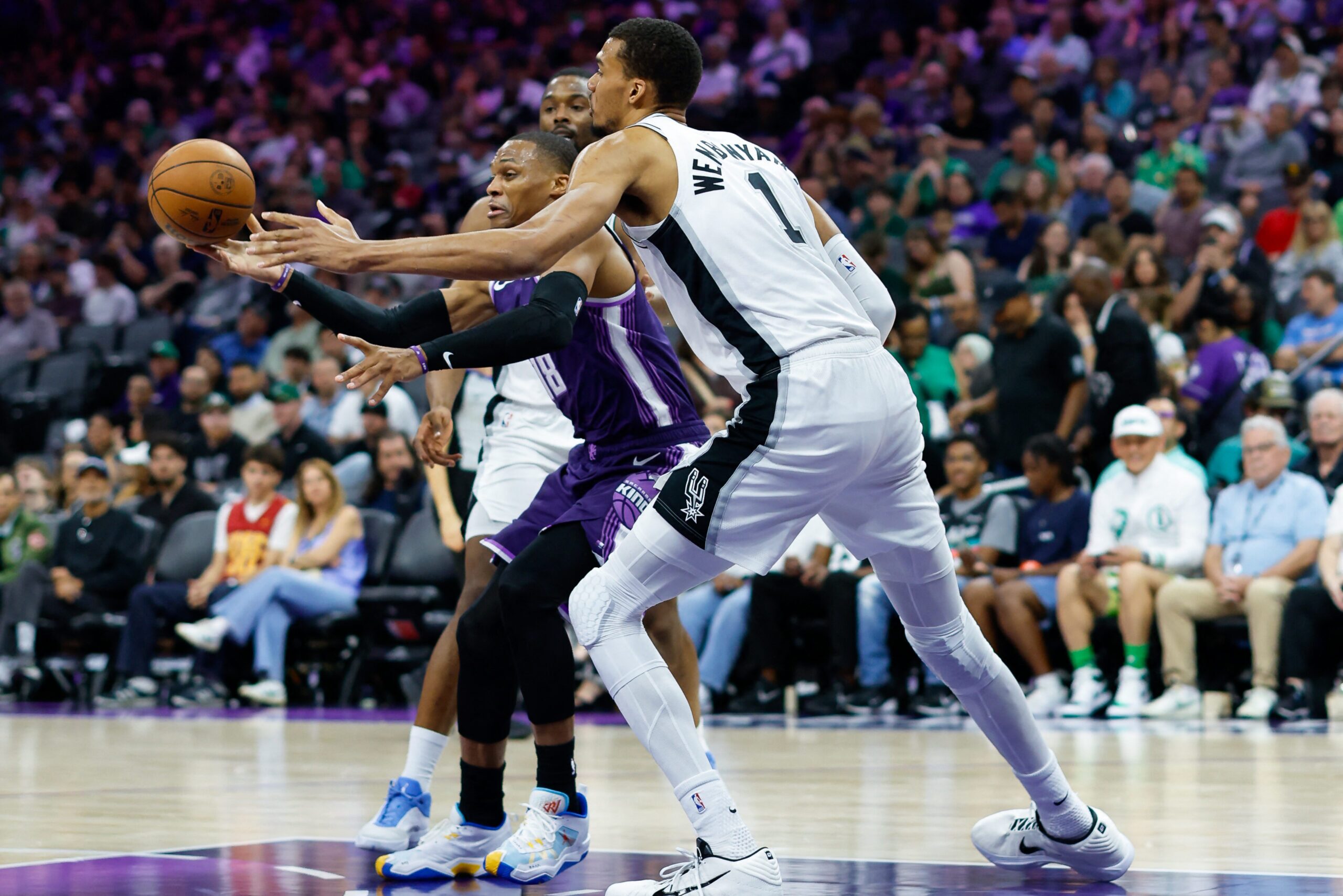
Russell Westbrook has retired from the NBA after 18 seasons, ending one of the most explosive, productive and debated careers in modern basketball.
The 37-year-old announced his retirement on August 12, 2026, through social media rather than a traditional press conference. His announcement came in a career-highlight video narrated by actor Michael B. Jordan, accompanied by a reflective caption: “Sometimes you don’t even know when you’ve already watched the end.”
Westbrook leaves the NBA as its all-time leader in career triple-doubles with 209, a 2017 MVP, a nine-time All-Star, a nine-time All-NBA selection, a two-time scoring champion, a three-time assists leader, and a member of the NBA’s 75th Anniversary Team.
He also finishes his career fifth in NBA history in assists with 10,351 and 14th in scoring with 27,176 points. His career averages were 20.9 points, 6.9 rebounds and 8.0 assists per game over 1,301 regular-season appearances.
The numbers tell only part of the story.
Westbrook’s career included an MVP season unlike almost anything the NBA had seen, a historic triple-double record, a trip to the NBA Finals, multiple superstar teammates, seven franchises and some of the most intense criticism any modern NBA star has faced.
Here is the complete breakdown of Russell Westbrook’s retirement, career stats, timeline, records and legacy.
Westbrook announced his retirement on Wednesday, August 12, 2026, after 18 NBA seasons.
Rather than holding a press conference, he released a roughly three-and-a-half-minute career video narrated by Michael B. Jordan. The video reflected on his career and accomplishments before Westbrook confirmed that his playing career was over.
The timing was notable because Westbrook still had NBA opportunities.
According to ESPN’s Shams Charania, Westbrook had received offers from the Sacramento Kings and Washington Wizards during the 2026 offseason. He ultimately chose to step away from basketball rather than continue his career.
That makes the retirement different from a situation in which a player simply could not find a roster spot. Westbrook had options; he decided that 18 seasons was enough.
| Category | Career total |
|---|---|
| NBA seasons | 18 |
| Games played | 1,301 |
| Career points | 27,176 |
| Career rebounds | 8,967 |
| Career assists | 10,351 |
| Points per game | 20.9 |
| Rebounds per game | 6.9 |
| Assists per game | 8.0 |
| Career triple-doubles | 209 |
| MVP awards | 1 |
| All-Star selections | 9 |
| All-NBA selections | 9 |
| Scoring titles | 2 |
| Assists titles | 3 |
| All-Star Game MVPs | 2 |
| NBA Finals appearances | 1 |
| NBA championships | 0 |
| NBA 75th Anniversary Team | Yes |
Westbrook’s career statistical profile is extraordinary even before the triple-doubles are considered.
He scored more than 27,000 points, recorded more than 10,000 assists and finished with nearly 9,000 rebounds. He is one of only a small number of players in NBA history to reach both 25,000 points and 10,000 assists.
His career shooting numbers also help explain why his legacy is more complicated than his counting statistics alone. Basketball-Reference lists Westbrook at 43.8% from the field, 30.8% from three-point range and 77.1% from the free-throw line for his career.
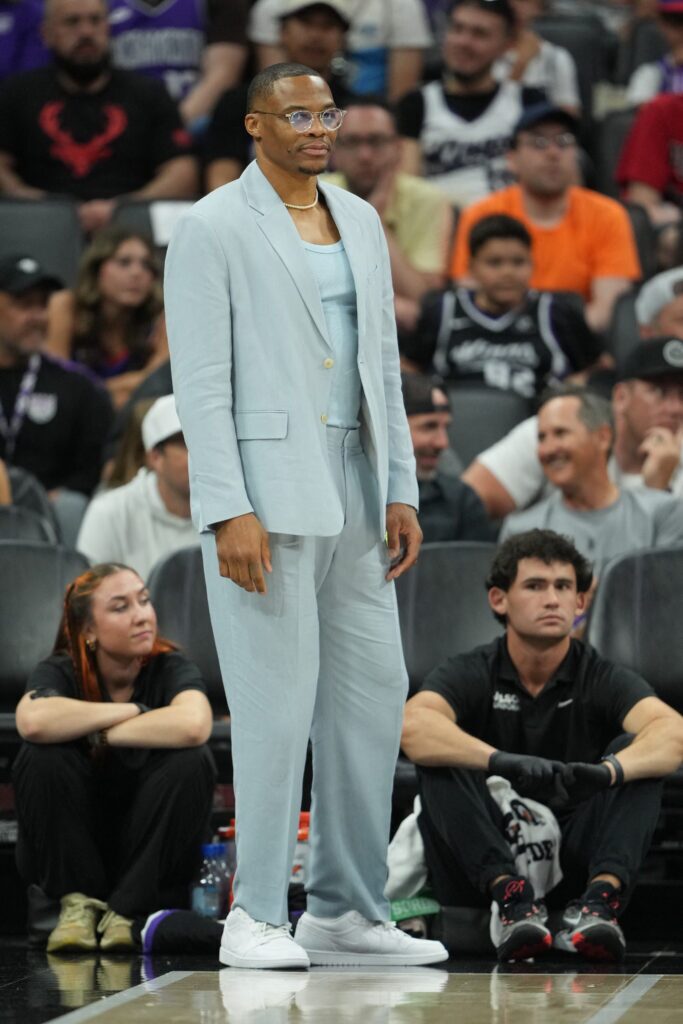
Westbrook finished his career with the Sacramento Kings in 2025-26.
At age 37, he averaged:
He appeared in 64 games for Sacramento.
The numbers were a long way from his MVP peak, but they also illustrate the longevity of his career. Westbrook remained a productive NBA rotation player nearly two decades after entering the league.
His final season also produced six triple-doubles, bringing his career total to the record-setting 209.
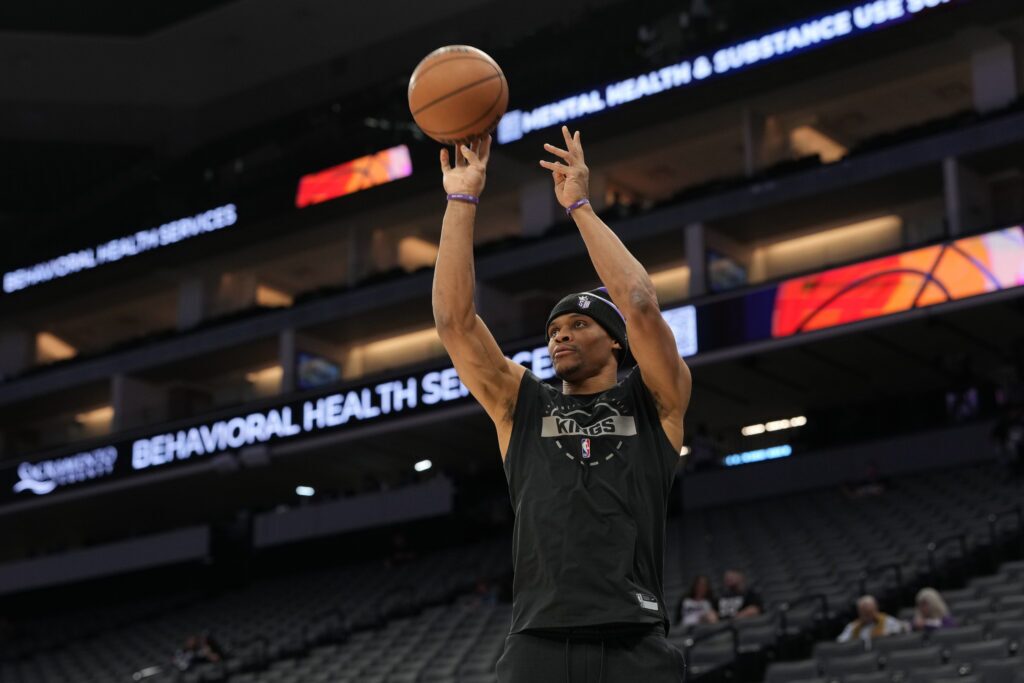
Westbrook played for seven NBA franchises during his 18-year career:
His longest and most influential stint came with Oklahoma City.
Westbrook spent his first 11 seasons with the Thunder organization after being selected fourth overall in the 2008 NBA Draft by the Seattle SuperSonics, who relocated to Oklahoma City shortly afterward.
The Seattle SuperSonics selected Westbrook with the fourth overall pick in the 2008 NBA Draft.
The franchise moved to Oklahoma City before the 2008-09 season, making Westbrook one of the foundational players of the new Thunder era.
He quickly established himself as an athletic, aggressive point guard and earned All-Rookie consideration.
Westbrook developed alongside Kevin Durant and James Harden as Oklahoma City assembled one of the NBA’s most talented young cores.
The Thunder reached the 2012 NBA Finals, where they lost to the Miami Heat.
That remains Westbrook’s only NBA Finals appearance.
Westbrook also represented the United States at the 2012 London Olympics, winning a gold medal. He later added two scoring titles and three assists titles to his résumé.
After Durant suffered a season-ending injury during the 2014-15 campaign, Westbrook took on an even larger offensive role.
He became one of the league’s most aggressive scoring and playmaking guards and eventually transformed the triple-double from an occasional statistical milestone into a defining part of his game.
This was the defining statistical season of Westbrook’s career.
He averaged:
31.6 points, 10.7 rebounds and 10.4 assists per game.
He recorded 42 triple-doubles, breaking Oscar Robertson’s previous single-season record of 41, and became the first player since Robertson in 1961-62 to average a triple-double over an entire season.
Westbrook won the 2016-17 NBA MVP award.
His season remains one of the most statistically unusual individual campaigns in NBA history.
Westbrook continued to average a triple-double in each of the next two seasons.
He averaged:
He became the only player in NBA history to average a triple-double in four different seasons.
Westbrook was traded to Houston in 2019, joining James Harden.
The partnership reunited two former Oklahoma City teammates, but the Rockets’ experiment lasted only one season.
Westbrook moved to Washington and produced another historic season.
In 2020-21, he averaged a triple-double again and broke Oscar Robertson’s career triple-double record.
That record eventually became the 209 triple-doubles Westbrook carried into retirement.
Westbrook joined the Lakers in 2021 alongside LeBron James and Anthony Davis.
The fit became one of the most scrutinized chapters of his career. Questions about shooting, turnovers, spacing and role eventually led to Westbrook accepting a reserve role.
The Lakers eventually moved on from the experiment.
Westbrook joined the Clippers and took on a different role, operating as a veteran contributor alongside Kawhi Leonard, Paul George and James Harden.
Westbrook joined Denver and played a reduced role compared with the superstar years of his career.
Westbrook’s final NBA season came with Sacramento.
He averaged 15.2 points, 5.4 rebounds and 6.7 assists in 64 games, finishing his career with six more triple-doubles.
Westbrook announced that his NBA career was over at age 37.
He walked away after 18 seasons, 1,301 regular-season games and 209 triple-doubles.
The biggest statistical mark of Westbrook’s career is obvious:
209 career triple-doubles.
He finished ahead of Oscar Robertson, Magic Johnson and every other player in NBA history.
But the career total understates how unusual Westbrook’s dominance in the category became.
He holds several major triple-double milestones, including:
His 42 triple-doubles in 2016-17 were particularly significant because they surpassed Robertson’s previous record of 41.
And Westbrook did not merely average a triple-double once.
He did it four times.
That is one of the strongest arguments for his statistical uniqueness.
Westbrook’s résumé goes well beyond triple-doubles.
Westbrook won the 2017 NBA MVP award after averaging 31.6 points, 10.7 rebounds and 10.4 assists.
He was selected to nine All-Star Games.
Westbrook earned nine All-NBA selections during his career.
He led the NBA in scoring twice.
He led the league in assists three times.
Westbrook won the All-Star Game MVP award twice.
Westbrook was selected to the NBA’s 75th Anniversary Team, placing him among the league’s officially recognized greatest players.
He won Olympic gold with Team USA in 2012.
Westbrook’s final statistical position gives a clearer picture of his career than any single award.
His combination of scoring and playmaking is especially unusual.
Westbrook finished with more than 27,000 points and more than 10,000 assists, placing him in an extremely small historical group.
Westbrook’s career cannot honestly be described only as a statistical masterpiece.
His critics had legitimate arguments.
His career shooting efficiency was not elite. He committed turnovers at a high rate, and his aggressive style sometimes created difficult possessions for his teams.
The later years also changed how many fans viewed him.
His Lakers tenure, in particular, became shorthand for the problems that can arise when a high-usage superstar’s strengths no longer fit his team’s offensive structure.
But judging the entire career through those final chapters creates another problem: it ignores how dominant Westbrook was at his peak.
The better historical view is more complicated.
Westbrook was simultaneously:
Those things can all be true at the same time.
The biggest criticism of Westbrook’s career is simple:
He never won an NBA championship.
He reached the Finals once, with Oklahoma City in 2012, but the Thunder lost to Miami.
That absence matters when comparing Westbrook with other all-time greats.
But it should not erase the rest of the résumé.
A player’s career value cannot be reduced to championship rings alone. Westbrook’s nine All-Star selections, nine All-NBA selections, MVP award, scoring titles, assist titles, Olympic gold medal and statistical records establish a résumé that is much larger than his Finals record.
The fairest criticism is not that Westbrook failed because he did not win a championship.
It is that his individual brilliance did not consistently translate into the highest level of team success.
That distinction matters.
The 2016-17 season is the obvious answer.
Westbrook was 28 years old, physically overwhelming, playing with enormous usage and carrying Oklahoma City’s offense after Durant’s departure.
His final numbers:
31.6 PPG | 10.7 RPG | 10.4 APG | 42 triple-doubles | MVP
He also became the first player since Oscar Robertson to average a triple-double for a full season.
The statistical accomplishment was so unusual that it changed how the league talked about triple-doubles.
Before Westbrook’s peak, averaging a triple-double over a full season was treated as an almost mythical achievement.
After Westbrook did it repeatedly, the league entered a different statistical era.
Oscar Robertson was the original triple-double benchmark.
Robertson averaged a triple-double during the 1961-62 season and remained the career leader in triple-doubles for decades.
Westbrook eventually surpassed him.
More importantly, Westbrook averaged a triple-double four times, compared with Robertson’s one such season.
The comparison is useful because it shows how historically unusual Westbrook’s production became.
He did not simply break Robertson’s record.
He repeatedly moved the statistical standard beyond what had previously been considered possible.
Westbrook’s résumé gives him an exceptionally strong Hall of Fame case.
He retires with:
The Hall of Fame question is therefore less about whether his résumé is historically significant and more about how his place among the greatest point guards and guards of his generation should ultimately be ranked.
Westbrook’s legacy will probably remain more complicated than his résumé suggests.
Some fans will remember the MVP season.
Others will remember the triple-doubles.
Some will remember the explosive dunks, relentless drives and impossible athleticism.
Others will remember the turnovers, missed jumpers and difficult team fits.
All of those memories are part of the same career.
The important point is that Westbrook’s statistical achievements are not merely the product of longevity.
He spent years producing numbers that had rarely been seen before.
He became the NBA’s career triple-double leader, averaged a triple-double four times, won an MVP, finished among the league’s all-time scoring and assists leaders, and remained in the NBA for 18 seasons.
That combination makes him one of the most statistically distinctive players of his generation.
Westbrook’s playing career is over, but his basketball legacy will continue through his records, awards and influence on the way guards are evaluated.
His 209 triple-doubles will be one of the first numbers associated with his name.
His 2016-17 MVP season will be another.
So will his partnership with Kevin Durant in Oklahoma City, his record-breaking triple-double years, his time with the Lakers and his transition from superstar to veteran role player.
The next stage of his career will determine how much of that legacy extends beyond the court.
Russell Westbrook retires as far more than the NBA’s triple-double leader.
He leaves the league after 18 seasons with 27,176 points, 10,351 assists, 8,967 rebounds and 209 triple-doubles.
He won an MVP, made nine All-Star teams, earned nine All-NBA selections, won two scoring titles and three assists titles, captured Olympic gold and earned a place on the NBA’s 75th Anniversary Team.
He also reached the NBA Finals, played for seven franchises and became one of the defining players of the post-2000 NBA.
His career was not perfect.
The shooting problems were real. The turnovers were real. The playoff limitations were real. The team-fit problems were real.
But so was the production.
Westbrook’s retirement closes the book on one of the most unusual careers in NBA history: a career built on speed, aggression, durability, relentless competition and a statistical achievement that may define him forever.
209 triple-doubles. One MVP. Nine All-Star selections. Four triple-double seasons. Eighteen NBA seasons.
Whatever the final argument about Russell Westbrook’s place in NBA history becomes, his statistical footprint is no longer debatable.
The record book is permanent.
