

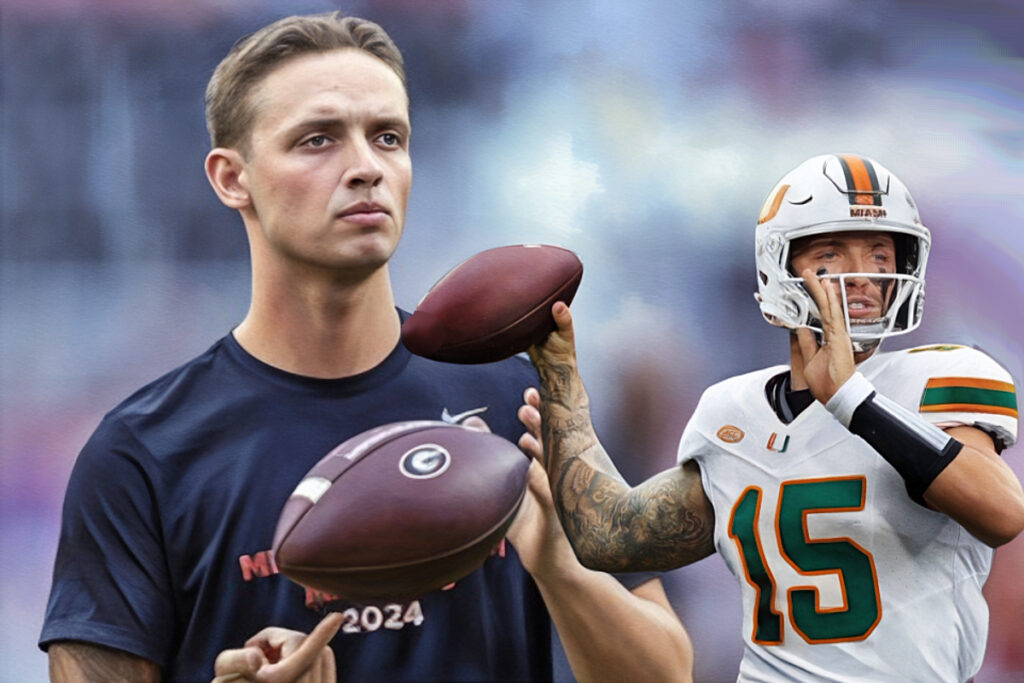
According to recent reports, Tennessee quarterback Nico Iamaleava is trying to renegotiate the terms of his NIL deal. He is scheduled to make $2 million per year, despite having just one year as a starter under his belt. If the Vols do not offer to give him a pay raise, he plans to take his talents elsewhere.
Iamaleava’s motivation comes from recent NIL deals signed by sixth-year senior Carson Beck, who just received $4 million per year from Miami, and senior transfer Darian Mensah, who pocketed $4 million per season to play at Duke. Both players had better seasons than Iamaleava, but that doesn’t mean some colleges won’t pony up a payday for the 20-year-old.
According to his representation, Iamaleava has offers from at least three schools if he decides to enter the transfer portal. The situation is a problem, but it isn’t the fault of the school, the transfer portal, and it’s not even completely the fault of greedy players like Iamaleava. The problem is due to growing pains in the relatively young NIL program and the antiquated thought processes of the NCAA.
When the O’Bannon brothers hit the NCAA square on their glass jaw in the courtroom, the walls came tumbling down. Picking up and rearranging the bricks has been a slow and painful process. Players definitely deserve a piece of the pie that they helped bake, and the NIL plan is a decent conduit, but it’s still figuring itself out.
NIL deals are flimsier than the paper they are written on. Players can jump from school to school and sign new NIL deals, voiding the old ones, as many times as they desire. There is nothing ironclad about them, and that’s apparently the way the schools want it. It may allow them to be poached, but it also allows them to do some poaching of their own.
The NCAA needs to mandate clauses in deals to give the schools the ability to hold the NIL rights to their athletes, and the only way a new school can sign a deal with that athlete is to purchase the rights from the school holding the contract. This won’t happen, though, because the NCAA is desperately clinging to the notion that athletes are actually student-athletes and amateurs.
When the NCAA caved on the NIL deals, they made it clear that schools were not allowed to pay players directly. The deals had to come from booster programs, even those sanctioned by the schools. The deals also could not be contingent on the athlete playing for a specific school. In other words, the athletes were not allowed to be paid to play their sport.
In the eyes of the NCAA, this would maintain the amateur status of the players, and they could cling to the illusion that these multi-millionaires were regular students who engaged in an extracurricular activity for no reward. This also allowed the schools to continue profiting off the sweat of these “kids”, to the tune of billions of dollars per year, without allowing the athletes to touch the spoils of their labor.
The NCAA needs to realize that it represents professional sports teams, and these “students” are actually professional athletes. Their refusal to admit to and acknowledge reality is the biggest problem in college sports today. By pretending things are as they have always been, the NCAA is unable to get involved, which is crazy, since they are supposed to be the governing body.
If the NCAA were to acknowledge these athletes as professionals and allow the schools to pay them directly, they would be able to stipulate hard and fast rules pertaining to NIL money and transfers. They could have non-compete clauses in deals and contracts that bind kids to schools unless they are bought out.
Until they take their fingers out of their ears and their heads out of other orifices, players in every sport will continue threatening to transfer, holding schools over a bucket for more and more money.
