
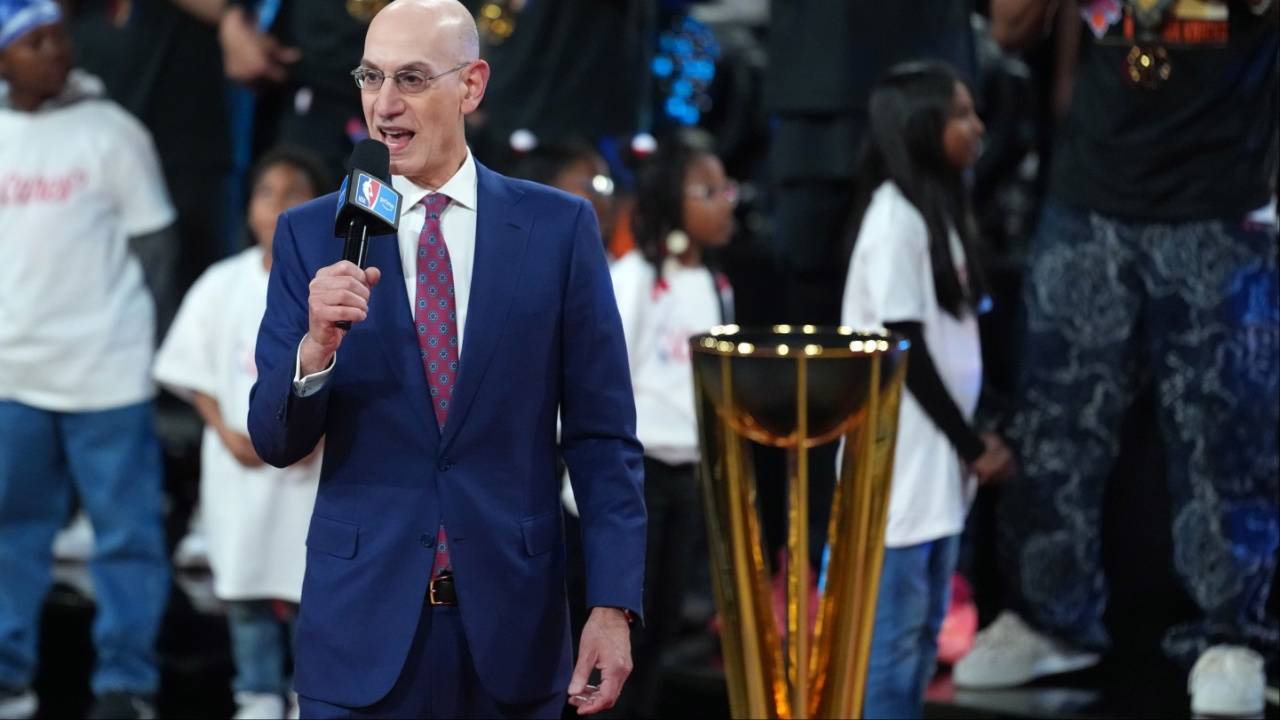
NBA Cup explained: All 30 teams compete in group play, eight advance to the knockout rounds, and only the championship falls outside the regular season. The Emirates NBA Cup 2026 runs from October 30 through December 11, ending at Hinkle Fieldhouse in Indianapolis. The format makes designated games count toward both tournament advancement and regular-season playoff positioning.
What Is The NBA Cup?
The NBA Cup is the league’s annual in-season tournament, previously called the NBA In-Season Tournament. Teams compete for a separate trophy while continuing their regular-season schedules. Winning the Cup does not replace winning the NBA Finals or automatically secure a playoff berth.
The easiest way to follow the competition is to track two records during group play. A designated Cup victory improves both a team’s tournament record and its regular-season record. A victory outside the Cup schedule improves only the regular-season record.
NBA Cup Explained: How Group Play Works
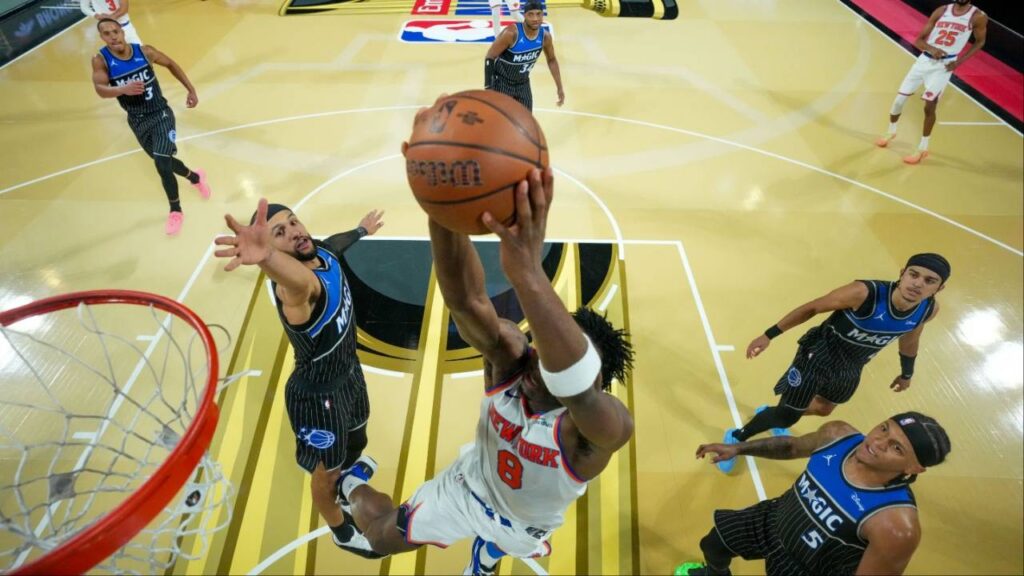
The league divides its 30 teams into six groups of five, with three groups in each conference. Every team faces each group opponent once, producing four tournament games per team. Each participant receives two home games and two road games.
Group assignments use a draw organized around the previous season’s standings, rather than simply copying the NBA’s divisions. Each conference’s teams are divided into five pots of three by prior-season record, with one team from each pot entering each group. A team’s designated Cup results determine tournament advancement, so its overall record cannot substitute for its group-play record. The earlier NBA Cup 2026 predictions examine the potential group winners, wild cards, and champion.
Which Teams Are In The 2026 NBA Cup Groups?
| Group | Teams |
| West A | Dallas Mavericks, Denver Nuggets, Houston Rockets, Phoenix Suns, Utah Jazz |
| West B | LA Clippers, Memphis Grizzlies, Minnesota Timberwolves, New Orleans Pelicans, Oklahoma City Thunder |
| West C | Golden State Warriors, Los Angeles Lakers, Portland Trail Blazers, Sacramento Kings, San Antonio Spurs |
| East A | Brooklyn Nets, Detroit Pistons, Milwaukee Bucks, Orlando Magic, Toronto Raptors |
| East B | Cleveland Cavaliers, Indiana Pacers, Miami Heat, New York Knicks, Philadelphia 76ers |
| East C | Atlanta Hawks, Boston Celtics, Charlotte Hornets, Chicago Bulls, Washington Wizards |
How Do Teams Reach The Knockout Rounds?
The six group winners advance, joined by one wild card from each conference. Each wild card goes to the second-place finisher with the best group-play record in its conference, with tiebreakers separating matching records. Finishing second keeps a team eligible, but does not guarantee a knockout berth.
The three group winners receive seeds No. 1 through No. 3 within each conference, ranked by group-play results and applicable tiebreakers. The wild card occupies the fourth position, even if its record matches or exceeds a group winner’s. The quarterfinals pair No. 1 against the wild card and No. 2 against No. 3.
The top two seeds host the quarterfinals, and the higher remaining seed hosts each conference semifinal. For example, a No. 1 seed surviving its quarterfinal would host either No. 2 or No. 3 next. The East and West semifinal winners meet in the championship, with every knockout game decided through single elimination.
How Do NBA Cup Tiebreakers Work?
Teams tied within a group are separated through an ordered set of criteria. Head-to-head group results come first, followed by group point differential and total group points scored. The previous season’s regular-season record comes next, with a random drawing resolving any remaining tie. Point differential is points scored minus points allowed, excluding overtime scoring for Cup tiebreakers.
Consider a hypothetical group where Team A and Team B both finish 3-1, with no third team sharing that record. A victory by Team A over Team B gives Team A the group title. A better group-play point differential for Team B cannot overturn that head-to-head result.
A three-team tie requires comparing results among all three tied teams rather than selecting one isolated matchup. Suppose Team A beats Team B, Team B beats Team C, and Team C beats Team A, with all three finishing 3-1. Each has a 1-1 record against the other tied teams, so group-play point differential becomes the next comparison.
Wild-card comparisons skip head-to-head group results because the candidates come from different groups. Point differential therefore becomes the first tiebreaker between second-place teams with matching records. For example, a hypothetical 3-1 team at plus-25 would beat another 3-1 candidate at plus-12.
Overtime scoring is excluded from both scoring tiebreakers, and a game requiring overtime contributes zero point differential. Suppose two teams finish regulation tied 110-110 before Team A wins 122-118 in overtime. Both receive zero differential for that game, and each contributes 110 points to its group-play points-scored total.
The scoring rules explain why teams might keep attacking late in an otherwise settled game. A larger regulation victory can improve a team’s position if qualification reaches the point-differential tiebreaker. Winning remains the priority, but the margin can become relevant after teams finish level.
When And Where Is The 2026 NBA Cup?
Group play runs from October 30 through November 27, with games every Friday during that span. Additional Cup Nights fall on Tuesday, November 24, and Wednesday, November 25. The championship takes place December 11 at Hinkle Fieldhouse in Indianapolis.
| Stage | 2026 Dates | Location |
| Group Play | October 30; November 6, 13, 20, 24, 25 and 27 | NBA team arenas |
| Quarterfinals | December 4-5 | Higher-seeded teams’ arenas |
| Semifinals | December 8 and/or December 9 | Higher-seeded teams’ arenas |
| Championship | December 11 | Hinkle Fieldhouse, Indianapolis |
The 2026 semifinals move to the higher-seeded teams’ home arenas, while the championship takes place at a neutral venue. The change gives qualifying teams another reason to value their position in the bracket. Fans should consult the official schedule for individual matchups, tipoff times and broadcast assignments.
Do NBA Cup Games And Stats Count?
Group play, quarterfinals and semifinals count toward regular-season standings and statistics. The championship result and individual performances are excluded from regular-season records and statistical totals. Both finalists play 83 games overall, consisting of 82 regular-season games plus the separate Cup final.
What Happens To Teams Eliminated From The NBA Cup?
The league initially assigns 80 regular-season matchups per team, reserving two opponents for scheduling after group play. The 22 nonqualifiers receive two games against other nonqualifiers during the December 6-7 and December 9-10 windows. Group-play standings and scheduling constraints help determine those matchups, rather than continuing the Cup bracket.
Most replacement games stay within the same conference, although two cross-conference games accommodate the uneven number of nonqualifiers. Quarterfinal losers play another quarterfinal loser from the same conference on December 7, 9 or 10. Semifinalists fill both reserved matchups through their quarterfinal and semifinal appearances. A semifinal loss therefore requires no additional replacement game.
What Do NBA Cup Winners Receive?
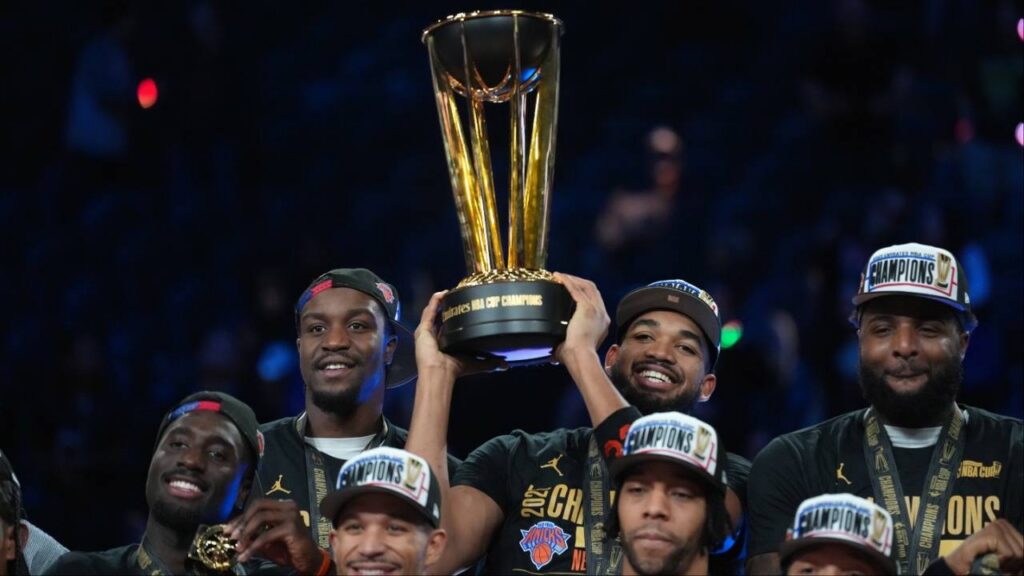
The champion receives the NBA Cup trophy, while players earn progressively larger bonuses for advancing through the knockout rounds. The Associated Press reports the following 2026 player awards. The amounts below identify the award associated with each finishing position, rather than separate bonuses to add together.
| Finish | Reported 2026 Full Standard-Contract Share |
| Champion | $604,985 |
| Runner-Up | $241,994 |
| Semifinal Elimination | $120,997 |
| Quarterfinal Elimination | $60,499 |
The collective bargaining agreement prorates awards according to inclusion on the team’s active or inactive list during knockout games. A player listed for every knockout game under a two-way contract receives 50% of the corresponding standard-contract award. Games under two-way or 10-day contracts count at half weight in that calculation.
The NBA Cup FAQ also identifies the tournament’s individual honors. A media panel selects the competition’s MVP and All-Tournament Team after the championship. Selection considers performances across group play and the knockout rounds.
Why Do NBA Cup Courts Look Different?
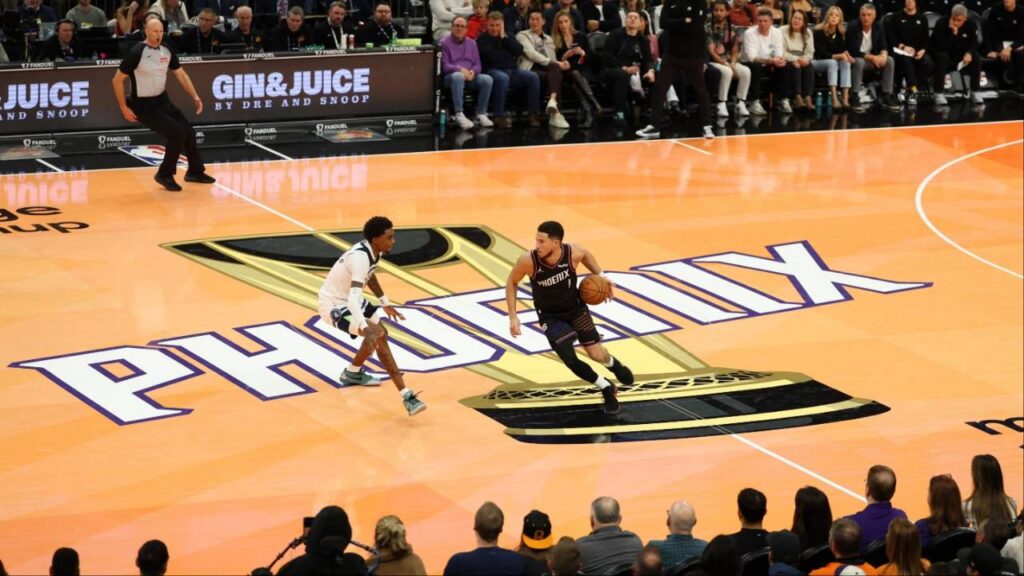
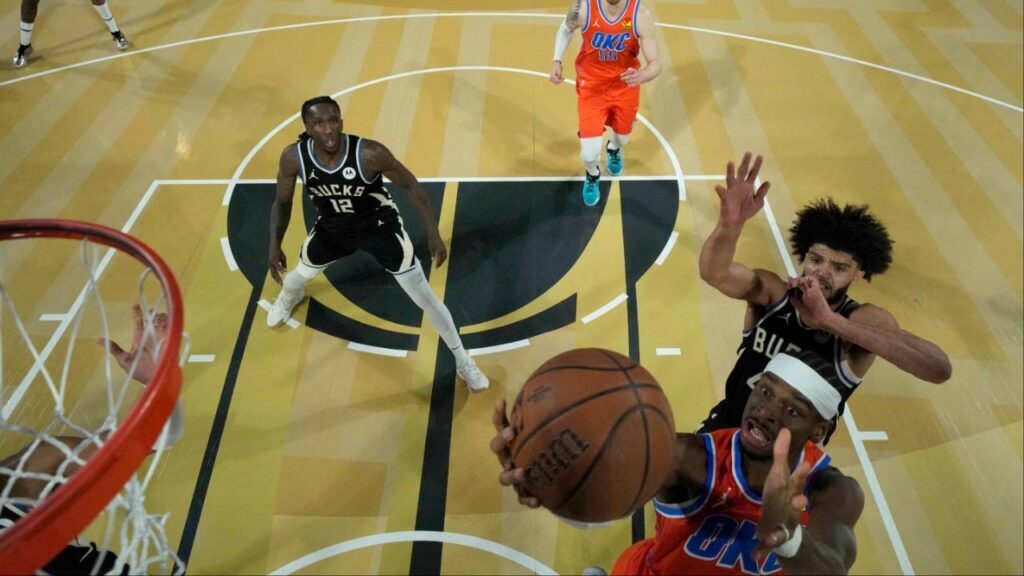
The tournament uses custom-painted courts to distinguish Cup games from the rest of the schedule. Artist Victor Solomon designed the 2026 floors around team identities, trophy imagery, and oversized wordmarks. The colors contrast with the home teams’ Statement Edition uniforms, creating a recognizable tournament presentation. The 2026 court designs also feature the slogan “30 Teams. 8 Advance. 1 Champion.”
End Of My NBA Cup Explained Rant
Home-court semifinals give the NBA Cup a stronger competitive identity because advancing teams can play another elimination game before their own fans. The higher seed receives a tangible reward, and supporters can attend without traveling to a neutral semifinal site. The NBA should keep that incentive while continuing to explain how group results establish the bracket.
Point differential creates a less comfortable tradeoff by encouraging teams to pursue extra baskets after a regulation result appears settled. The rule supplies a measurable tiebreaker, but late possessions can become more about qualification arithmetic than winning that night’s game. The format rewards both beating opponents and, sometimes, extending the margin.
