

The 2025 MLB season has already delivered some awe-inspiring moments from the mound and with the sticks. Pitchers with electric stuff and triple-digit velocity fill roster spots on every club. The filthy arsenal of pitches that seems to be exhibited on almost a nightly basis begs the question: How can hitters barrel up some of this stuff?
“The hardest thing to do in baseball, is to hit a round ball, with a round bat, squarely.” – Ted Williams
Baseball purists can only daydream and wonder how the Splendid Splinter would have fared against a Spencer Strider two-seamer that dots the lower-inside corner of the box at 98mph. Maybe it’s the high-volume, strength, and conditioning that pitchers now diligently commit to year-round, which has allowed for such a bump in movement and velocity to their repertoire.

Or maybe it is the construction of detail-oriented “pitching labs” that are now appearing nationwide. One such lab at Wake Forest can be attributed to the development of Cincinnati Reds pitcher Rhett Lowder, a second-year MLB pitcher who seems to baffle hitters with movement, spin, and location.
Among the elite pitchers who have hit the pinnacle of achievement in baseball by being called to the big leagues, are a select few with unique tools. Pitchers who invent, modify and create newly discovered pitches of their very own making.
This group might toy with hitters and set them up for dealing a nearly unhittable pitch. Here are four pitches that are so special and delivered with such potent movement and velocity that they deserve their own almost villainous title.

What is traditionally known as simply “forkball” has seemed to evolve and grow into an unhittable entity. The pitch is also ingrained into Blue Jays ace Kevin Gausman’s arsenal as a “splitter”. The commonality is that the ball drops vertically as it reaches the plate, in effect to either disappear or “ghost” the hitter attempting to make contact. Senga has become a front-of-the-rotation starter for the NL East-leading Mets, in part due to his execution of this pitch.
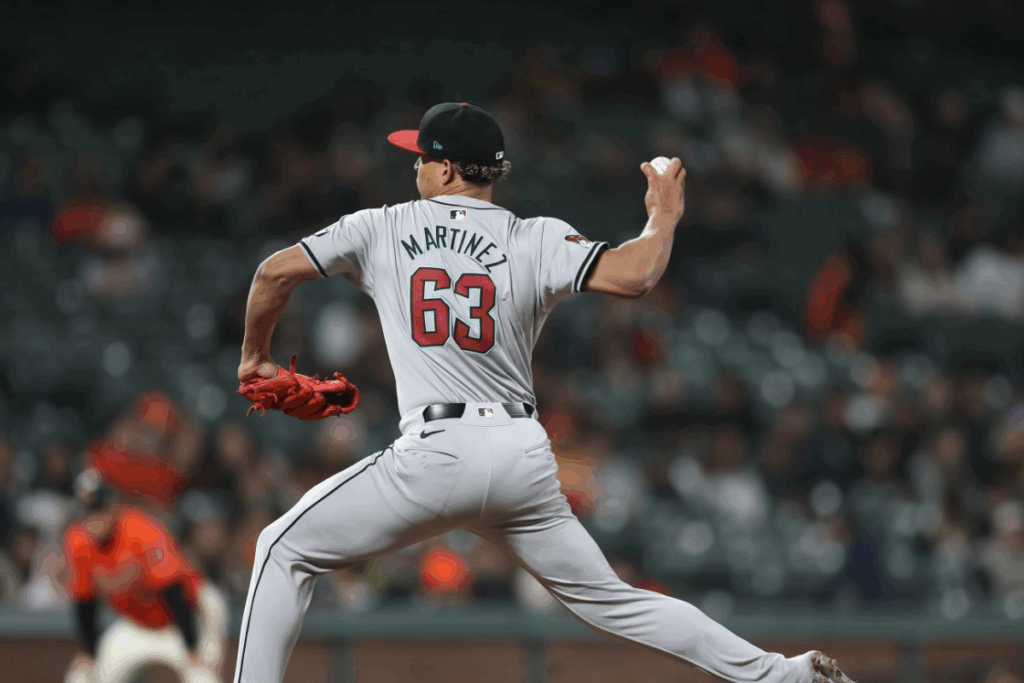
The D-Backs’ newly appointed closer touches 100mph with ease. It is Martinez’s lethal split finger that intimidates and sets him apart. The pitch made famous by the late Hall of Famer Bruce Sutter has been modified and catered for use by several pitchers over the past few decades. Martinez, though, installs a grip that allows the ball to be pushed and spun on release.
The result of such a delivery is the ball arriving with far less spin than a conventional splitter, more like a knuckleball. From there, a pitch coming in at 90mph, appearing like a regular four-seamer, drops and shuffles. A work of magic, as opposing hitters should describe it. Martinez has not given up a hit this season, while using this pitch. He has allowed only eight in over 300 offerings of the pitch, through this season and last.

The Pirates’ phenom burst onto the scene and was dealing in 2024. Clearing triple-digits with his fastball was customary for Skenes, and he often appeared to be throwing harder as the game went on. Skenes is also an anomaly in that his pre-game warmup is entirely his own, with routines and materials that are unlike any other.
Taking bullpen with a 50-pound, compact slosh pipe strapped to his back and then airing out some hail-mary type football passes in the outfield, Skenes has his system. His 7-pitch arsenal is a product of that system and a testament to this generational athlete’s level of preparation and skill.
Skenes can throw any of his pitch options to any spot he chooses, but the Splinker, which comes in at a hard 97mph, is truly unique. It may not have the level of dip that his regular splitter has, but the combination of the velocity and slight drop often proves baffling enough for hitters to whiff on.

Dodgers, and let’s face it, baseball fans everywhere, eagerly await the return to the mound of the TWP superstar. Coaches might want to remove the reverse slider pitch from Ohtani’s arsenal. The slight torsion of the arm in motion could further aggravate pre-existing injuries.
The reverse slider is reminiscent of Fernando Valenzuela’s screwball. The ball arrives outside to righties and finishes on the inside. No hit was allowed on this pitch in 2023, the last season that the great Shohei Ohtani took to the mound. His return, if and when it comes, will be must-watch TV, and hitters will be watching to see if the reverse slider makes its return.

Baseball fundamentals don’t usually venture out to this level of creativity in developing a pitch arsenal. Perhaps it was out of boredom while sitting in the pen during their high school or minor league days. Or maybe it was through conversation with an elder in the MLB community. Somewhere along the line, these pitchers stepped out of the box, figuratively, and experimented with something new until they got it just right. Their subjects (hitters), will have to be equally as creative if they plan to make contact with one of these filthy pitches.
