
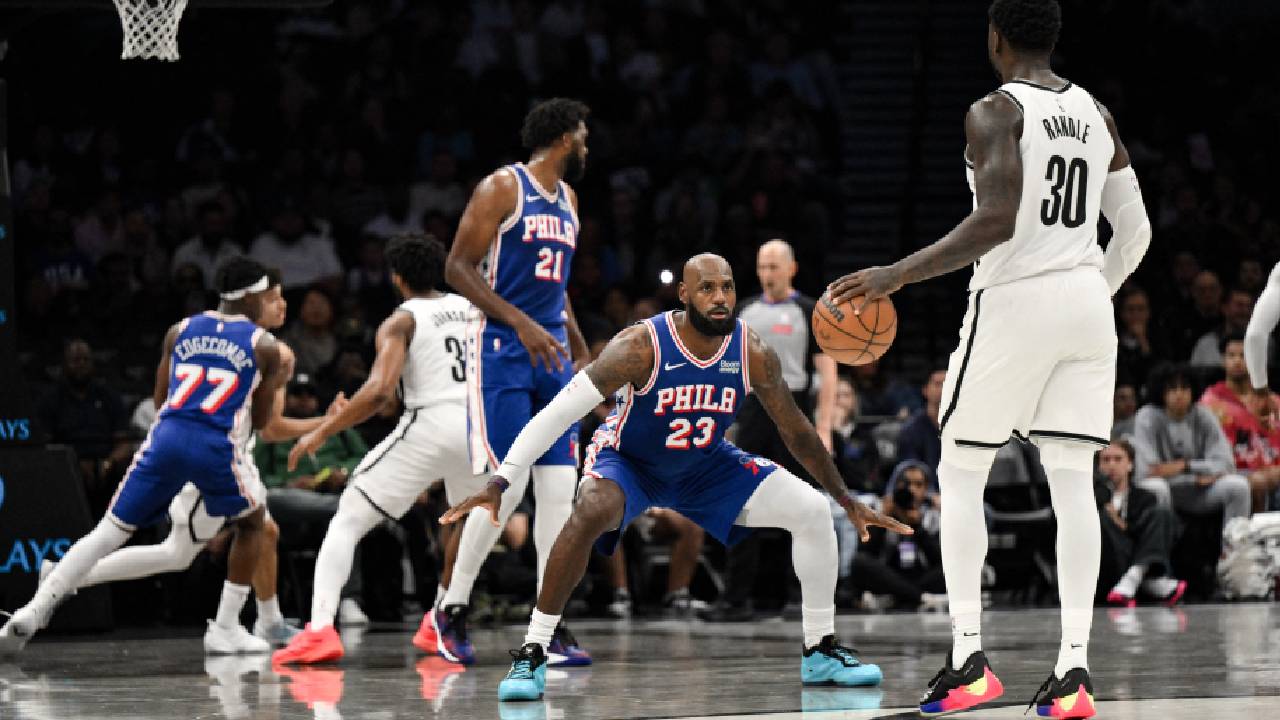
LeBron James and the Philadelphia 76ers have raised their championship ceiling without eliminating the weaknesses threatening their postseason ambitions. Joel Embiid’s availability, defensive consistency, and offensive chemistry remain potential obstacles to surviving four playoff series. The 76ers must demonstrate that their improved roster can overcome the problems that ended last season.
The previous championship outlook article examined how James and Jaylen Brown could improve Philadelphia’s scoring options and postseason flexibility. Injuries, defensive mismatches, and uncertain offensive responsibilities remain unresolved despite those additions. Championship credibility requires structural improvement rather than another collection of recognizable stars.

Embiid’s availability matters because Philadelphia struggles to replace his influence on both ends. The center appeared in only 38 regular-season games last season, leaving the Sixers without their primary interior option for extended stretches. LeBron James and the 76ers must prevent another substantial decline during his absences.
Philadelphia’s on-off statistics illustrate the offensive problem. The Sixers scored 119.1 points per 100 possessions with Embiid playing, compared with 111.3 when he sat. Lineup combinations influence those figures, but the 7.8-point difference establishes the importance of dependable replacement possessions.
James could narrow that gap by organizing reserve possessions, identifying mismatches, and creating opportunities before the offense becomes stagnant. Better passing would reduce Philadelphia’s dependence on difficult late-clock attempts when Embiid rests. Playmaking cannot replace Embiid’s rebounding, rim protection, and interior presence.
Frontcourt uncertainty increased after Ariel Hukporti suffered a season-ending Achilles injury during the 76ers’ preseason opener. The reported Achilles injury leaves Adem Bona’s recovery from a foot sprain particularly important. Dominick Barlow’s back issue further complicated Philadelphia’s preparations entering its October 8 matchup with the Brooklyn Nets.
Tacko Fall remains a potential depth option, although the previous 76ers’ opportunity article distinguished his audition from a guaranteed rotation role. Fall has also dealt with a reported hip strain, while Anfernee Simons missed Philadelphia’s Brooklyn matchup with hamstring tightness. Dean Wade offers small-ball flexibility, although the Sixers still need dependable rebounding against larger opponents.
A reserve combination featuring James, Simons, Kentavious Caldwell-Pope, Wade, and Bona offers one possible framework for maintaining offensive organization. Caldwell-Pope brings perimeter defense, while Wade provides shooting and positional flexibility. The untested lineup cannot become a dependable solution until Philadelphia evaluates its defense and rebounding against established rotations.

The Sixers’ results against winning teams provide a sharper warning than its overall 45–37 record. Philadelphia finished 18–33 against opponents above .500, compared with a dominant 27–4 record against losing teams. Championship contention requires more competitive performances against opponents capable of exposing defensive weaknesses.
Defensive ratings reveal a narrower regular-season gap between Eastern contenders. Philadelphia allowed 114.4 points per 100 possessions, compared with 114.1 for the Cleveland Cavaliers and 112.3 for the New York Knicks. New York also finished with a plus-6.4 net rating, while the Sixers ended slightly below zero.
The Knicks exploited Philadelphia’s weaknesses during a four-game Eastern Conference semifinal sweep. New York outscored the 76ers by 89 points across the series, exposing problems that extended beyond one disastrous performance. Game 4 ended 144–114, reinforcing the consequences of repeated defensive breakdowns.
The Game 4 breakdown documents the Knicks’ 25 three-pointers on 44 attempts, a remarkable 56.8% performance. Philadelphia cannot dismiss that defeat as merely an exceptional shooting night. Better screen navigation, rotations, and closeouts must reduce the quality of opportunities opponents generate.
A measurable defensive target involves matching the Atlanta Hawks’ 112.9 defensive rating from the 2025–26 regular season. The Sixers would need to improve its previous 114.4 rating by approximately 1.5 points to match that benchmark. Leaguewide improvement could raise the standard, making Atlanta’s figure a reference point rather than a guaranteed top-ten finish.
Brown offers an answer against physical wings, while Caldwell-Pope provides another option for difficult perimeter assignments. The pairing could improve matchup flexibility and reduce unnecessary defensive help. James could conserve energy against less demanding assignments without consistently becoming the opponent’s preferred target.
Jalen Brunson presents a direct test of whether those assignments can withstand opposing adjustments. Caldwell-Pope could navigate initial screens, while Brown supplies help against drives or handles selected switching assignments. Nurse could also use pre-switching, moving James away from an anticipated screener before New York creates its preferred matchup.
Karl-Anthony Towns complicates that strategy because his perimeter shooting can pull a frontcourt defender away from the basket. Aggressive help against Brunson could create an open shot for Towns or leave Philadelphia poorly positioned for rebounds. Successful coverage requires coordinated rotations, disciplined closeouts, and reliable rebounding behind the initial matchup.

Lebron James and the 76ers must create better opportunities rather than simply distribute touches among four established scorers. Tyrese Maxey, Brown, Embiid, and James can each influence possessions, but overlapping responsibilities could produce hesitation or unnecessary isolation. Philadelphia needs defined roles that preserve individual aggression without sacrificing offensive continuity
The Sixers scored 114.3 points per 100 possessions last season, compared with the Knicks’ 118.7. The 4.4-point difference establishes the scale of Philadelphia’s offensive challenge. James could narrow that gap by creating cleaner opportunities rather than simply increasing the team’s individual scoring options.
The 76ers’ offensive challenge extends beyond finding enough shots for its established scorers. Better spacing must create opportunities near the basket and open three-pointers without sacrificing Maxey’s ability to attack off the dribble. James’ greatest contribution could involve improving possession quality while reducing the difficult attempts that previously limited Philadelphia’s offense.
Maxey’s shooting splits illustrate how James could improve the Sixers’ offensive efficiency. The guard converted 41.7% of his 3.4 catch-and-shoot three-point attempts per game last season, compared with 33.5% on 5.2 pull-up attempts. The 8.2-percentage-point difference provides a measurable reason to create more opportunities away from the dribble.
James could create those opportunities through penetration, transition passing, and decisions that force defenders to rotate before Maxey receives the ball. He must retain opportunities to attack off the dribble rather than become exclusively a spot-up shooter. Philadelphia needs complementary offensive responsibilities, not a system that sacrifices Maxey’s established strengths.
Brown’s offensive role requires a different approach because his strength involves attacking defenders through physical drives. James could find Brown against rotating defenses, allowing the forward to attack closeouts rather than repeatedly create against established coverage. Embiid’s interior gravity could occupy help defenders, opening driving lanes and passing opportunities.
Brown averaged 28.7 points while shooting 47.7% from the field during his final regular season with Boston. The forward also converted approximately 68.8% of his restricted-area attempts, demonstrating his effectiveness finishing near the basket. The Sixers should exploit that strength through drives against rotating defenders rather than relying on repeated isolations.
Possession management becomes critical when several players expect significant offensive responsibility. Maxey’s player statistics show 2.4 turnovers per game last season, compared with Brown’s 3.6. Different roles complicate comparisons, but clearer decisions could reduce possessions lost through uncertain responsibilities.
A James-Embiid pick-and-roll offers an organizing action, provided Philadelphia anticipates defensive counters. Opponents could trap James, crowd Embiid’s receiving space, or force another player to make the next decision. Brown and Maxey must recognize those openings quickly enough to exploit defensive rotations.
The 76ers’ preseason loss against the Nets demonstrated the unfinished nature of that offensive partnership. James recorded 10 points, five assists, and four rebounds while attempting only one official field goal and making all eight free throws. Embiid committed eight turnovers, illustrating how individual contributions can coexist with problems in collective execution.
Nurse’s comments about James acknowledged occasional “little clunky segments” during the starting group’s early adjustment. Brown’s 22 points and VJ Edgecombe’s seven assists during the preseason win against New York offered encouragement. Preseason scoring cannot establish a permanent hierarchy, making spacing and turnover control more meaningful evaluation points.
What’s your take? Post it in our free sports community at stadiumrant.app, or download Stadium Rant on the App Store.
Philadelphia’s opening-night schedule introduces immediate tests against New York on October 20 and Cleveland on October 22. Those matchups will challenge defensive execution, possession management, and rotation flexibility. Early results cannot establish championship readiness, but the Sixers’ performance should reveal whether its improvements extend beyond star power.
Embiid’s availability remains the greatest championship risk because his absence simultaneously weakens Philadelphia’s interior defense, rebounding, and offensive structure. James can improve creation, while Brown and Caldwell-Pope provide answers to specific matchup problems. Neither addition guarantees that the Sixers can withstand another extended absence from their most important frontcourt player.
The strongest championship case requires dependable lineups without Embiid, meaningful defensive improvement, and better results against winning opponents. Cleaner opportunities for Maxey and purposeful possessions for Brown would demonstrate James’ influence on Philadelphia’s offensive structure. LeBron James and the 76ers possess championship talent, but Embiid’s availability could ultimately determine whether that talent produces a title.
