
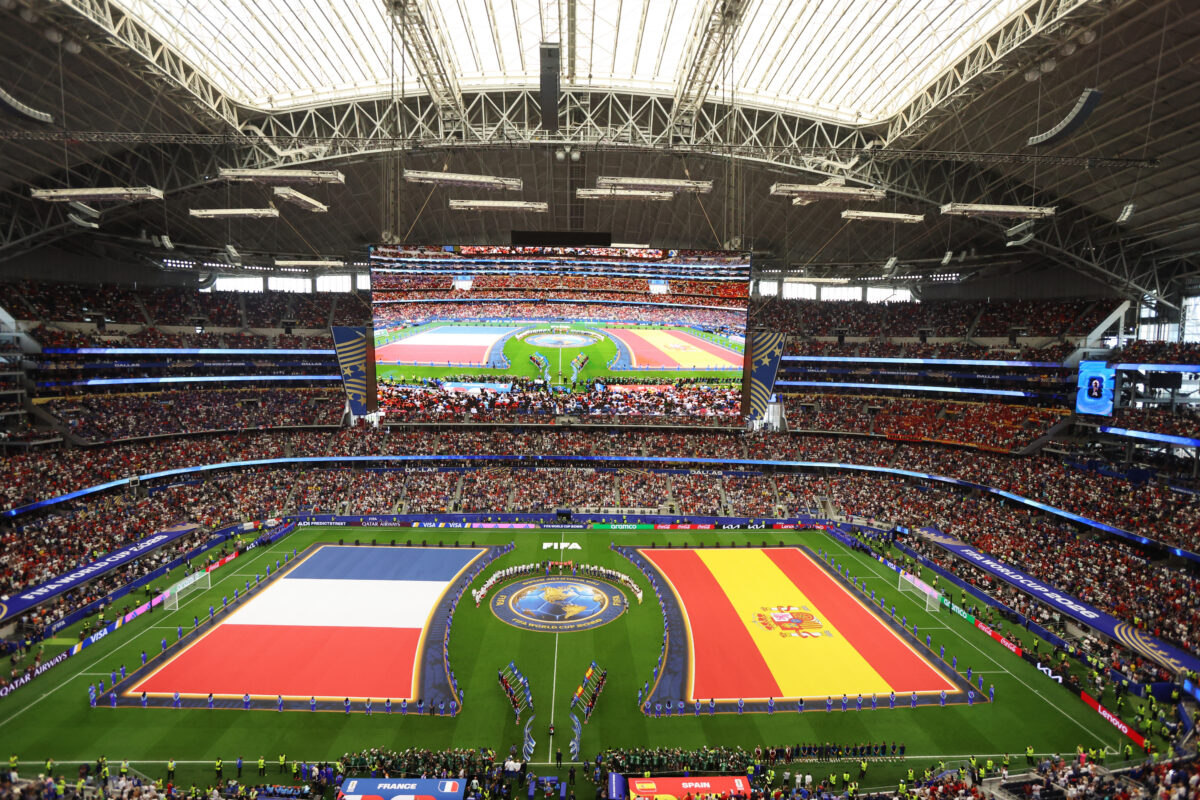
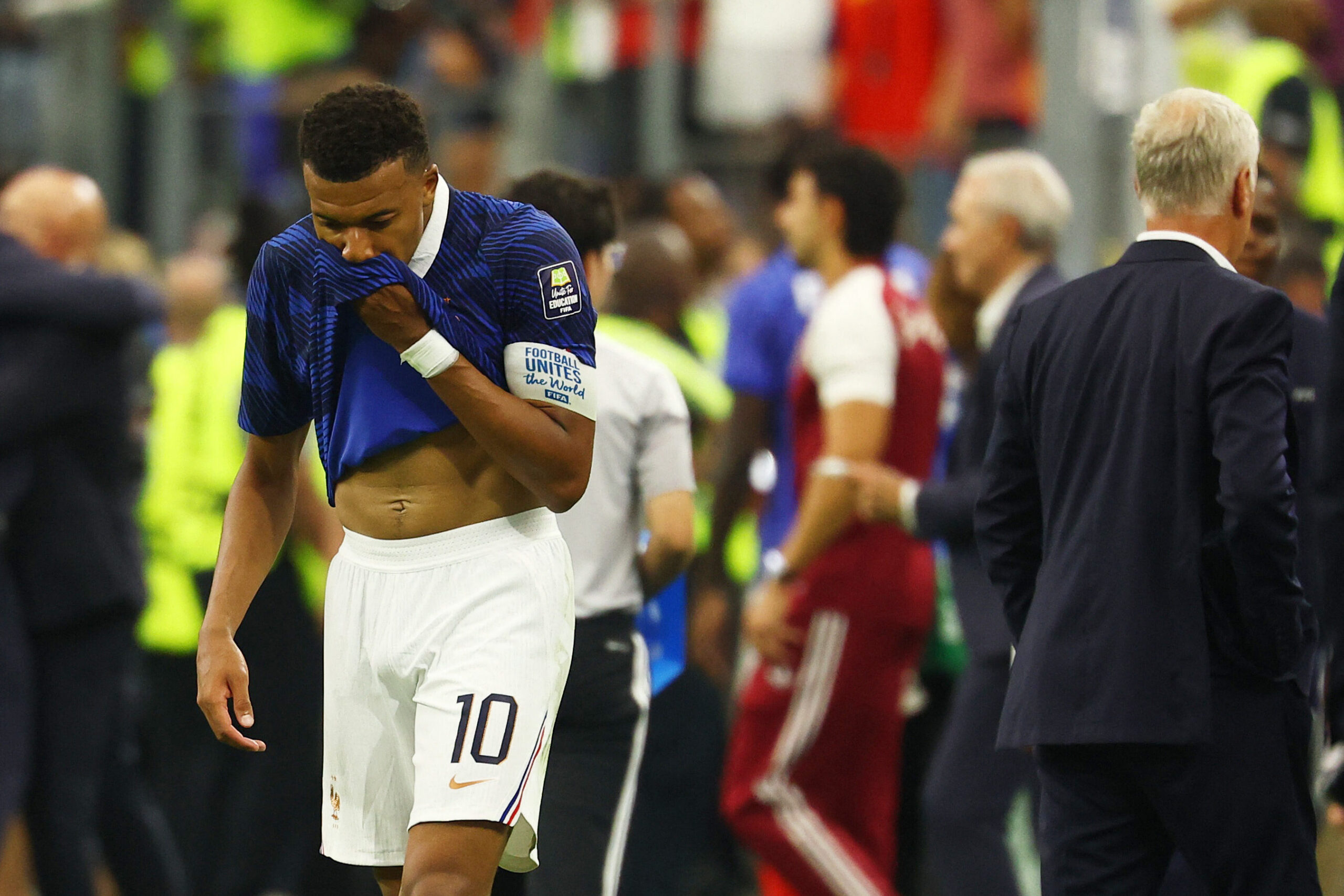
Kylian Mbappé didn’t hold back after France’s 2-0 World Cup semifinal exit to Spain. In a pair of post-match interviews, the France captain walked through a detailed tactical breakdown of what went wrong — pointing squarely at Didier Deschamps’ midfield setup rather than just individual errors. Here’s exactly what he said, the stats that back it up, and whether the criticism holds.
Did Kylian Mbappé blame Deschamps directly? Not by name, but he described the tactical setup — not just player execution — as the core problem, specifically France’s midfield being outnumbered.
Why did France lose to Spain? A combination of a midfield numbers disadvantage (Spain’s double pivot repeatedly turning into a functional three against France’s fixed two), poor first-touch quality in transition, and a Lucas Digne penalty concession that opened the scoring.
France also didn’t register a shot on target until deep into the second half, per France 24’s live coverage of the match. That underlines just how toothless the front four Mbappé referenced actually looked in practice.
What formation did France use? A 4-2-3-1 with Adrien Rabiot and Aurélien Tchouaméni as the double pivot behind four attacking players — the same shape that had carried them through six straight wins.
He did make changes, though none altered the outcome. Rabiot was substituted at halftime, with Désiré Doué and later Manchester City’s Rayan Cherki introduced to add fresh legs and creativity. Neither substitution shifted the fundamental issue Mbappé identified — France still lacked a third body in central midfield to match Spain’s numbers, since both substitutions came in attacking positions rather than reinforcing the pivot.
Cherki’s own post-match assessment was blunt: “They were better than us in every part of the game, and they were hungrier than us I think… this afternoon Spain has been better than us.”
France’s 4-2-3-1 had carried them through a perfect 6-0-0 group-and-knockout run, outscoring opponents 16-2 along the way. The shape asks just two central midfielders to cover the width of the pitch, which had been sustainable against opponents who didn’t have the individual quality or structural discipline to consistently exploit that space.
Spain is a different problem entirely. On paper, they lined up with a double pivot of Rodri and Fabián Ruiz. In practice, that pivot regularly became a functional three, with Pedri (or, at times, a withdrawn Yamal) dropping deep to receive the ball alongside them — giving Spain a consistent extra body in central areas whenever France pressed.
The same shape that punished less sophisticated opponents in transition became a liability against a team built to manufacture exactly that kind of numerical overload.
Speaking to French outlet M6 in the mixed zone, Mbappé didn’t just lament the result. He walked through a specific tactical breakdown of what went wrong — and where the responsibility for it sat.
“Right from the start, with the pressure we applied, we always found ourselves three against two in midfield, and against Spain, that’s already a challenge,” Mbappé said, as reported by Sports Illustrated. “Fabián and Rodri had plenty of time to play; there was a lack of communication in our pressing. We needed to play one-on-one, force them to run with us because they’re a team that doesn’t like to run without the ball.”
He went further, addressing what happened even when France did win the ball back: “Even when we recovered the ball, technically, the first passes, the first touches, weren’t up to the standard of a World Cup semifinal. When you add all that up, the result is defeat.”
Later, speaking to Fox and quoted by The Athletic, Mbappé returned to the same theme: “It was difficult for us. Tactically, we had a plan to go for them with pressure, to go one for one, to not let them lead the tempo and play the way they want to play… That’s what we let them do. We let the midfield too much time to play and they have the quality to play. It’s difficult when you don’t change the plan.”
That last line is the one worth sitting with. Mbappé isn’t just describing a below-par performance — he’s describing a plan that wasn’t working and, in his account, wasn’t adjusted.
The individual data reflects how thoroughly that numbers battle was lost. Mbappé finished the match with zero shots on target, zero chances created, one completed take-on, and just 12 completed passes from 34 touches, per Squawka. WhoScored’s tracking showed he had only 15 touches in the entire first half — the lowest of any outfield player on the pitch through 45 minutes.
The penalty itself is worth revisiting in detail, because the actual sequence complicates the tidy “midfield overload caused everything” narrative slightly — while still connecting back to it.
In the 19th minute, the move built from a Marc Cucurella cross into France’s box. Digne brought the ball down on his chest and attempted to clear it, but Yamal stepped across him at that exact moment and took the full force of the clearance, going down under the contact. Referee Iván Barton pointed to the spot immediately, and Mikel Oyarzabal converted in the 22nd minute to put Spain ahead.
So this wasn’t a case of Digne being left isolated in an extended one-on-one duel because his midfield had been dragged out of shape — it was a specific, in-the-moment defensive lapse: Digne controlling under pressure, not tracking Yamal’s run, and catching him with a clearance he never saw coming.
Where it does connect back to the broader pattern Mbappé described is context, not direct causation. Spain’s sustained territorial control — a product of the midfield overload discussed above — meant France spent long stretches defending deep in their own box rather than higher up the pitch, which is exactly the kind of situation that produces exactly this type of scrambled, high-pressure clearance. Fewer of these moments happen when a team is winning the ball back higher up the field with support; more of them happen when a back line is repeatedly forced into last-ditch defending because the midfield in front of it isn’t winning the territorial battle.
Deschamps didn’t publicly clash with his captain, but his own explanation for the defeat leaned in a notably different direction — toward execution rather than setup. “We were a little below our usual level; we made more technical mistakes than we have lately,” he said, per Sports Illustrated, pointing also to William Saliba’s injury and Adrien Rabiot playing under the risk of a yellow card as complicating factors.
He did, however, take a share of responsibility when pressed: “If we didn’t show the same offensive flair we’ve had up to now, it’s our fault and the manager’s. We have to be at our absolute best, and the team wasn’t tonight.”
Notably, Deschamps stopped short of admitting the midfield numbers were a mistake he’d make differently. The closest he came was acknowledging that France “were second best on a technical level,” per World Soccer Talk — a framing that locates the problem in individual performance rather than the system asking four players to attack against a team built to dominate the ball.
There’s a reasonable tactical case for his read. France went into a semifinal against the tournament’s best-organized possession team with a fixed midfield two, up against Spain’s pattern of turning their nominal double pivot into a functional three by dropping a third player deep — the exact numbers deficit Mbappé identified.
That same 4-2-3-1 had carried France to a perfect six-match run, but every previous opponent had allowed more transition space than Spain’s system is built to concede. Against a team that, per Deschamps’ own pre-match comments, had conceded just one goal in six matches by refusing to let opponents play through midfield, doubling down on the same shape without an in-game adjustment is a defensible thing to question.
The counterpoint is that Deschamps has a point too: even a numerically disadvantaged midfield doesn’t fully explain 12 completed passes and one take-on from a player of Mbappé’s caliber.
Systems create problems, but execution is still on the players operating within them, and Mbappé’s own admission that “our first touches were not good enough” cuts against laying this entirely at his manager’s door.
What’s clear is this wasn’t a case of a captain toeing the company line in defeat. Kylian Mbappé identified a specific, defensible tactical flaw, described it in detail across two separate interviews, and did so without ever directly criticizing Deschamps by name — leaving just enough space for people to draw their own conclusions about where the accountability really sits.
It’s also worth noting the moment this happened in. The semifinal was Deschamps’ 26th World Cup match in charge, surpassing Germany’s Helmut Schön for the most matches managed at the tournament in history — a genuine milestone reached on the same night his captain publicly questioned his setup, in what’s now confirmed as his final match in permanent charge of France before Saturday’s third-place playoff.
