
Dear MLB, say it ain’t so.
On the heels of arguably the greatest World Series in decades, Major League Baseball is currently riding a prosperous wave of attention and popularity not realized in recent years. The stars of that series, such as Shohei Ohtani and Vladimir Guerrero, Jr., are household names around the world and captivated television audiences at an average of 51 million viewers across the U.S., Canada, and Japan.
Despite all that momentum, there is a distinct chance that MLB could yank the rug out from under all baseball fans in 2027.
The current collective bargaining agreement (CBA) between team owners and the Major League Baseball Players Association (MLBPA) expires following the 2026 season. Because there is a major sticking point between the two sides in the current pact, the new CBA must address that to avoid a dreaded work stoppage in 2027.
For baseball fans, that impasse does not appear to be remotely close to being solved, regardless of how much time the players and owners have to negotiate.
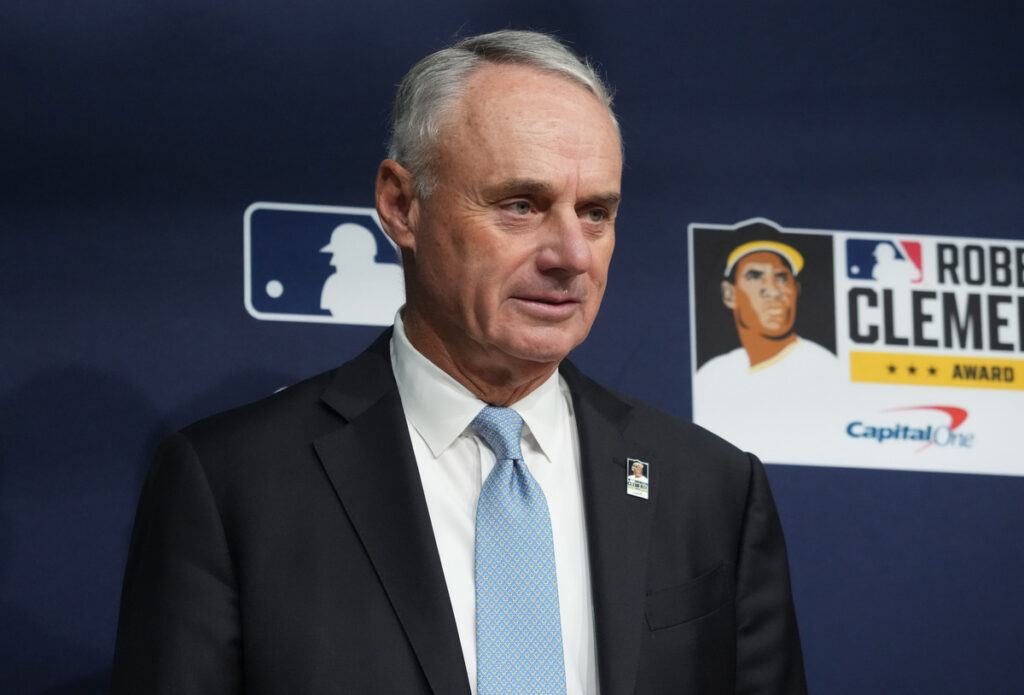
To understand how and why the CBA and MLB commissioner, Rob Manfred, may be in for a rocky ride, one must first understand what specific topics are covered in the current agreement:
The major obstacle standing in the way of harmony between MLB and the players’ union deals with the issue of a salary cap and revenue sharing. Of the four major professional sports leagues, MLB is the only one without a structured salary cap that ensures the equality of each team’s payroll.
MLB has become a league of “haves” and “have-nots” in regard to economics, and the absence of a salary cap is front and center as a cause of that. The result of the last two World Series has not done anything to dissuade those in favor of equal payrolls across the board.
The Los Angeles Dodgers have claimed the last two championships, and on the surface, they seem to be taking full advantage of the absence of an MLB salary cap. The Dodgers’ total payroll of $350 million in 2025 is roughly double the league’s average and $84 million more than the previous record for a series champ, which was set by the Dodgers themselves just one year earlier.
Baseball is seemingly the only sport that needs to fend off criticism for the lack of economic parity.
“No one argues that the Kansas City Chiefs are ruining football by dominating the sport because the Chiefs didn’t buy their way to a championship, and it’s perceived that the Dodgers did,” said Victor Matheson, economics professor and expert in the business of sports at the College of the Holy Cross. “And, of course, it’s perceived that the Dodgers did so because they (spend) about $100 million more on batters and pitchers in their lineup than the (runner-up Toronto Blue) Jays did.”
Baseball fans, and small-market “have nots,” have cried foul with the recent signings posted by the Dodgers. It started in 2023 when Ohtani signed his $700 million deal, which was followed by Los Angeles guaranteeing $325 million to World Series MVP Yoshinobu Yamamoto. They signed Blake Snell to a $182 million deal last season, and presumably overpaid reliever Tanner Scott with a four-year, $72 million pact in January.
It has become such an issue that even the affluent New York Yankees have taken umbrage with the Dodgers’ loose spending.
“It’s difficult for most of us owners to be able to do the kinds of things they’re doing,” said Yankees owner Hal Steinbrenner to the YES Network a week after the Scott deal.
Steinbrenner is far from the only voice in this opinion. Baltimore’s David Rubenstein has expressed concerns, and Colorado Rockies’ Dick Monfort concurs with the Yankees’ top man.
“The only way to fix baseball is to do a salary cap and a floor,” said Monfort to the Denver Gazette in March.
To put this in perspective, the Dodgers’ total projected 2026 outlay of $508.3 million is just a few million dollars shy of the combined payrolls of the game’s six lowest-spending teams — Miami, the Athletics, Tampa Bay, the Chicago White Sox, Pittsburgh, and Cleveland.
Competitive balance is the goal for Manfred and his staff, but that is not possible for the six teams listed above, whose total payrolls are all under $100 million.
Manfred faces the unenviable task of appeasing both sides of the table, and he believes he is doing so with the greater good of the game in mind.
“I never use the word salary within one of cap,” Manfred said in July. “What I do say to them is in addressing this competitive issue that’s real, we should think about this system is the perfect system from a player’s perspective.
While on the surface it makes total sense for MLB to implement some form of economic thresholds, it appears as if the other side, the players, has no intention of making that happen. That is what has the baseball world fretting over the upcoming CBA negotiations.
Tony Clark, executive director of the MLBPA, is intensely opposed to implementing a salary cap, as he sees that it garners no advantage for the players for their part in the game.
“A cap is not about any partnership,” Clark said. “A cap is not about growing the game. That’s not what a cap is about. As has been offered publicly, a cap is about franchise values and profits. That’s what a cap is about.”
Star players, including Philadelphia’s Bryce Harper, have been extremely vocal about their resistance to such an idea. Harper stood nose-to-nose with Manfred in July and told him any talk of a cap would require him to “get the f— out of our clubhouse.”
Others, such as Mets’ slugger Pete Alonso, feel a negative outcome is inevitable.
“No one’s talking about it, but we all know that they’re going to lock us out for it, and then we’re going to miss time,” Alonso said during the 2025 break. “We’re definitely going to fight to not have a salary cap and the league’s obviously not going to like that.”
With the current CBA set to expire in just over a year, the two negotiating sides are not currently likely to make a compromise.
Diehard MLB fans have been through enough.
Baseball has lived through recent scandals. They include absorbing the cancellation of the 1994 World Series, living through the steroid era, and surviving the Houston Astros’ alleged cheating schemes. Add those infamous events, with simply ingesting the exorbitant cost of attending a game live these days, MLB fans should not be the ones who suffer.
MLB needs to experience a reality check. All involved, players and owners alike, must realize that without their fans, there is no product. Those who support their extravagant paychecks cannot relate to the bickering from both sides, especially when all parties involved are multi-millionaires many times over.
It is time for MLB players and owners to decide how much greed for generational wealth is enough. If they don’t, baseball fans across the world will decide that THEY have had enough.
