
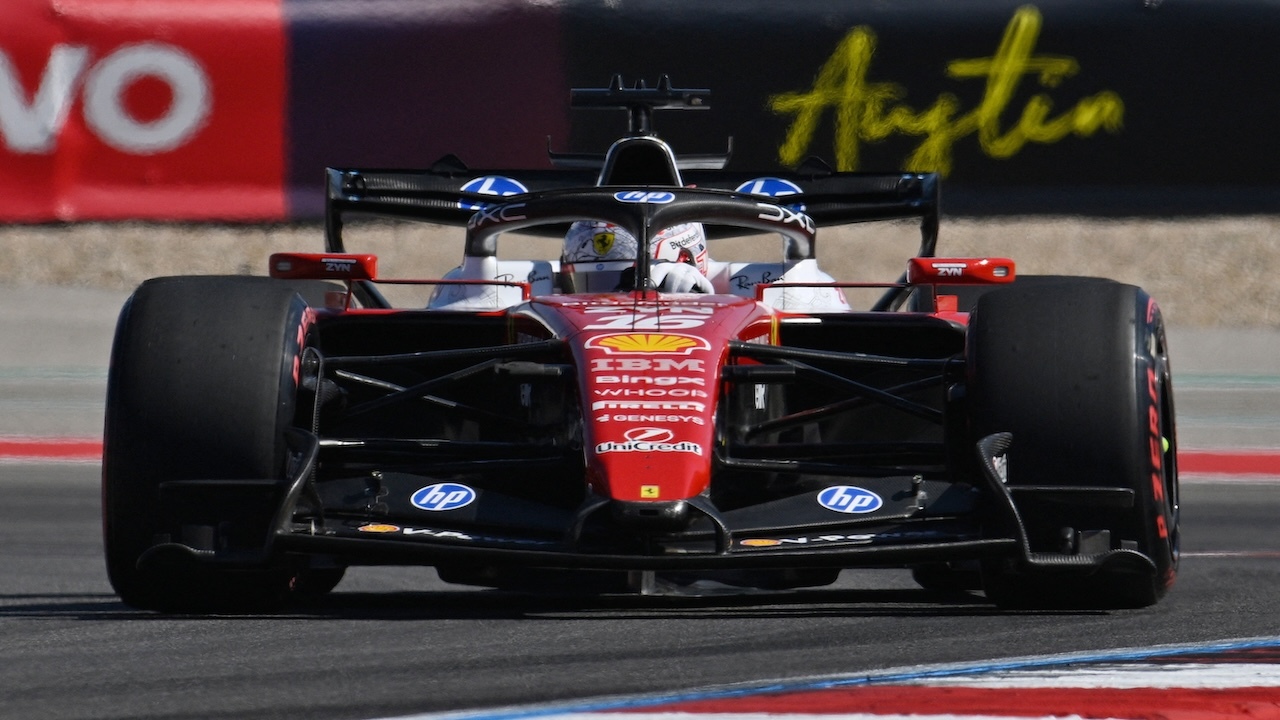
During the Grand Prix in Austin, Ferrari did what they do best: raised the hopes of all Tifosi, only to ultimately deliver a result that, while impressive, simply wasn’t enough. This is a pattern commonly exhibited by the Italian team. Either on a scale of one race or a whole Championship, they consistently fall just short of glory. Is this an issue that will continue affecting their performance season after season?
Ferrari’s Weekend At COTA
Ferrari came into the weekend with some upgrades to their car, and the fans were excited to see the impact the changes would have on their pace. The practice sessions exceeded expectations. Charles Leclerc topped the first two and Lewis Hamilton was first in the third one. Despite the great results, even the drivers themselves warned against reading too deeply into the apparent pace.
“Obviously, all the hard work that has been done in order to bring this upgrade as soon as possible is also helping us a little bit, but we shouldn’t carry too high expectations going into tomorrow. I feel like the others have more potential to unlock.” – Leclerc after the first two practice sessions.
The Monegasque’s words ended up being prophetic. Although Ferrari came into qualifying strong, come Q3 they had lost their momentum. They finished fourth and fifth, a disappointing result given the promising start to the weekend. During a press conference held after the Grand Prix, Leclerc admitted that losing the pole had subsequently cost them the victory. He cited problems with bringing the tyres up to the right temperature as the main reason for the team’s relatively poor performance in Q3.
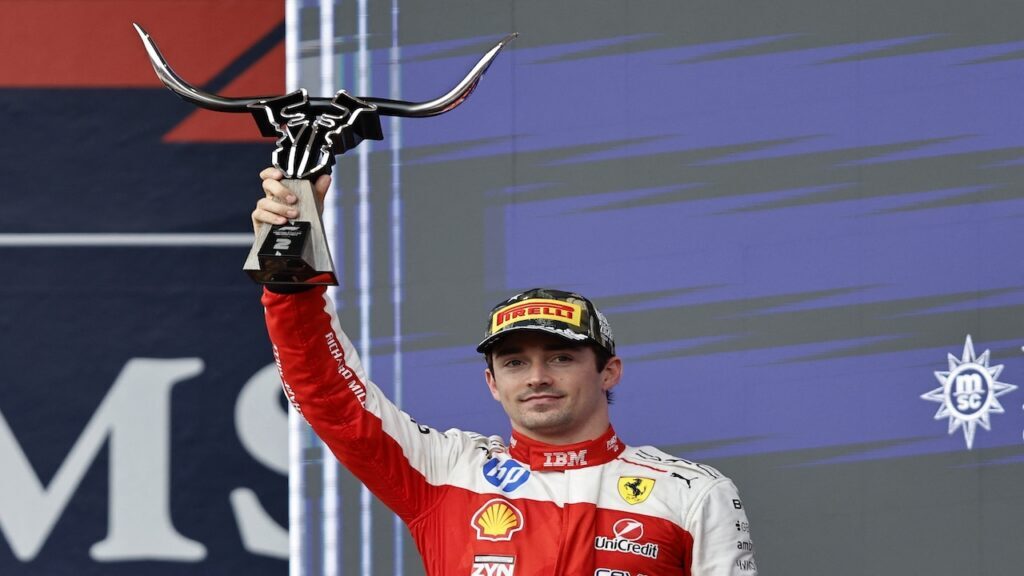
Second placed Ferrari’s Charles Leclerc celebrates on the podium with a trophy after the United States Grand Prix IMAGN IMAGES via Reuters/Michael Johnson
While Hamilton had somewhat disappeared during the Grand Prix, Leclerc has been a prominent figure throughout, even leading the race for a few laps. He always oscillated around the podium and was especially rapid during his last stint on a set of hard tires. It was that part of the race that allowed him to move into P2. Unfortunately, he was not able to challenge Kimi Antonelli for the win.
Ferrari’s Big Problem
“I think we are on the right way, but for sure, when you have this feeling that you are in a good shape on the weekend and you do P2, you can have also a bit of frustration.”
Those were comments Fred Vasseur, Ferrari’s team principal, shared after the Austin Grand Prix. They showcase a deep-rooted issue with the Italian team. While they are often good, they never seem to be good enough. This can be seen on a smaller scale with singular race weekends, but it is also apparent when whole seasons are taken into consideration.
To see it, one doesn’t have to look any further than the 2024 season. Ferrari came alive especially during its second half, managing three wins in the last 12 races, as well as consistent podium finishes. Through hard work, the team came within inches of the Constructors’ Championship, only to ultimately miss out on it by only 14 points. They could not deliver the final blow that would let them finish the season victorious. In 2026, championships are far out of their reach, but the team seems to have transferred the struggle onto singular race wins.
Implications For 2027
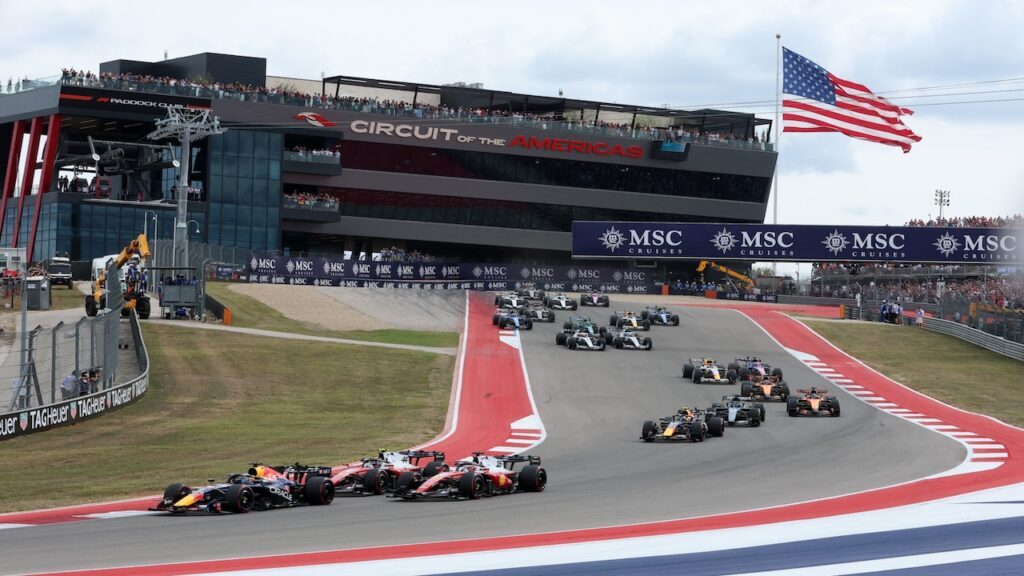
Red Bull’s Max Verstappen, Ferrari’s Charles Leclerc and Ferrari’s Lewis Hamilton in action during the race IMAGN IMAGES via Reuters/Michael Johnson
The goal of any Formula One team is always to win, and Ferrari is no different. While there is little they can do to fight for trophies in 2026, 2027 remains a possibility.
Mercedes started the current season ahead of all other teams by a mile, but the differences have decreased as time went on. They are still the quickest, which could be seen even in Austin, but not nearly as dominant as they were early on. If the momentum of teams like Ferrari and Red Bull continues into the next season, there could be a more substantial championship fight in the cards. For the Tifosi, the question is whether Ferrari will do enough to be serious contenders.
Vasseur has gone on record to say that all the improvements made to this year’s car are also an investment in the future:
“Today, what we will develop, we will be able to carry it over on next year’s project. We will continue to work, but perhaps on different things, different aspects. The development that we do now, 80% will be carried over.”

The hope, however, is far from a promise of turning the team’s situation around. Year after year, the fans go into the season repeating, “This is our year”. Year after year, it is not. If 2027 is to be different, bigger changes need to be made within the Italian institution.
End Of My Ferrari Rant
The Tifosi want to believe, but every near-miss builds the frustration and makes it harder to show up to races with hope for a truly great result. It seems like no matter what changes, the underlying inability to take that final leap that would bring glory back to Maranello remains. The Grand Prix in Austin showed, not for the first time, that Ferrari’s 2026 car simply isn’t fast enough, no matter how many upgrades it receives between the races.
How does this bode for the upcoming season? Will 2027 keep Ferrari fans repeating “This is our year”, or will the failed start under the new regulations become the straw that broke the camel’s back?
