
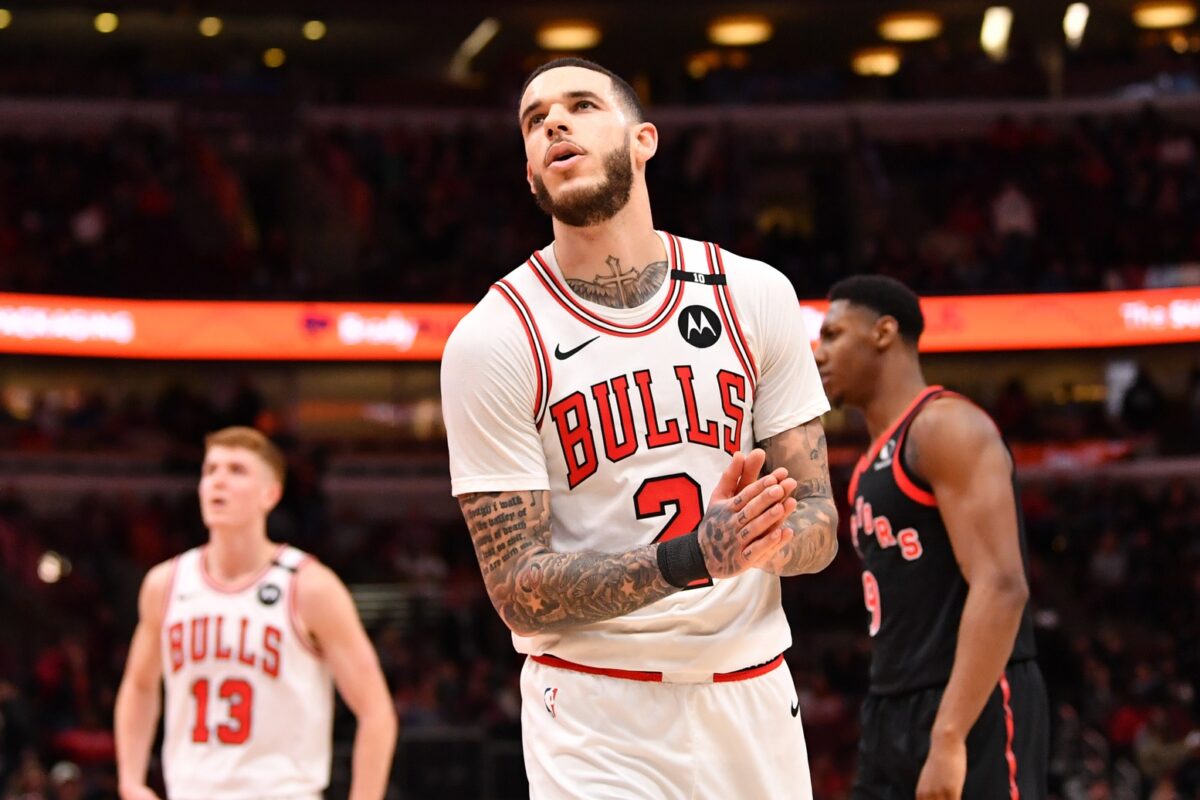
The Cleveland Cavaliers traded Isaac Okoro to the Chicago Bulls in exchange for Lonzo Ball. With Okoro being one of the team’s better defenders, the bench will look and play differently next season.
How will Ball look playing next to this team, though? Shouldering a hefty load of injuries, his game has had to adapt to accommodate the wear and tear on his body.
Here’s a brief look at Ball’s career, including his injury history, and how his play style will fit in with this current Cavaliers squad.
Ball’s Career
Being drafted by the Los Angeles Lakers with the second-overall pick in 2017, Ball has had a solid career statistically. He’s averaging 11.4 points, 5.5 rebounds, and 5.8 assists per game with 1.5 steals.
Ball was traded to the New Orleans Pelicans for the 2019-20 season as part of the move that sent Anthony Davis to LA. In New Orleans, he averaged 13.1 points, 5.5 rebounds, and 6.4 assists in his 118 games.
LONZO BALL 🔥
— Ballislife.com (@Ballislife) May 2, 2021
33 PTS (Career High)
11 REB
8 AST
8 3PT (T-Career High)
3 STL
W
pic.twitter.com/KJOiC0KnKS
In 2021, Ball was traded to the Bulls as part of a sign-and-trade deal. He averaged 10.3 points, 4.4 rebounds, and 4.2 assists in 70 games.
I will never forget the first 29 games of Lonzo Ball’s time on the Bulls 👀🔴 pic.twitter.com/AGsHAO03Pi
— Taco Trey Kerby (@treykerby) June 28, 2025
Last season, in his 35 games with the Chicago Bulls, he averaged 7.6 points, 3.4 rebounds, and 3.3 assists per game. He finished shooting 36.6 percent from the field and 34.4 percent from deep.
While Ball’s numbers aren’t bad, there is a major factor holding his game back (and probably why the Bulls moved away from him). He is one of the more injury-prone guards currently playing in the NBA.
Troubling Injury History
Having never played through a full season in his entire career, injuries have been a recurring issue for Ball. He initially tore his meniscus during his rookie season, and an improper recovery process led to multiple ankle sprains in the rest of his time with the team.
His most significant injury-related challenge has been his most recent meniscus tear. Receiving the injury in the 2021-22 season with Chicago, it caused him to miss both the 2022-23 and 2023-24 seasons.
Ball returned this season, but missed the final 22 games with a right-wrist sprain. He only participated in two seasons over his four years with the Bulls and was limited to 35 games in each due to his health.
Ball With The Cavaliers
Despite the injury history, Cleveland believes Ball can make enough of a difference to make a move for him. How would he fit with the Cavaliers specifically, though?
Ball’s a talented scorer who has the size to grab boards and be a defensive presence, as well as being a natural facilitator. He also plays well off screens, particularly when driving to the hoop.
How Lonzo Ball bout to be coming off the high screen pick & roll with Adams. Finally a legit screener in Nola 💪🏽 pic.twitter.com/Lce3o052n8
— K.L. Brown, CEO of Sweat Box (@sweatboxprogram) November 21, 2020
Ball is shooting 59.1 percent from less than five feet, and 40 percent from 10 to 19 feet. He struggles from outside, though, shooting less than 35 percent behind the arc last season.
Ball did, however, finish last season with the highest three-point attempt rate of his career (.802), which is significant because until then he’d never cracked .680. Considering he also had the lowest rebound percentage (8.0) of his career, it seems as though his physicality has taken a hit.
Posting his lowest assist rate (18.9) is a concern as well, as Ball’s never dipped below 20.0 in this regard. These changes in his style of play led to the second-lowest player efficiency rating he’s seen, too, at 12.2 (his lowest being 11.7 back in 2018-19).
This kind of play should still benefit Cleveland, though, especially considering Ball would be playing primarily off the bench. Lacking the shot required to be a consistent deep threat could hurt, but his playmaking ability will be a massive benefit as the Cavaliers’ bench is rife with shooters.
Impressive numbers from LONZO BALL tonight!
— Ballislife.com (@Ballislife) December 6, 2019
20 PTS
6-9 FG
4-5 3PT
11 AST
6 REB
3 STL
2 BLK
🎥 @PelicansNBA
pic.twitter.com/FuxkYz3SMn
Ball also posted the highest steal rate (2.8) and free throw percentage (.815) of his career last season, with the lowest usage (15.9) and turnover rates (13.9) he’s ever seen. These stats suggest that, although his physicality has declined, he is becoming a more efficient player.
While Ball’s PER last year may say different, this can largely be attributed to the team he was on. Similar to the 2018-19 Lakers, the Bulls were a bloated roster with low expectations.
Unlike these teams, Cleveland is one of the better-constructed rosters in the modern NBA. Their bench placed eighth in scoring and field goal percentage (39.7 points, shooting 45.9 percent), sixth in assists (9.6), fourth in minutes (96.6), and third in three-point percentage (38.0).
Ball’s role being relegated to mainly supporting the stars should see these areas of his (and the Cavaliers’) game enhanced. With his usage rate already being the lowest of his career, this should fit in perfectly with the new demands of his health.
On the defensive end, Ball’s addition shouldn’t see too much variation from what fans saw last season. He finished with a lower defensive rating than Okoro (113.3 compared to 114.9), even if that isn’t the most fair comparison.
Welcome the newest Cavalier, Lonzo Ball to the Land‼️
— Jaylon Tyson Fan Club (@IsaacOkoroFan) June 28, 2025
Here are some defensive highlights!
pic.twitter.com/zVS59e3x4Q
Ball and Okoro played and guarded different positions, while being asked to accomplish very different things. Whereas Ball is asked to limit a guard’s impact, Okoro is often tasked with shutting down a team’s top scorer.
This will inevitably lead to different-looking defensive ratings, with multiple factors affecting each player in ways unique to them. The fact that they are this close in number, however, speaks to Ball’s ability to do what he’s asked on defense.
It’s probably not the best idea to acquire an injury-prone guard when both Darius Garland and Donovan Mitchell are in the starting lineup, but the upside he offers can make this team better. Especially considering that Ty Jerome is likely to play for another team next season.
End Of My Cavaliers Rant
While his PER says Ball’s becoming a less efficient player, the stats he’s improving in (as well as the roster he was a part of) suggest otherwise. The need to decrease his physicality is causing him to be a more calculated player, and his numbers should balance out to show that the more games he plays.
Ball is a natural playmaker and scorer who can also make a defensive impact, providing the Cavaliers with two things they desperately need at the guard position: size and depth. Listed at six feet six inches, he is easily the tallest point guard on the team.
Okoro’s defense will be missed, but Ball’s scoring and playmaking both will help Cleveland off the bench. His history with injury is worrying, but with what he offers when healthy, the move makes the Cavaliers better on paper.
