
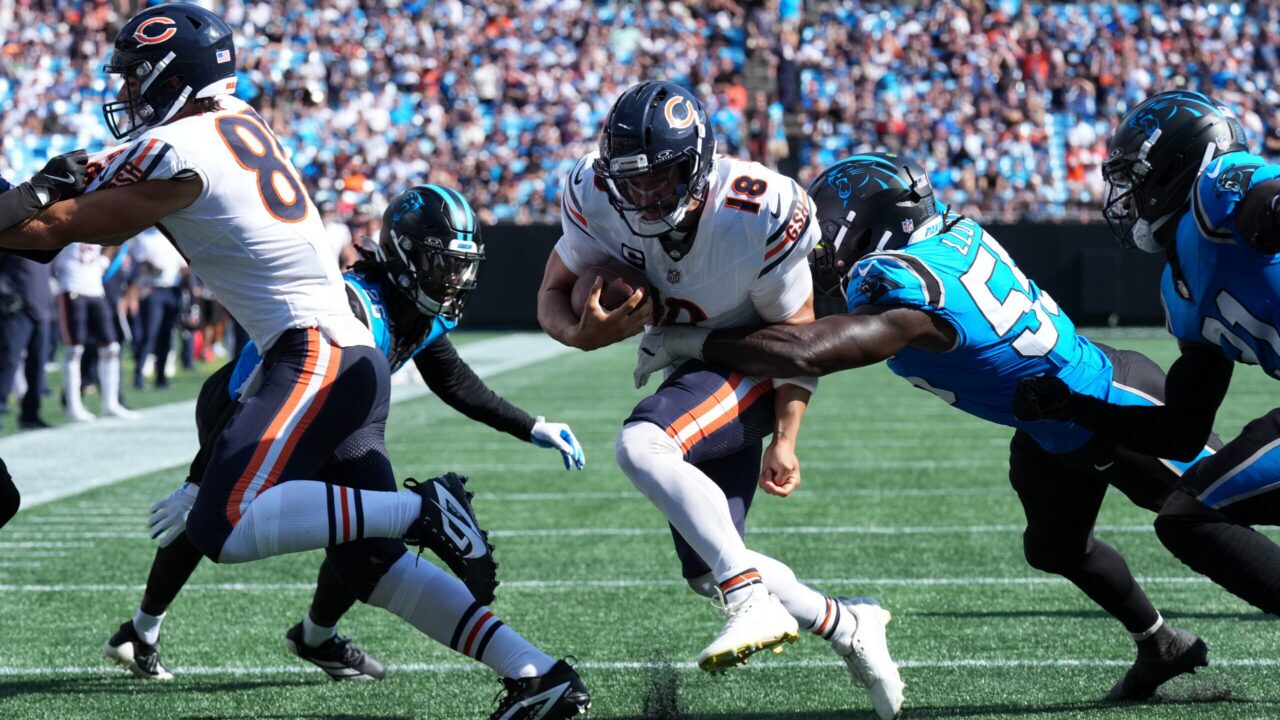
Caleb Williams opened his third NFL season with four total touchdowns as the Chicago Bears crushed the Carolina Panthers 59-37 in a historic Week 1 shootout. Williams completed 21 of 29 passes for 269 yards and two touchdowns while adding 65 rushing yards and two rushing scores. Chicago’s offense produced 552 total yards, while D’Andre Swift added 124 rushing yards and three touchdowns in a performance that made the Bears impossible to ignore.
| Category | Stat |
| Final Score | Bears 59-37 Panthers |
| Caleb Williams Passing | 21-of-29, 269 yards, 2 TDs |
| Caleb Williams Rushing | 65 yards, 2 TDs |
| Caleb Williams Total TDs | 4 |
| D’Andre Swift Rushing | 124 yards, 3 TDs |
| Kyle Monangai Rushing | 100 yards, 1 TD |
| Bears Total Offense | 552 yards |
| Bears Rushing Offense | 291 yards |
| Combined Points | 96 (NFL Week 1 Record) |
| Previous Week 1 Record | 88 points (Saints vs. Buccaneers, 2018) |
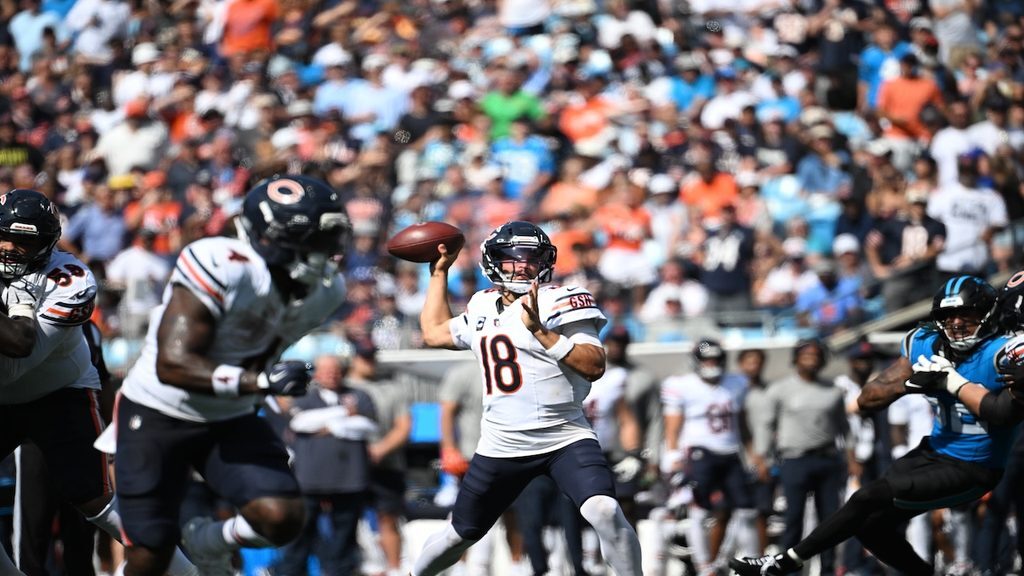
Caleb Williams produced 334 total yards and four touchdowns without needing excessive passing volume, completing more than 72% of his throws while adding another 65 yards on the ground. The combination matters because Chicago did not need Williams to dominate every possession through the air to generate an explosive offensive performance. Williams could attack Carolina with his arm, extend plays with his legs and rely on a powerful rushing game when the defense adjusted.
The performance also needs to be viewed through the correct stage of Williams’ career. The 2026 season is Williams’ third NFL campaign, and the quarterback entered Week 1 after throwing for a franchise-record 3,942 yards in 2025 while leading Chicago to the NFC North title and a playoff victory. Sunday’s eruption therefore looked less like a first breakthrough and more like the next step for a quarterback who has already established himself as one of the league’s most intriguing young starters.
CALEB WILLIAMS.
— CHGO Bears (@CHGO_Bears) September 13, 2026
FIRST TD OF THE SEASON.
🔥🔥🔥🔥🔥 pic.twitter.com/7Z4nKYxl7Z
Williams’ 269 passing yards may not look overwhelming compared with some of the enormous Week 1 quarterback totals, but the number does not tell the full story. Chicago’s rushing attack was so effective that Williams did not need to force the passing game, allowing the offense to remain balanced while still generating explosive plays. Completing 21 of 29 attempts also kept the Bears ahead of the chains and prevented Carolina from repeatedly creating obvious passing situations.

The efficiency became particularly important once the Panthers found offensive rhythm. Carolina and Chicago reached a 31-31 tie, yet the Bears responded with three consecutive touchdowns across a 7:38 stretch and regained control of the game. Williams therefore showed the ability to remain productive when the pressure increased instead of allowing a defensive adjustment to derail the offense.
Williams’ mobility also made the passing numbers more dangerous than they appear on paper. Carolina could not simply flood the secondary with coverage because Williams could escape pressure and attack open space himself. The threat of a run from the quarterback creates another layer for a defense to solve, and Chicago repeatedly benefited from that uncertainty.
Chicago’s 59-37 victory produced 96 combined points, breaking the previous Week 1 NFL record of 88 combined points. The eight-point improvement made the Bears-Panthers matchup the highest-scoring Week 1 game in league history. The historic total gives the result significance beyond one team’s season-opening victory.
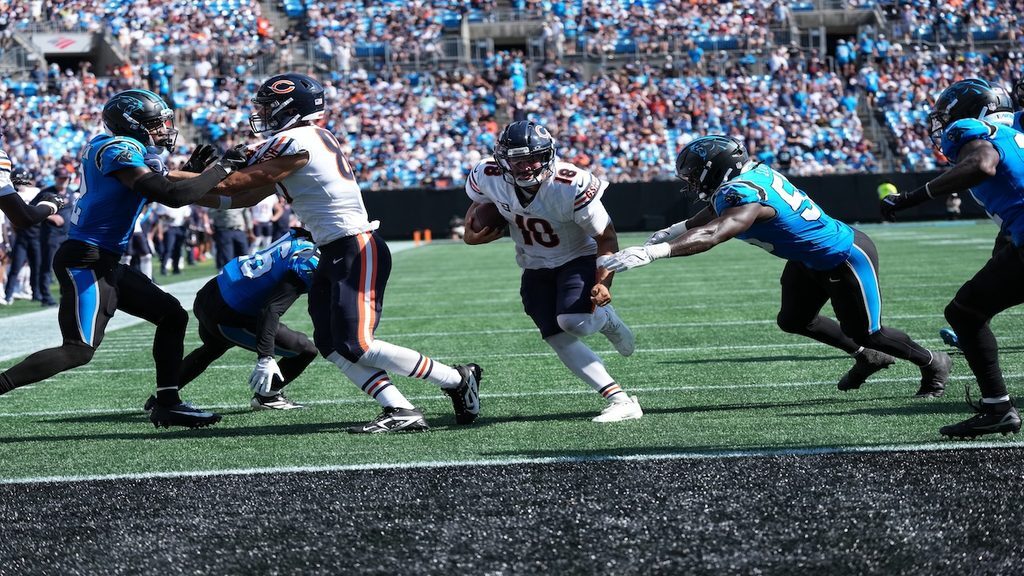
The offensive explosion was not simply a consequence of one quarterback throwing for an enormous number of yards. Chicago produced 291 rushing yards, scored eight touchdowns and repeatedly created explosive gains through multiple players, while Carolina continued moving the football well enough to keep the game competitive. The 59-37 final score therefore reflected an afternoon when both offenses consistently found ways to punish defensive mistakes.
D’Andre Swift’s 124 rushing yards and three touchdowns were central to Williams’ success because Carolina could never focus exclusively on the quarterback. Chicago’s running game consistently forced defenders toward the line of scrimmage, creating opportunities for Williams to attack through the air and opening lanes for the quarterback to use his mobility. Swift’s production also gave the Bears a reliable source of offense whenever the Panthers found a way to disrupt the passing game.
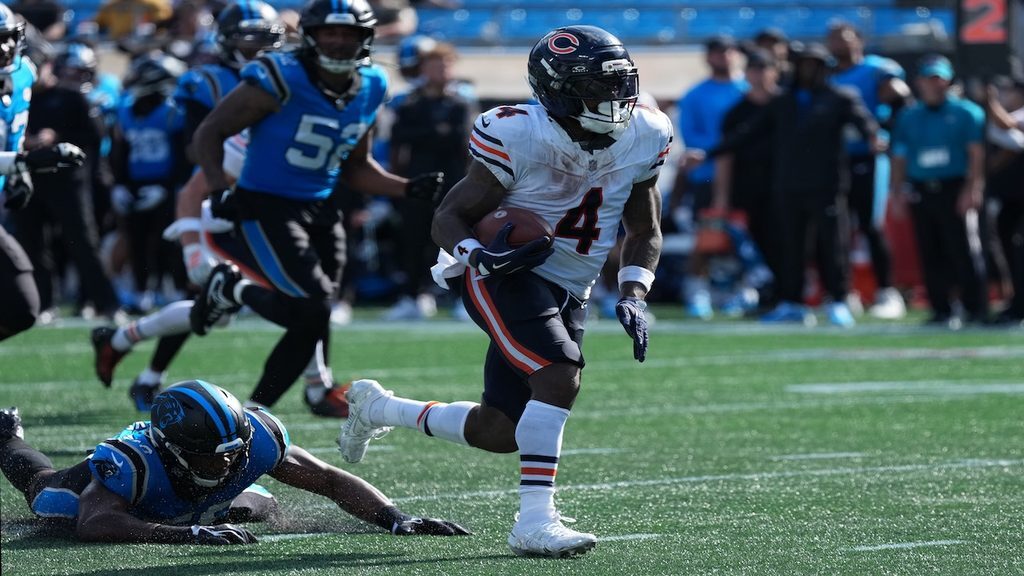
Kyle Monangai added another 100 rushing yards and a 61-yard touchdown, making Chicago’s backfield even more difficult to contain. Two explosive runners alongside a mobile quarterback create a defensive problem that becomes increasingly complicated with every successful rushing play. Carolina had to choose between loading the box and risking big passes or giving the running game more room and hoping Williams could be contained.
The broader tactical point is more important than either rushing total. Williams becomes more dangerous when defenses have to respect the run before reacting to the pass, because each commitment creates another potential weakness. Ben Johnson’s offense used that conflict effectively throughout the game.
Ben Johnson’s offensive system entered another season with the advantage of continuity, and Week 1 showed what that familiarity can produce. Williams now has a deeper understanding of Johnson’s terminology, concepts and preferred reads, while Johnson has a much larger body of evidence showing how to build an offense around his quarterback. Chicago consequently looked capable of attacking Carolina in several different ways without becoming predictable.
The 552 total yards and eight touchdowns represent the clearest evidence of that versatility. Chicago could attack with Swift, Monangai, Williams’ legs, intermediate throws and explosive passing plays, forcing Carolina to defend a much larger portion of the field. A quarterback becomes significantly harder to contain when the defense cannot identify one obvious threat that must be eliminated.
Johnson’s offense also passed an important situational test after the 31-31 tie. Three consecutive Chicago touchdowns transformed a potential shootout into a decisive victory, showing that the Bears could respond to momentum swings rather than simply survive them. That ability will matter far more during the season than the raw 59-point total because strong playoff teams eventually have to win games that become uncomfortable.
Uh, Ben Johnson might've been serious pic.twitter.com/at1XEXexS2
— PFF (@PFF) September 13, 2026
Chicago’s offensive performance was spectacular, but allowing 37 points gives the Bears an obvious area for concern. Bryce Young threw for 361 yards and three touchdowns, while Carolina repeatedly found openings throughout a game that remained competitive far longer than the final 22-point margin suggests. The Bears cannot expect Williams and the offense to produce 59 points every week simply to protect a defense that gives opponents similar opportunities.
The defensive issue does not diminish what Williams accomplished. Chicago repeatedly answered Carolina’s scoring bursts, recovered after the 31-31 tie and ultimately created enough separation to turn the game into a comfortable victory. A team that can produce points this efficiently has a much larger margin for error than one with an average offense.
The bigger question is how sustainable that margin becomes against stronger opponents. The Bears’ offense may already be good enough to carry the team through defensive mistakes against some teams, but another playoff run will require more consistent defense. Williams’ performance gives Chicago a powerful foundation, while the 37 points allowed explain why the season cannot be judged solely by the scoreboard.
Caleb Williams after the #Bears’ 59-37 win:
— Arye Pulli (@AryePulliNFL) September 13, 2026
“This is going to be kind of our worst game. I know points don’t necessarily show that, but execution, the blocking, the penalties, all these different things.”
Not satisfied. pic.twitter.com/rLR5MwF0CW
Williams does not need Week 1 to prove that he belongs in the NFL. The second-year breakout already established his ability to lead a competitive Chicago team, and the 2026 opener instead provided a glimpse at what happens when a more experienced Williams operates inside an offense that can threaten defenses from several directions. The quarterback’s development is now less about proving his potential and more about determining how close he can get to his ceiling.
The Minnesota Vikings will provide the next test in Week 2. A different defensive game plan should reveal whether opponents can disrupt the balance that made Chicago so dangerous against Carolina or whether Johnson’s offense has genuinely developed into one of the NFL’s most difficult units to defend. Williams has already delivered the opening statement, and the rest of the season will determine how much weight it ultimately carries.
Caleb Williams’ four-touchdown performance mattered because it arrived within an offense that finally gave him answers everywhere he looked. Chicago ran for 291 yards, scored 59 points and produced 96 combined points with Carolina in a record-setting Week 1 shootout, while Williams controlled the game without needing to force the action. The Bears still have defensive questions to answer, but Williams’ third season could be the year Chicago discovers just how dangerous its quarterback and offense can become.
