
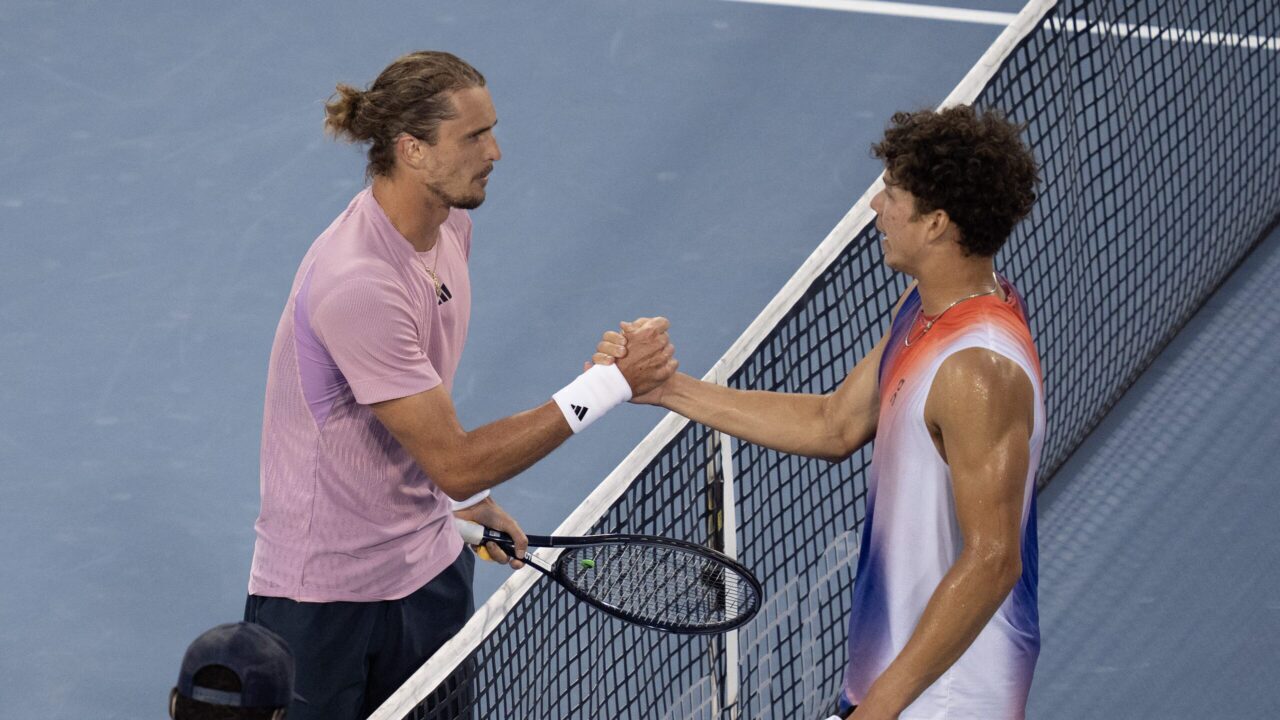
Ben Shelton vs Alexander Zverev has been one-sided every single time it’s happened. Zverev leads their Lexus ATP Head2Head series 5-0, having won 10 of the 11 sets they’ve ever played, according to the ATP Tour.
Sunday’s US Open final at Arthur Ashe Stadium is the first time these two have ever met at a Grand Slam — and the first time the number 5-0 has meant this much.
Every meeting has gone the same way, but not always for the same reasons:
Shelton has won exactly one set across five matches — the opener in that first Cincinnati meeting — and hasn’t taken one since, as detailed by Sports Betting Dime’s head-to-head breakdown.

The pattern across all five matches isn’t really about Shelton’s level dropping — it’s about what happens in the tightest moments.
Three of the five matches have been decided by tiebreaks, and Zverev has won every single one of them against Shelton. That’s the real story hiding inside the 5-0 scoreline: this isn’t a matchup where Zverev is simply better for four sets and worse for one.
It’s a matchup where the margins are frequently razor-thin, and Zverev’s own serving efficiency has kept Shelton under constant scoreboard pressure — a 81% and 89% first-serve-points-won performance in two of the five wins meant Shelton rarely got a sniff of Zverev’s own service games, let alone the cushion to relax on his own.

The deeper reason this rivalry has been so lopsided is stylistic, not just situational. Zverev’s return position — deep behind the baseline, aided by his 6-foot-6 frame and reach — absorbs the pace and awkward bounce of Shelton’s left-handed kick serve.
The exact weapon that gives most right-handers trouble on tour. At last year’s ATP Finals, Shelton won just 10 of 54 return points against Zverev’s serve, according to CBS Sports’ betting analysis — a genuinely alarming number, even accounting for it coming at the tail end of a long season.
Once rallies start, Zverev’s two-handed backhand is, as one tennis analyst put it, “tailor-made to handle Shelton’s forehand,” per TennisNerd’s final preview
Shelton’s lefty forehand naturally travels crosscourt into exactly the wing where Zverev is most comfortable absorbing and redirecting pace.
That’s not a coincidence repeating five times. It’s a genuine style matchup, and it’s why beating Zverev here likely requires Shelton to change his shot selection, not just serve better.

None of those five previous meetings happened on this stage, and Shelton arrives in a completely different place than he was in any of them.
This is his first Grand Slam final, and he got here by beating defending champion and two-time major winner Carlos Alcaraz in the quarterfinals — a five-set, 3-hour-plus classic that finished at 3:33 a.m. local time, the latest finish in US Open history, according to ATP Tour’s tournament resource page.
Shelton followed that with a win over fellow American Frances Tiafoe in the semifinals. Shelton is also playing in front of a home crowd chasing genuine history:
Shelton is the first Black American man to reach the US Open final since Arthur Ashe in 1972, and he’s bidding to become the first American man to win any major since Andy Roddick in 2003.
That combination — the Alcaraz statement win, the crowd, the stakes of a maiden major final — is a different psychological environment than a Cincinnati quarterfinal or a round-robin match in Turin. It doesn’t erase five defeats, but it’s also not nothing.
The Alexander Zverev vs Ben Shelton head-to-head isn’t just lopsided on paper — Zverev’s path to Sunday has also been the more comfortable one physically.
Zverev dismantled Karen Khachanov in straight sets in the semifinals and arrives having already broken his Grand Slam duck this year with a title at Roland Garros, plus a run to the Wimbledon final — this is his third major final of the season and sixth of his career, per ATP Tour’s final preview.
Shelton, by contrast, has already survived a five-set war against Alcaraz and a demanding semifinal against Tiafoe — over a potential best-of-five final, that physical gap could matter as much as the tactical one.
If the pattern from the previous five meetings holds, Zverev’s advantage shows up specifically in tight, high-pressure moments — tiebreaks, break points, the games where Shelton’s serve is supposed to bail him out and instead gets neutralized.
Betting markets clearly expect exactly that: Zverev is priced around -137 to Shelton’s +133, roughly a 58% implied probability, according to Sports Betting Dime’s market data.
The honest case for Shelton isn’t that the head-to-head is misleading — 10 of 11 sets lost is not a small-sample fluke.
It’s that every previous meeting happened at a tour-level event where Zverev, by his own admission after Munich, was simply the more battle-tested player in the biggest moments.
A Grand Slam final in New York, in front of a crowd willing an American into tennis history, against a Zverev who has to prove he can close out a major on a surface and stage where he’s never lifted this specific trophy, is a genuinely different test than anything in their previous five meetings.
The record says Zverev wins the moments that matter. Sunday is simply the biggest moment either of them has ever shared a court for — and it’s the first time we’ll find out whether that record travels to a stage this size.
